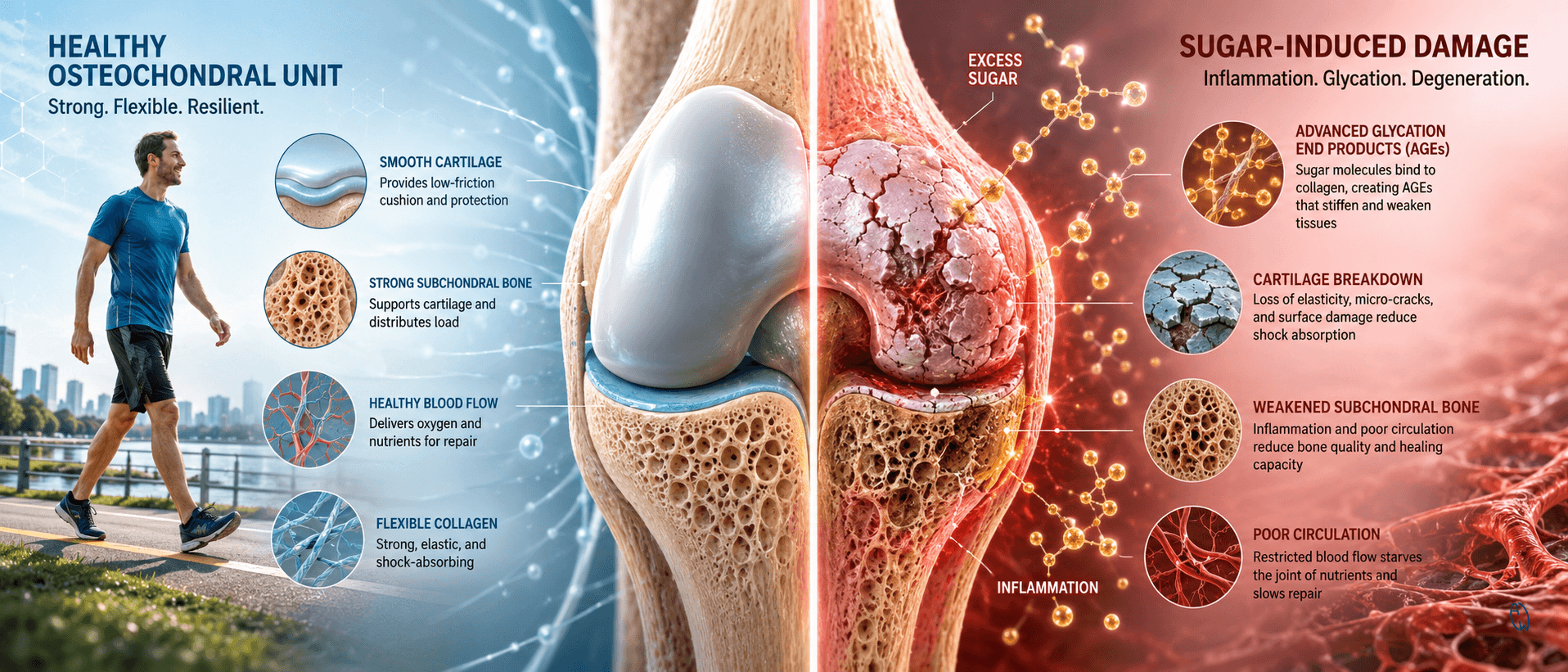
Is Sugar Aging Your Joints Faster Than Time? The Hidden Damage of Glycation, Alcohol, and Poor Recovery
Most people blame age when their joints begin to hurt.
Others blame old sports injuries, long hours sitting at a desk, or years of wear and tear.
While these factors certainly matter, there is another contributor that often goes unnoticed: your daily lifestyle habits.
What you eat, drink, and do every day can either support your body's ability to heal—or slowly contribute to its breakdown.
Two of the biggest offenders are excessive sugar consumption and regular alcohol intake.
Over time, these habits can affect inflammation, collagen health, cartilage, spinal discs, tendons, ligaments, bone quality, and the body's natural ability to recover.
For many people struggling with chronic pain, stiffness, slow healing, or degenerative joint conditions, the problem may not be a lack of treatment. It may be a lack of recovery.
What Is Glycation?
One of the most overlooked processes affecting musculoskeletal health is called glycation.
Glycation occurs when sugar molecules, particularly glucose and fructose, attach themselves to proteins and fats without the help of enzymes.
This reaction creates harmful compounds known as Advanced Glycation End Products (AGEs).
Think of AGEs as microscopic rust building up inside your body's tissues.
As AGEs accumulate, they:
-
Stiffen collagen fibers
-
Reduce tissue elasticity
-
Increase chronic inflammation
-
Interfere with normal tissue repair
-
Accelerate cartilage breakdown
-
Weaken tendons and ligaments
Because collagen is one of the most important structural proteins in the body, glycation can affect nearly every joint, disc, tendon, ligament, and connective tissue from head to toe.
Over time, tissues lose their flexibility, resilience, and ability to absorb force.
Sugar Provides Energy. Protein Builds the Body.
One observation we frequently notice in clinical practice is that many scoliosis patients seem to crave sugary foods and refined carbohydrates more than protein-rich foods.
While scoliosis itself does not directly cause sugar cravings, there may be several reasons why this occurs.
A body living with scoliosis is constantly adapting to asymmetrical loading patterns.
The nervous system is continuously coordinating posture, balance, breathing mechanics, muscle activation, and spinal stabilization throughout the day.
Even while standing still, muscles are working harder to keep the body balanced against gravity.
This increased demand may encourage the body to seek quick sources of energy, leading many people to reach for:
-
Sweetened drinks
-
Bubble tea
-
Pastries
-
Desserts
-
Processed snacks
-
Refined carbohydrates
The challenge is that sugar primarily provides fuel.
Protein provides the building materials.
Think of it this way:
Sugar is the gasoline. Protein is the construction material.
Many people consume plenty of fuel but not enough bricks.
Without adequate protein, the body has fewer raw materials available to maintain and repair:
-
Muscles that stabilize the spine
-
Tendons and ligaments that support joints
-
Cartilage that cushions movement
-
Intervertebral discs that absorb shock
-
Bone tissue that continually remodels
-
Connective tissues that help maintain posture
At the same time, excessive sugar intake may contribute to inflammation and glycation, creating a double challenge for recovery.
The body receives fewer building blocks while the tissues themselves become less capable of repairing damage.
This does not mean sugar causes scoliosis.
However, nutritional habits may influence how effectively the body recovers from exercise, responds to rehabilitation, supports tissue healing, and adapts to everyday physical stress.
The Other Recovery Killer: Alcohol
Another pattern we frequently observe in adults struggling with chronic pain, spinal conditions, and joint degeneration is regular alcohol consumption.
Many people work hard on exercise and treatment but underestimate how much alcohol may be affecting their recovery.
The effects are often subtle and accumulate slowly over time.
Healing Happens During Recovery
Many people focus on what happens during a workout.
The body focuses on what happens afterward.
Exercise creates the stimulus.
Recovery creates the result.
During sleep and recovery, the body is actively:
-
Repairing damaged tissues
-
Producing growth hormone
-
Building muscle
-
Supporting collagen production
-
Regulating inflammation
-
Recovering the nervous system
Unfortunately, alcohol can interfere with several of these processes.
While alcohol may help some individuals fall asleep faster, it often reduces the quality of restorative sleep.
The result is a body that spends less time performing the repair work needed to recover effectively.
Alcohol and Collagen Repair
Collagen forms the foundation of:
-
Tendons
-
Ligaments
-
Cartilage
-
Fascia
-
Intervertebral discs
-
Bone matrix
Regular alcohol consumption may impair collagen production and tissue regeneration.
For individuals recovering from injuries, surgery, scoliosis rehabilitation, disc degeneration, or chronic pain conditions, this may contribute to slower healing and poorer tissue quality over time.
Alcohol and Inflammation
Although many people associate alcohol with relaxation, excessive alcohol intake may increase inflammation throughout the body.
Chronic inflammation can:
-
Increase pain sensitivity
-
Slow tissue healing
-
Impair muscle recovery
-
Affect joint health
-
Accelerate degeneration
When combined with high sugar intake, the body may face a continuous cycle of inflammation and reduced recovery capacity.
Alcohol and Bone Health
Bones are living tissues that constantly remodel themselves.
Old bone is removed and replaced with new bone throughout life.
Excessive alcohol consumption has been associated with impaired bone formation and reduced bone quality.
This becomes especially important for:
-
Aging adults
-
Patients with Osteoarthritis and Chronic Inflammation
-
Individuals recovering from fractures
-
Patients with osteoporosis
-
People managing scoliosis and spinal degeneration
Strong bones require more than calcium.
They depend on healthy hormones, quality sleep, proper nutrition, movement, and effective recovery.
How Glycation Damages the Body From Head to Toe
Knee and Hip Joints
The knees and hips absorb enormous forces every day.
Healthy cartilage and connective tissues allow these joints to move smoothly and absorb impact.
When AGEs accumulate, cartilage becomes less resilient and more vulnerable to damage.
Over time this may contribute to:
-
Meniscus degeneration
-
Hip labral injuries
-
Chronic knee pain
-
Reduced mobility
Shoulder Joint and Rotator Cuff
The shoulder depends heavily on healthy collagen structures.
As glycation increases, tendons and connective tissues become less flexible and more susceptible to injury.
This may contribute to:
-
Rotator cuff tendinopathy
-
Shoulder impingement
-
Tendon tears
-
Chronic inflammation
Spinal Joints and Intervertebral Discs
The spine depends on collagen-rich discs and ligaments to remain strong and flexible.
Glycation can:
-
Stiffen collagen fibers
-
Reduce disc hydration
-
Impair nutrient exchange
-
Increase susceptibility to degeneration
Over time, this may contribute to:
-
Degenerative disc disease
-
Chronic neck pain
-
Chronic back pain
-
Sciatica
-
Facet joint arthritis
-
Postural instability
For individuals living with scoliosis, maintaining healthy tissue quality may be particularly important because the spine already experiences uneven loading patterns throughout daily life.
Hands, Ankles, and Feet
Smaller joints are equally vulnerable.
AGE accumulation may contribute to:
-
Trigger finger
-
Tendon stiffness
-
Reduced mobility
-
Early osteoarthritis
-
Chronic foot and ankle discomfort
These problems are especially common among individuals with diabetes and long-term insulin resistance.
The Vicious Cycle of Sugar, Alcohol, and Degeneration
One of the biggest challenges is that these lifestyle factors often work together.
Excess sugar promotes AGE formation.
AGEs increase inflammation.
Inflammation slows healing.
Alcohol disrupts sleep and recovery.
Tissues repair more slowly.
The body becomes less resilient.
Wear and tear accumulate faster than repair.
Over time, what begins as occasional stiffness or discomfort can gradually progress into chronic pain, degeneration, and reduced mobility.
Who Is Most at Risk?
Risk tends to be higher among:
-
People consuming high-sugar diets
-
Individuals with diabetes
-
Sedentary individuals
-
People with poor sleep quality
-
Adults experiencing age-related collagen decline
-
Individuals recovering from injuries or surgery
The longer these factors persist, the greater the cumulative impact on tissue quality and healing capacity.
How to Support Healthier Joints, Discs, and Connective Tissues
Reduce Added Sugar
Limit:
-
Soft drinks
-
Sweetened beverages
-
Candy
-
Pastries
-
Processed snacks
-
Refined carbohydrates
Prioritize Protein
Include quality protein sources such as:
-
Fish
-
Eggs
-
Lean meats
-
Greek yogurt
-
Tofu
-
Legumes
Protein provides the amino acids needed to build and repair connective tissues.
Be Mindful of Alcohol Intake
Reducing alcohol consumption may improve:
-
Sleep quality
-
Recovery
-
Inflammation control
-
Collagen production
-
Healing capacity
Move Every Day
Movement improves circulation, nutrient delivery, joint nutrition, and insulin sensitivity.
Stay Hydrated
Water supports cartilage health, collagen function, and disc hydration.
Focus on Recovery
Remember:
Exercise creates the stimulus. Recovery creates the result.
The strongest treatment plan in the world cannot outwork poor recovery habits.
The Bottom Line
Joint degeneration is not simply a consequence of getting older.
The body is constantly breaking down old tissues and building new ones.
The quality of that rebuilding process depends on the environment we create every day.
Excess sugar may accelerate glycation and inflammation.
Alcohol may interfere with recovery and tissue repair.
Poor nutrition may leave the body without the building blocks it needs.
Together, these factors can influence the health of your joints, discs, muscles, ligaments, tendons, and connective tissues.
Your body is not made from sugar.
It is built from the nutrients, movement, sleep, and recovery habits you practice every day.
Sugar may provide energy.
Protein provides the building materials.
And recovery is where healing actually happens.