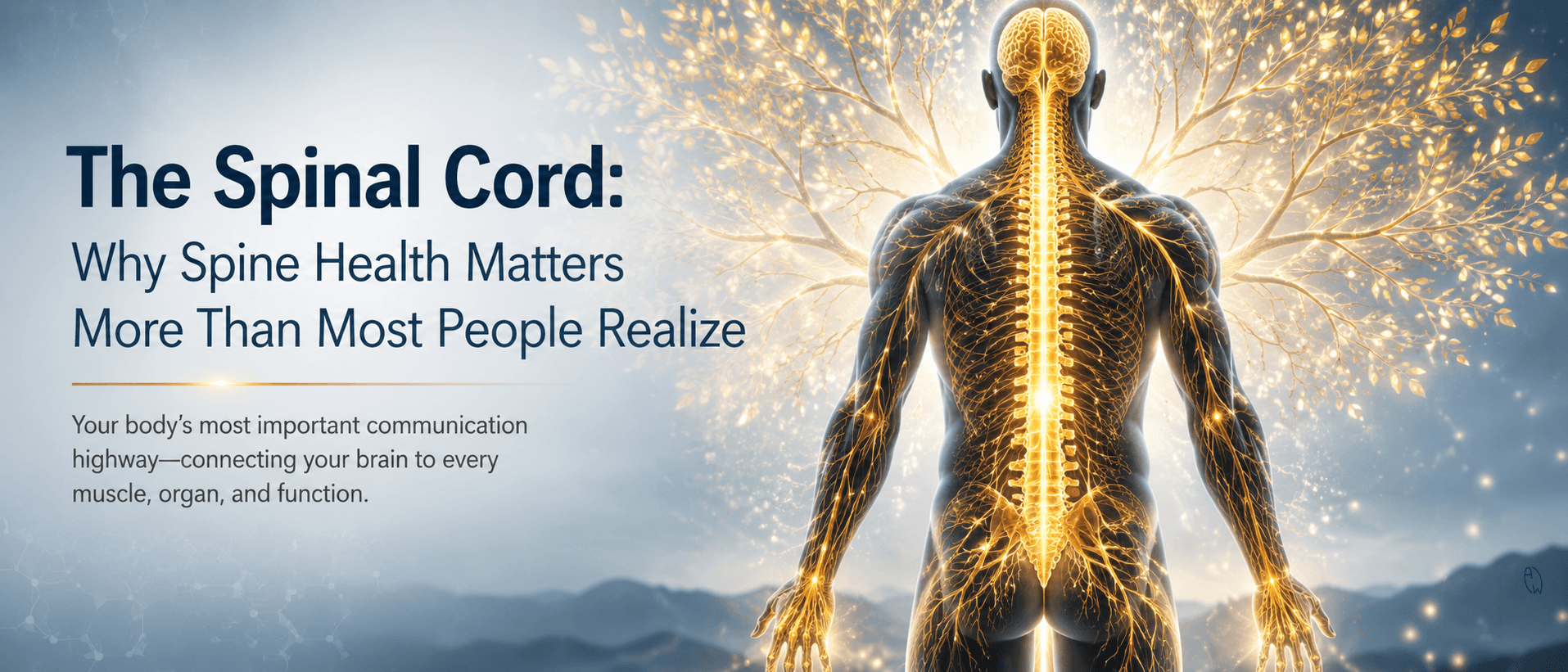
The Spinal Cord: Why Spine Health Matters More Than Most People Realize
When most people think about the spine, they think about posture, neck pain, back pain, or scoliosis.
As a chiropractor who spends every day working with patients experiencing spinal conditions, I see the spine differently.
The spine is not simply a stack of bones holding us upright.
It is the protective housing for one of the most important structures in the human body: the spinal cord.
The spinal cord is the body's primary communication highway. It carries information between the brain and every muscle, organ, tissue, and system in the body. Every movement you make, every sensation you feel, every breath you take, and every action you perform depends on this communication network functioning properly.
This is one of the reasons many healthcare professionals refer to the spine as the "Tree of Life."
What Is the Spinal Cord?
The spinal cord is a highly specialized neural pathway approximately 45 cm long in adults. It extends from the base of the brain through the spinal canal and serves as the primary connection between the brain and the rest of the body.
The spinal cord is protected by:
-
The vertebral column (spinal bones)
-
The meninges (protective membranes)
-
Cerebrospinal fluid (CSF)
Inside the spinal cord is butterfly-shaped gray matter surrounded by white matter. Together, these structures transmit millions of signals through 31 pairs of spinal nerves that branch throughout the body.
Without this system, there would be no coordinated movement, no sensation, no balance, no reflexes, and no efficient communication between the brain and body.
The fact that the human body has built multiple layers of protection around the spinal cord tells us just how important this structure truly is.
Why We Call the Spine the Tree of Life
Imagine the spinal cord as the trunk of a tree.
The spinal nerves are the branches extending throughout the body, reaching every muscle, organ, and tissue.
If the trunk becomes damaged, compressed, or stressed, the branches may not function as efficiently.
The spine is a remarkable piece of biological engineering. It must be strong enough to protect the spinal cord while remaining flexible enough to allow bending, twisting, lifting, walking, running, and countless other daily movements.
It also serves as an attachment point for muscles, ligaments, and connective tissues that help us move and function.
The spine is both protective and mobile. It is one of the most sophisticated structures in the human body.
What Happens When the Nervous System Is Under Stress?
One thing I frequently see in clinical practice is that people ignore warning signs until symptoms become severe.
Patients often tell me:
"I thought it was just a stiff neck."
"I thought the tingling would go away."
"I thought I had simply slept in a bad position."
Sometimes they are right.
Sometimes they are not.
Symptoms that may indicate nerve irritation or neurological involvement include:
-
Numbness in the hands or feet
-
Tingling sensations
-
Burning sensations
-
Muscle weakness
-
Reduced coordination
-
Neck pain
-
Back pain
-
Radiating arm or leg pain
-
Difficulty walking
-
Changes in sensation
-
Loss of bladder or bowel control
Not every symptom is serious.
However, symptoms involving the nervous system should never be ignored or self-diagnosed.
The earlier a problem is properly assessed, the better the chances of understanding what is truly causing it.
Not Every Tight Muscle Is Actually a Muscle Problem
One of the most important lessons I have learned from treating patients is that not every tight muscle is actually a muscle problem.
Many people assume that when a muscle feels tight, painful, or restricted, the solution is simply to massage it harder.
But the human body is rarely that simple.
In fact, just recently I saw a patient who believed his symptoms were caused by a tight muscle. He sought aggressive treatment to release the area, but his condition worsened significantly and eventually required emergency medical evaluation because he could no longer walk normally.
To be clear, this does not mean sport massage therapy is dangerous. Many massage therapists provide excellent care and help countless people every day.
The lesson is that not every symptom originates from the tissue that hurts.
Sometimes muscles tighten because they are protecting an injured joint.
Sometimes they tighten because they are compensating for poor movement patterns.
Sometimes they are responding to irritation originating from a spinal disc, nerve, ligament, or dysfunctional joint.
The body is intelligent.
It rarely creates chronic tension without a reason.
When I evaluate a patient with persistent tightness, one of the first questions I ask is:
"What is this muscle trying to protect?"
That question often leads us to the real source of the problem.
Your body is not a piece of dead meat that simply needs to be pounded harder because it feels tight.
It is a living, adaptive, highly intelligent system constantly responding to posture, movement, injury, stress, and neurological input.
When we focus only on eliminating symptoms without understanding why they exist, we risk missing the true cause.
That is why a proper diagnosis should always come before a treatment plan.
Is Chiropractic Care Just About Making Things Pop?
One of the biggest misconceptions about chiropractic care is that treatment is simply about creating a popping sound.
The reality is far more complex.
The sound itself is called cavitation. It occurs when gases are released from a joint during movement.
The sound is not the goal.
The goal is to improve movement, reduce mechanical stress, restore function, and help the body move more efficiently.
In practice, chiropractic assessment involves evaluating:
-
Joint mobility
-
Movement quality
-
Biomechanics
-
Posture
-
Neuromuscular function
-
Muscle balance
-
Functional limitations
Our objective is not to "put bones back into place."
Our objective is to improve the mechanical environment surrounding the joints, muscles, and nervous system so the body can function as efficiently as possible.
What I See Every Day in the Clinic
After years of treating patients with neck pain, back pain, scoliosis, postural imbalances, and movement dysfunction, one observation continues to stand out.
The human body wants to move well.
When movement improves, people often feel better.
When unnecessary mechanical stress is reduced, people often function better.
When joints, muscles, and the nervous system work together more efficiently, people frequently notice changes they were not expecting.
When there is no major tissue damage, severe degeneration, fracture, or significant injury present, many patients report feeling noticeably different shortly after treatment.
Some say:
-
"I feel lighter."
-
"I can turn my head further."
-
"My back feels less restricted."
-
"I can stand straighter."
-
"I didn't realize how tight I was until now."
Some healthcare professionals may attribute these experiences to expectation effects or bias.
That is a reasonable scientific discussion and should always be considered.
However, from a biomechanical perspective, it is also reasonable that when a restricted joint begins moving more normally, surrounding muscles reduce their protective tension, movement improves, and the nervous system receives different sensory input.
The nervous system is constantly monitoring the body's environment.
Every joint, muscle, ligament, and connective tissue is continuously sending information to the brain.
When movement quality improves and unnecessary stress decreases, many patients naturally report feeling and functioning better.
This does not mean chiropractic care is a cure-all.
It does not mean every patient experiences immediate results.
It does not mean every condition is caused by the spine.
What it does mean is that movement, biomechanics, and nervous system function are deeply connected.
Why This Matters for People With Scoliosis
At All Well Scoliosis Centre, we work with many adolescents and adults living with scoliosis.
One of the biggest misconceptions we encounter is the belief that scoliosis only affects appearance.
While most scoliosis cases do not directly injure the spinal cord, spinal curvature changes how forces travel through the spine, muscles, ligaments, joints, and nervous system.
Over time, these compensations may contribute to:
-
Muscle fatigue
-
Postural imbalance
-
Reduced mobility
-
Back pain
-
Neck pain
-
Rib tightness
-
Uneven loading of joints
-
Reduced exercise tolerance
This is why scoliosis management should focus on more than simply measuring the Cobb angle.
We must also consider movement quality, spinal function, muscle balance, breathing mechanics, strength, endurance, and overall nervous system health.
A spine does not need to be perfectly straight to be strong.
However, it does need to function efficiently.
Chiropractor vs Orthopaedic Doctor: What's the Difference?
Patients often ask whether they should see a chiropractor or an orthopaedic doctor.
The answer depends on the problem.
Orthopaedic doctors are medical specialists trained to diagnose and manage musculoskeletal diseases and injuries. Their expertise includes fractures, severe degeneration, trauma, sports injuries, and surgical management when necessary.
Chiropractors focus heavily on spinal biomechanics, posture, movement, rehabilitation, neuromuscular function, and conservative non-invasive management of musculoskeletal conditions.
Medical doctors are primarily trained to diagnose disease and manage symptoms through medications, imaging, injections, and surgery when appropriate.
Chiropractors focus on restoring movement, reducing mechanical stress, improving biomechanics, and enhancing neuromuscular function through conservative approaches.
These philosophical differences are often the source of misunderstanding.
In reality, both professions play valuable roles.
The best outcomes often occur when healthcare providers work together to help patients function at their highest potential.
When Should You See a Spine Specialist?
You should seek professional evaluation if you experience:
-
Persistent numbness or tingling
-
Radiating pain into the arms or legs
-
Progressive weakness
-
Changes in posture
-
Chronic neck or back pain
-
Recurrent headaches associated with neck tension
-
Significant changes in balance or coordination
-
Scoliosis progression
-
Loss of mobility affecting daily activities
The goal is not simply to manage symptoms.
The goal is to understand why they are happening.
Protecting Your Spine
One lesson I have learned after years in clinical practice is that the body often whispers before it screams.
Most serious problems do not appear overnight.
They begin with small warning signs.
A stiff neck that never fully resolves.
Recurring headaches.
Shoulder tightness.
Tingling in the fingers.
Reduced flexibility.
Poor posture.
Chronic fatigue during everyday activities.
Not every symptom indicates a serious problem.
However, recurring symptoms are often the body's way of asking for attention.
The spinal cord works continuously every second of your life.
It allows your brain to communicate with your body and your body to communicate with your brain.
Most people never think about their spinal cord until something goes wrong.
Yet this remarkable structure allows every movement, sensation, and interaction you have with the world.
As someone who works with spinal and postural conditions every day, I have developed tremendous respect for the complexity of the human spine and nervous system.
The spine is not merely a collection of bones.
It is a living, dynamic structure designed to protect the body's most important communication highway.
Move regularly.
Build strength.
Maintain mobility.
Pay attention to warning signs.
And when symptoms arise, seek proper evaluation rather than guessing.
Your spinal cord is quite literally the connection between your brain and the rest of your life.
That is why many healthcare professionals continue to refer to the spine as the Tree of Life.
About the Author
Dr. Albert is a chiropractor at All Well Scoliosis Centre in Singapore. He works with adolescents and adults experiencing scoliosis, postural imbalances, spinal discomfort, and movement-related conditions. His clinical approach focuses on improving spinal function, movement quality, and long-term musculoskeletal health through evidence-informed, non-invasive care.
Through years of clinical practice, Dr. Albert has helped patients better understand the relationship between posture, movement, spinal biomechanics, and nervous system function. His passion is empowering individuals to take an active role in their spinal health through education, movement, and sustainable lifestyle habits.