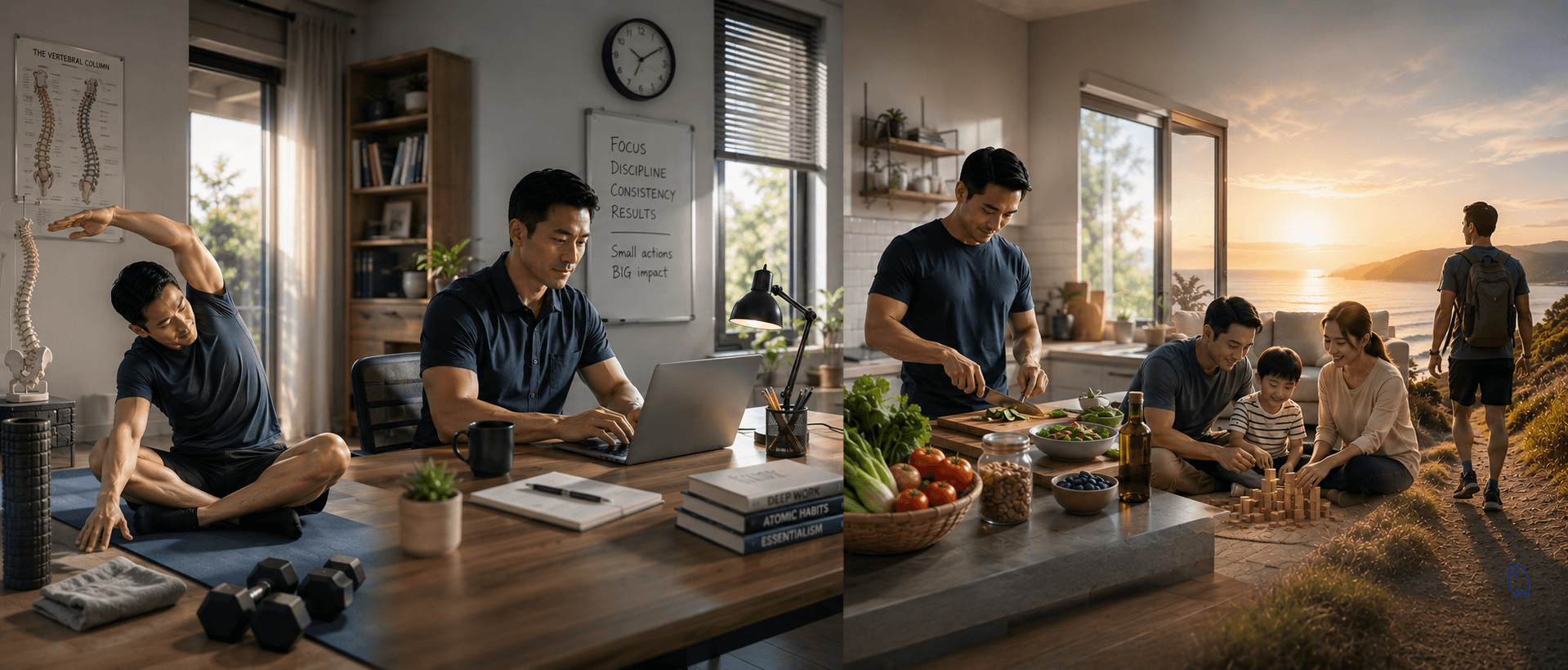
How Do You Stay Motivated? The Truth Is: I Don't.
One of the questions I get asked most often by patients, colleagues, friends, and even family members is:
"How do you stay motivated?"
My answer usually surprises people.
I don't rely on motivation.
In fact, I think motivation is overrated.
Motivation feels great when it's there. You wake up energized, excited, and ready to take action. You feel inspired to exercise, eat healthy, study, work on your goals, or finally start that rehabilitation program you've been postponing.
But motivation is like the weather.
Some days it's sunny.
Some days it's raining.
Some days it's nowhere to be found.
If your success depends entirely on motivation, you'll only move forward when conditions are perfect.
Life doesn't work that way.
Discipline Beats Motivation Every Time
What has helped me far more than motivation is discipline.
Discipline means doing what needs to be done, even when you don't feel like doing it.
You exercise because it's important.
You prepare nutritious meals because your body needs it.
You go for your rehabilitation exercises because recovery matters.
You go to bed on time because sleep affects your health.
You continue learning because growth never stops.
Not because you're motivated.
Because you've decided it's important.
The reality is that motivation starts the journey, but discipline keeps you moving.
The people who achieve meaningful results aren't necessarily the most motivated people.
They're the people who keep showing up when motivation disappears.
Building Habits Makes Life Easier
The good news is that discipline isn't something you're born with.
It's a skill.
And like any skill, it can be practiced.
One of the easiest ways to develop discipline is through habits.
When something becomes a habit, you stop negotiating with yourself.
You don't ask:
"Should I exercise today?"
You simply exercise.
You don't ask:
"Should I do my scoliosis exercises?"
You simply do them.
You don't ask:
"Should I get enough sleep tonight?"
You simply follow your routine.
Habits reduce decision fatigue.
The less you rely on feelings, the more consistent you become.
Consistency creates results.
The Same Principle Applies to Scoliosis
Many people think that once their scoliosis is "fixed," everything will be fine.
Unfortunately, health doesn't work that way.
Scoliosis, like many health conditions, is something that asks for your attention.
It's your body's way of saying:
"Please acknowledge me."
Even if someone undergoes surgery, it doesn't automatically guarantee freedom from pain, stiffness, weakness, or future discomfort.
The spine still needs movement.
The muscles still need strength.
The nervous system still needs coordination.
The body still needs care.
Recovery requires discipline.
Maintaining health requires discipline.
Building strength requires discipline.
There is no surgery that can replace healthy daily habits.
Recovery Is Not Just About Treatment
Many people believe recovery happens during treatment sessions.
Treatment can certainly help.
But what happens between appointments often matters even more.
Recovery requires:
-
Regular movement
-
Following exercise programs
-
Managing stress
-
Prioritizing sleep
-
Proper nutrition
-
Staying hydrated
-
Building strength
-
Managing workload
These things aren't exciting.
They rarely make social media headlines.
But they work.
The body responds remarkably well when given the right environment consistently.
Processed Food Is Easy. Health Is Earned.
Let's be honest.
Processed food is convenient.
It's quick.
It's cheap.
It's available everywhere.
But convenience doesn't always mean it's helping your body.
Your body is constantly working behind the scenes.
Every meal provides information.
Every choice either supports recovery or creates additional stress.
A highly processed diet often means:
-
Lower nutritional value
-
Less fibre
-
Poorer recovery
-
Increased inflammation
-
Greater energy fluctuations
Your body can handle occasional indulgences.
But long-term health is built through consistent choices.
Again, not motivation.
Discipline.
Sleep Is a Discipline Too
Many people think of exercise and nutrition when discussing health.
Few people think about sleep.
Yet sleep may be one of the most powerful recovery tools available.
Sleep is when your body:
-
Repairs tissue
-
Regulates hormones
-
Consolidates learning
-
Supports immunity
-
Recovers from physical stress
Going to bed on time is a discipline.
Waking up consistently is a discipline.
Creating a recovery routine is a discipline.
Health doesn't happen accidentally.
It's built intentionally.
Happiness Is Fleeting Too
Just like motivation, happiness comes and goes.
Nobody feels happy every day.
Nobody feels inspired every day.
Nobody feels confident every day.
If we wait until we feel happy before taking action, we'll spend much of our lives standing still.
The goal isn't to feel motivated all the time.
The goal is to continue doing what matters, regardless of how we feel.
That's where meaning comes from.
Find Your Values and Motivation Becomes Less Important
I've found that discipline becomes much easier when your actions align with your beliefs and values.
Ask yourself:
-
What matters most to me?
-
What kind of person do I want to become?
-
What kind of health do I want in ten years?
-
How do I want to show up for my family?
-
What example do I want to set for my children?
-
What future am I building today?
When your actions align with your values, discipline feels less like punishment and more like purpose.
You stop chasing motivation.
You start living intentionally.
I'm Not Perfect Either
I want to be honest.
I still have days where motivation disappears.
I still have days where I don't feel like training.
I still have days where I want to postpone things.
I'm guilty of letting those feelings get the better of me sometimes.
But I've learned that discipline isn't about being perfect.
It's about returning to the path.
Again.
And again.
And again.
Every day is another opportunity to practice.
Final Thoughts: You Decide
If you're waiting for motivation before exercising, recovering, eating better, sleeping earlier, learning something new, strengthening your spine, or improving your health, you may be waiting a very long time.
Motivation is wonderful when it shows up.
Welcome it when it comes.
But don't depend on it.
Build habits.
Develop discipline.
Stay consistent.
Focus on what matters to you.
Because the people who achieve lasting health, meaningful recovery, and long-term success are rarely the most motivated.
They're the ones who continue doing what needs to be done, even when they have every reason not to.
You don't need motivation every day.
You need purpose.
You need consistency.
You need discipline.
The choice is yours.