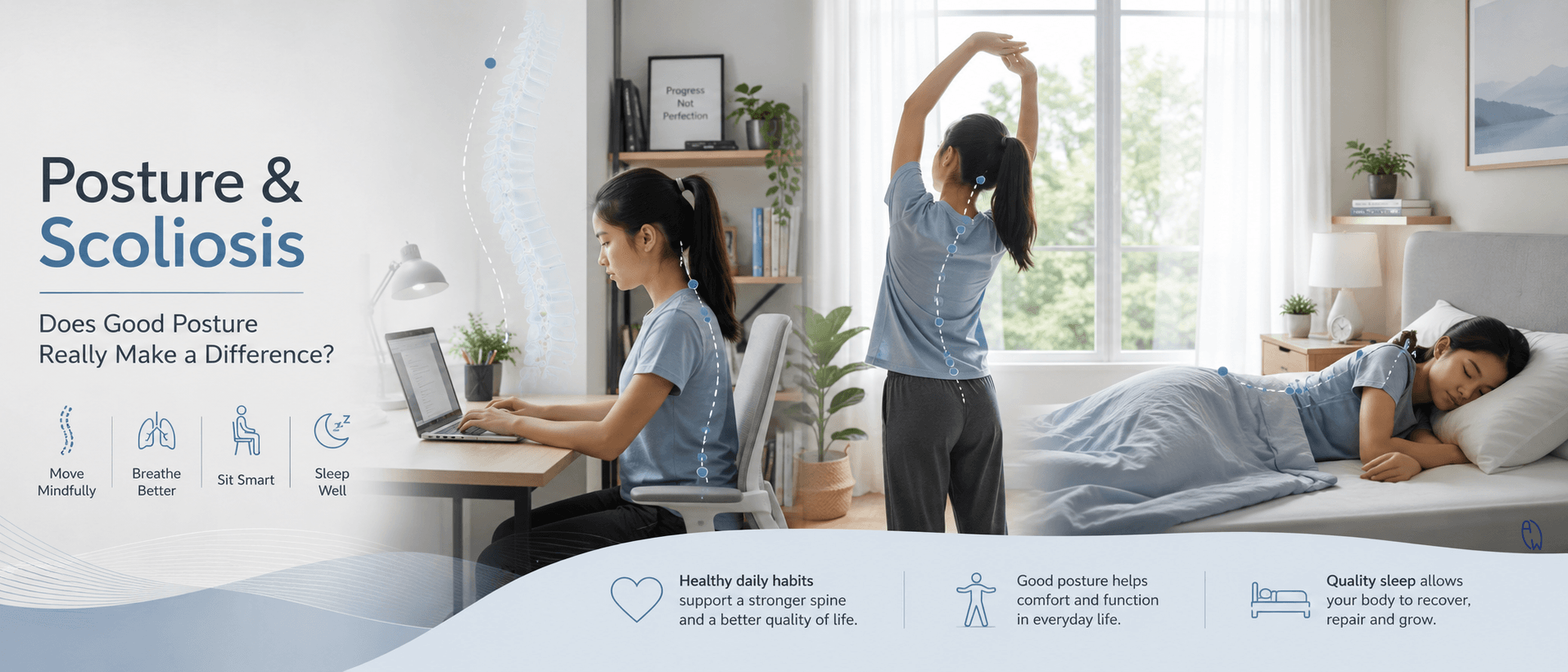
Posture and Scoliosis: Separating Myths from Facts
Posture and Scoliosis: Does Good Posture Really Make a Difference?
"Sit up straight!"
For many families living with scoliosis, these three words become part of everyday life.
Parents say it while their child is studying. Teachers remind students during class. Grandparents gently mention it over dinner. It usually comes from a place of love and concern, with the hope that standing or sitting straighter might help protect the spine.
For someone living with scoliosis, these reminders can become a daily routine. Teenagers may wonder if they're doing something wrong every time they slouch. Adults often look back and ask themselves whether years of poor posture contributed to their spinal curve.
But is posture really the problem?
Can poor posture cause scoliosis?
Can sitting up straighter stop the curve from progressing?
Or are we placing too much importance on posture while overlooking the factors that truly matter?
These are some of the most common questions we hear at All Well Scoliosis Centre, and they deserve a clear, evidence-based answer.
The short answer is this:
Good posture matters—but not for the reasons many people think.
Maintaining healthy posture can improve comfort, reduce muscle fatigue, support breathing, and help your body move more efficiently throughout the day. However, good posture does not cause scoliosis, nor can it cure or reverse a structural scoliosis curve.
Understanding this distinction is important. It helps patients and families move beyond unnecessary guilt and frustration, allowing them to focus on the daily habits that genuinely support long-term spinal health, recovery, and overall well-being.
Can Poor Posture Cause Scoliosis?
No.
This is perhaps the biggest misconception surrounding scoliosis.
Idiopathic scoliosis—the most common form affecting adolescents—has no single known cause. Current research suggests that it develops due to a combination of factors, including genetics, growth patterns, neurological control, connective tissue characteristics, and spinal biomechanics.
Similarly, neuromuscular scoliosis develops because underlying neurological or muscular conditions affect the body's ability to support the spine—not because someone sat incorrectly.
Poor posture may make someone look as though they have scoliosis, but it does not create the three-dimensional structural rotation that defines true scoliosis.
Likewise, sitting perfectly straight every day will not prevent scoliosis from developing if someone is genetically predisposed.
This is important for both patients and parents to understand.
Then Why Does Everyone Keep Talking About Posture?
Because posture still plays an important role.
Although posture doesn't determine whether scoliosis exists, it can significantly influence:
-
Muscle fatigue
-
Neck and shoulder tension
-
Lower back discomfort
-
Rib cage mobility
-
Breathing efficiency
-
Energy levels throughout the day
-
Joint loading
-
Overall quality of movement
Think of scoliosis as the shape of the spine.
Think of posture as how you use that spine every day.
One affects structure.
The other affects function.
Good Posture Does Not Straighten the Curve
Many teenagers become anxious when parents constantly remind them to "stand straighter."
Unfortunately, this often creates unnecessary stress.
Even when a teenager with scoliosis tries very hard to stand perfectly straight, the spinal curve itself remains.
The body naturally compensates for the curvature by adjusting the shoulders, pelvis, rib cage, and muscles.
These adaptations are not laziness.
They are simply how the body maintains balance.
Rather than chasing "perfect posture," the goal should be efficient posture—one that minimizes strain while allowing the body to move naturally.
Why Posture Still Matters for Daily Comfort
Good posture helps distribute forces more evenly throughout the body.
When posture improves, patients often notice:
-
Less neck stiffness
-
Reduced shoulder tension
-
Better sitting endurance
-
Less lower back fatigue
-
Improved walking efficiency
-
Better breathing during activities
-
Reduced muscle overuse
These improvements may not reduce the Cobb angle directly, but they often make daily life much more comfortable.
For many adults living with scoliosis, this can significantly improve quality of life.
The Hidden Role of Sleep in Scoliosis
One aspect of posture that many people overlook is sleeping posture.
Sleep is when the body performs much of its recovery.
During deep sleep, muscles relax, tissues repair themselves, and the nervous system processes the day's activities.
Poor sleep habits may not worsen the spinal curve directly, but they can contribute to:
-
Increased muscle tightness
-
Morning stiffness
-
Fatigue
-
Reduced tissue recovery
-
Poor exercise performance
-
Higher pain sensitivity
For growing children and teenagers, quality sleep is especially important because growth and tissue repair occur predominantly during sleep.
Aim for approximately 7–8 hours of quality sleep each night (or more for growing children and teenagers according to age-appropriate sleep recommendations).
Choosing the Right Mattress
Many patients ask whether they should buy an expensive orthopedic mattress.
The answer is surprisingly simple.
Most people with scoliosis benefit from a medium-firm mattress that supports the body's natural curves without allowing excessive sinking.
A mattress that is too soft may allow the body to collapse into awkward positions.
One that is excessively hard may create pressure points and reduce comfort.
Comfort, support, and consistency are more important than marketing claims.
Pillow Height Matters More Than Most People Realize
Your pillow should keep your neck in a neutral position.
A pillow that is too high or too low can place unnecessary stress on the cervical spine, shoulders, and surrounding muscles.
The ideal pillow height depends on:
-
Sleeping position
-
Shoulder width
-
Mattress firmness
-
Individual body shape
For side sleepers, the pillow should generally fill the space between the shoulder and the head.
For back sleepers, a lower pillow usually helps maintain a neutral neck position.
Is There a Best Sleeping Position for Scoliosis?
There is no single sleeping position that cures scoliosis.
The most important goal is obtaining restful, uninterrupted sleep while keeping the body comfortable.
Different individuals may find relief in different positions.
Some people benefit from placing a pillow:
-
Between the knees while side sleeping
-
Under the knees while lying on the back
-
Alongside the body for additional support
Rather than focusing on achieving a "perfect" sleeping posture, prioritize comfort, spinal support, and restorative sleep.
Sitting for Long Hours: The Modern Challenge
Today's students and office workers often sit for many hours without moving.
Prolonged sitting can increase:
-
Neck tension
-
Shoulder tightness
-
Lower back discomfort
-
Hip stiffness
-
Muscle fatigue
Even people without scoliosis experience these problems.
For someone with scoliosis, prolonged static positions may amplify existing muscular imbalances.
Fortunately, the solution is simple.
Movement.
The Best Sitting Posture Is Your Next Posture
One of the best pieces of advice is this:
There is no perfect sitting posture if you stay in it for hours.
Instead:
-
Stand up every 30–60 minutes.
-
Walk for a few minutes.
-
Stretch gently.
-
Roll your shoulders.
-
Change positions regularly.
Our bodies are designed for movement, not prolonged stillness.
Stretching Helps the Muscles—Not the Curve
Stretching is excellent for maintaining flexibility and reducing muscular tightness.
However, stretching alone does not correct structural scoliosis.
It should be viewed as one component of a comprehensive management plan that supports:
-
Muscle flexibility
-
Joint mobility
-
Blood circulation
-
Recovery after prolonged sitting
-
Better movement quality
Posture, Breathing, and the Chest Wall
Scoliosis can influence the position of the rib cage and chest wall.
In larger curves, this may reduce chest wall mobility, making deep breathing more difficult.
Good posture can help maximize available chest expansion by encouraging:
-
Better rib movement
-
Improved diaphragm function
-
More efficient breathing mechanics
Breathing exercises and posture awareness are often valuable components of scoliosis rehabilitation.
Your Shoulders, Hips, and Joints All Work Together
The spine never functions alone.
Everything is connected.
Shoulders, hips, knees, ankles, and feet all contribute to how the body balances itself.
When one area becomes stiff or weak, other joints compensate.
This is why scoliosis management often includes improving overall movement quality rather than focusing only on the spinal curve.
Healthy posture supports the entire kinetic chain.
So What Really Matters?
Rather than constantly worrying about standing perfectly straight, focus on healthy daily habits:
-
Sleep 7–8 hours with good sleep quality.
-
Choose a supportive medium-firm mattress.
-
Use a pillow that keeps your neck neutral.
-
Avoid sitting continuously for long periods.
-
Stand up and move regularly.
-
Stretch to reduce muscle tightness.
-
Stay physically active.
-
Build strength and endurance.
-
Practice posture awareness without becoming overly rigid.
-
Maintain good breathing habits.
These everyday choices won't eliminate scoliosis, but they can make a meaningful difference in comfort, movement, recovery, and long-term spinal health.
How We Support Better Posture at All Well Scoliosis Centre
At All Well Scoliosis Centre, we believe posture is an important part of living well with scoliosis—but it is only one piece of the puzzle.
Our comprehensive, non-surgical approach combines the CLEAR Protocol, ScoliBalance, and ScoliBrace when appropriate. Rather than simply telling patients to "sit up straight," we assess how the entire body moves, including posture, muscle balance, breathing mechanics, spinal alignment, and daily habits. We then create an individualized plan to improve function, reduce discomfort, and support long-term spinal health.
Our goal is not perfection.
It is helping every patient move better, feel stronger, and build sustainable habits that support their spine throughout life.
Final Thoughts
Posture does not cause scoliosis.
Posture alone cannot cure scoliosis.
But healthy posture, quality sleep, regular movement, and thoughtful daily habits can make a meaningful difference in how your body feels and functions.
Small actions, repeated consistently, often have the greatest impact over time.
If you or your child has scoliosis, don't focus on chasing "perfect posture."
Focus on building a healthier body that can support your spine every single day.
Instead of asking:
"Am I sitting perfectly?"
Ask yourself:
• Did I move today?
• Did I sleep well?
• Did I stretch?
• Did I breathe deeply?
• Did I give my spine the recovery it needs?
Because scoliosis is managed through hundreds of small healthy decisions—not one perfect posture.
Frequently Asked Questions (FAQ)
Can poor posture cause scoliosis?
No. Poor posture does not cause structural scoliosis. Idiopathic and neuromuscular scoliosis develop through factors beyond simply how someone sits or stands.
Will sitting up straight fix scoliosis?
No. Sitting up straight cannot correct the spinal curve, but maintaining good posture may reduce muscle fatigue and improve comfort.
What mattress is best for scoliosis?
Many people find a medium-firm mattress provides a good balance of support and comfort. The best mattress is one that allows restful sleep while supporting your body comfortably.
Does sleeping position affect scoliosis?
Sleeping position does not cure or worsen scoliosis directly. However, comfortable positioning, proper pillow support, and adequate sleep are important for recovery, muscle health, and overall well-being.
How often should I get up if I sit all day?
Aim to stand, stretch, or walk every 30–60 minutes to reduce stiffness, improve circulation, and decrease muscle fatigue.