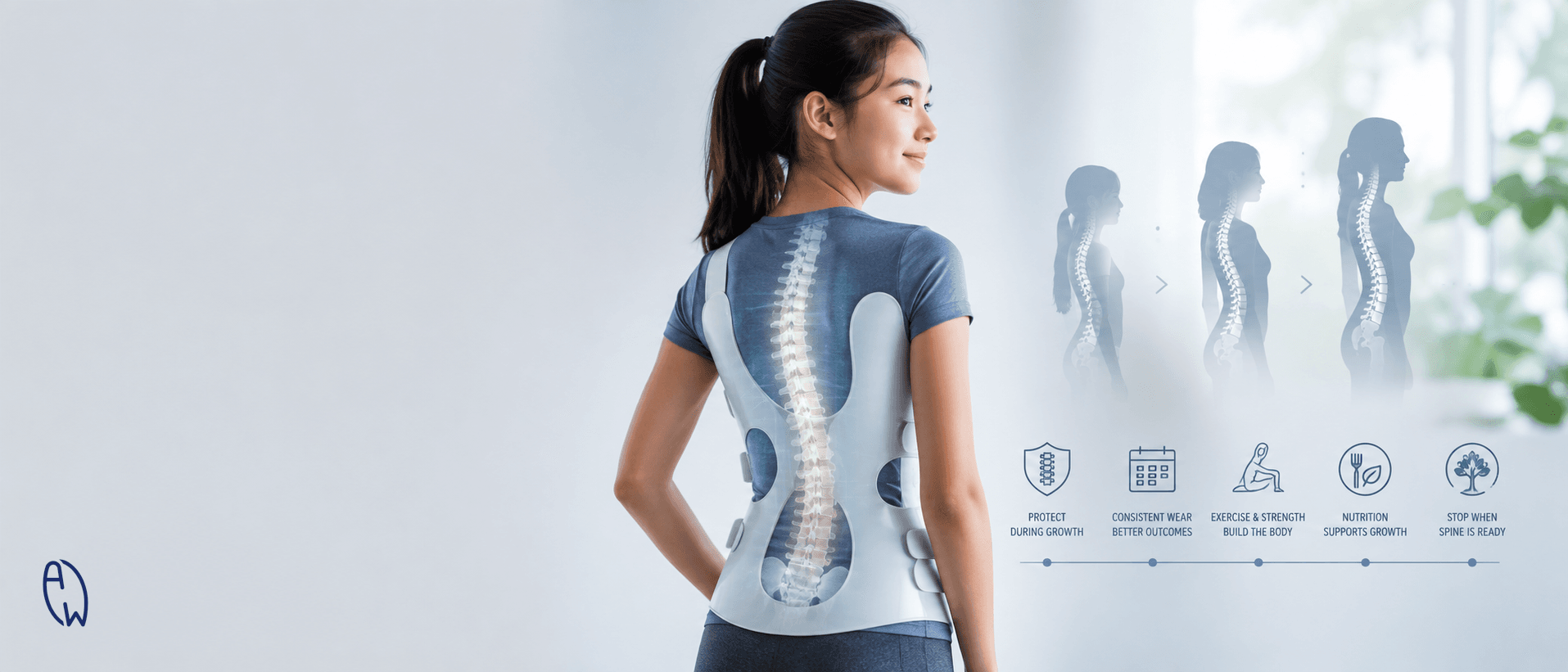
When Can You Stop Wearing a Scoliosis Brace? Don't Stop Too Early
One of the happiest moments for a young scoliosis patient can be seeing improvement.
The shoulders look more level.
The posture looks better.
The X-ray looks better.
The Cobb angle may have improved.
And naturally, the next question is:
“Can I stop wearing my scoliosis brace now?”
Sometimes the answer is yes.
But sometimes, not yet.
And understanding the difference is extremely important.
A Scoliosis Brace Is More Than External Support
For appropriately selected adolescents with idiopathic scoliosis, a brace is used during growth to help control the risk of curve progression.
The strongest evidence for this comes from the landmark Bracing in Adolescent Idiopathic Scoliosis Trial (BrAIST).
BrAIST studied skeletally immature adolescents with moderate idiopathic scoliosis who were at risk of progression. Patients assigned to bracing were prescribed at least 18 hours of brace wear per day.
The trial was stopped early because the benefit of bracing became clear.
In the intention-to-treat analysis, 75% of patients assigned to bracing reached skeletal maturity without their curve progressing to 50° or more, compared with 42% of those assigned to observation.
The researchers also found that greater hours of brace wear were associated with greater treatment success.
The message is important:
When bracing is appropriately prescribed, wearing it consistently during growth can make a meaningful difference.
A Brace Works Best When You Wear It as Prescribed
Having a brace is one thing.
Wearing it consistently is another.
BrAIST demonstrated a relationship between brace-wear time and treatment success. Other research has also found that early adherence is associated with continued adherence and better bracing outcomes. In one study, 97% of patients who were adherent early in treatment achieved the study's definition of bracing success, compared with 71% of those who were not initially adherent.
This does not mean every patient needs the same number of hours.
Your prescribed schedule should come from your treating team based on your curve, growth and treatment plan.
But it does mean:
A brace cannot do its job sitting in the closet.
If you have been prescribed a brace, wearing it as directed is an important part of the treatment.
Ref: Compliance matters
The Goal of Bracing Is to Protect the Spine During Growth
A scoliosis brace is not simply designed to make someone look straighter while wearing it.
Its purpose is to help manage the curve during a period when the spine is still growing and potentially vulnerable to progression.
Think of it as a protective window.
The patient is growing.
The curve is being monitored.
The brace provides corrective support.
Exercise develops movement and physical capacity.
Nutrition supports the growing body.
And the treatment team monitors progress.
The goal is ultimately to reach skeletal maturity with the best possible curve control.
Ref: Bracing works
Improvement Does Not Automatically Mean You Are Finished
This is where patients and parents can become confused.
A patient may say:
“My back looks straighter.”
Or:
“My Cobb angle improved.”
Or:
“I feel completely fine without the brace for a few hours.”
Those are encouraging signs.
But they do not automatically mean the spine is ready for complete brace discontinuation.
The more important question is:
Has the spine reached the stage where it can safely transition away from the same level of external support?
Growth status matters.
Skeletal maturity matters.
Curve magnitude matters.
Bone maturity can matter.
And the patient's individual risk of progression matters.
Feeling better is not the same as being finished.
What Happens If You Stop Bracing Too Early?
Stopping bracing before the appropriate stage of maturity may expose a patient to renewed curve progression.
A 2024 scoping review examined 43 studies on brace discontinuation in adolescent idiopathic scoliosis.
The researchers found substantial variation in when and how patients were weaned from their braces.
Curve progression after brace cessation was common. Across 12 studies reporting early progression, the mean Cobb-angle progression was 3.8°. In seven studies reporting progression of more than 5°, 236 of 700 patients—approximately 34%—experienced more than 5° of progression after brace cessation or weaning. Larger curves appeared more likely to progress.
This does not mean every patient will progress after stopping.
It means that brace discontinuation deserves careful planning.
Ref: Stopping too early can carry risk
“But My Spine Is Straighter Now”
That is good news.
It may mean the treatment is working.
But an improved curve does not necessarily mean:
“The treatment is finished.”
If a patient is still growing, the spine may remain vulnerable.
Stopping too early can mean giving up an important part of the treatment strategy before the appropriate endpoint has been reached.
Think of it this way:
Improvement is progress.
Skeletal maturity is a milestone.
Brace discontinuation is a decision.
They are not necessarily the same thing.
When Is It Usually Time to Consider Stopping?
There is no single age or Cobb angle that applies to every patient.
Clinicians may consider several factors, including:
-
Skeletal maturity
-
Remaining growth
-
Risser stage
-
Sanders bone-age stage
-
Growth in standing or sitting height
-
Time since menarche in girls
-
Current Cobb angle
-
Curve pattern
-
Individual progression risk
A 2024 scoping review found that Risser stage was commonly used in published protocols, but also highlighted the potential value of hand and wrist skeletal maturity assessments, including Sanders staging, when determining the optimal time to stop bracing.
This is why brace discontinuation should be a clinical decision, not simply a date on the calendar.
Does Stopping Mean You Have to Wean Slowly?
This is where newer research gives us an important answer.
For years, gradual brace weaning has commonly been used.
But a 2024 randomized clinical trial challenged the assumption that every patient needs a prolonged weaning period.
The study included 369 adolescents with AIS who were already considered ready to stop bracing and had reached skeletal maturity.
Researchers compared immediate brace removal with an additional six months of nighttime bracing.
After 24 months, there was no significant difference between the groups in Cobb-angle change, curve progression or truncal balance.
But there is an extremely important detail:
These patients were already ready to wean.
The study does not mean that a patient can stop wearing a brace whenever they want.
It means that once the treating team has determined that the patient is ready for brace discontinuation, a long gradual weaning period may not necessarily provide additional protection.
So the critical question is:
“Am I ready to stop?”
Not simply:
“How quickly can I stop?”
Ref: But once a patient is truly ready to wean, gradual weaning isn't necessarily superior
Don't Confuse Comfort With Readiness
We understand why patients want to stop.
A brace can be uncomfortable.
It can affect clothing choices.
It can feel restrictive.
Teenagers may feel different from their friends.
Some patients simply become tired of wearing it after years of treatment.
Those feelings are real.
But the answer should not automatically be:
“Then stop.”
Instead, tell your treatment team.
If the brace is uncomfortable, the fit may need to be reviewed.
If the patient is struggling with adherence, the treatment plan may need additional support.
If the spine has reached the appropriate stage of maturity, it may genuinely be time to transition away.
But sometimes the answer will simply be:
“Not yet.”
And “not yet” does not mean treatment has failed.
It may mean that the treatment is still doing its job.
Don't Throw Away the Progress You Have Made
Imagine spending years managing a scoliosis curve during growth.
The patient wears the brace.
Attends appointments.
Exercises.
Builds strength.
Maintains healthy habits.
The curve remains controlled.
Then, simply because the patient feels better, the brace is stopped before the spine is ready.
That is a risk worth discussing.
The goal of bracing is not simply to make adolescence more comfortable.
The goal is to help the patient reach skeletal maturity with the best possible curve control.
The BrAIST trial demonstrated that bracing can significantly reduce the risk of progression to a high-risk curve threshold in appropriately selected adolescents, and that greater brace-wear time was associated with greater treatment success.
So if the treatment is working, don't abandon it prematurely.
What About ScoliBrace?
Different braces use different designs and correction strategies.
At All Well Scoliosis Centre, we use ScoliBrace as part of our scoliosis treatment approach for appropriately selected patients.
A 2024 prospective pilot study followed adolescent girls treated with the ScoliBrace through skeletal maturity and six months after brace treatment. The study investigated Cobb angles, brace-wear time and quality of life. The final analysis included 21 patients, making it a relatively small pilot study rather than definitive proof of effectiveness.
This distinction is important.
We should not claim that one small pilot study proves that ScoliBrace is superior to every other scoliosis brace.
But it adds to the growing research examining three-dimensional, customized bracing approaches.
Whatever brace is prescribed, the fundamentals remain important:
Appropriate patient selection.
Good brace fit.
Adequate wear time.
Regular monitoring.
Exercise and rehabilitation.
And knowing when the patient is ready for the next stage.
The Brace and the Body Work Together
Being pro-brace does not mean believing that the brace should do everything.
Quite the opposite.
The brace is one part of a larger strategy.
The brace provides external corrective support.
Exercise develops movement control.
Strength training develops physical capacity.
Nutrition provides the raw materials needed to maintain muscle.
Consistency allows those efforts to work together.
The goal is not:
Brace OR exercise.
It is:
Brace + exercise + strength + nutrition + monitoring.
That is a much more complete approach.
What If You Really Want to Stop Wearing Your Brace?
Talk to your treatment team before making major changes to your brace schedule.
Don't simply stop because your X-ray looks better.
Don't stop because you feel better.
Don't stop because you have reached a certain birthday.
And don't stop because you are tired of wearing it.
Instead, ask:
“Has my spine reached the stage where I can safely transition away from the brace?”
That is the question that matters.
If the answer is not yet, there is still a reason to continue.
If the answer is yes, your treatment team can guide you through the next stage.
Frequently Asked Questions About Scoliosis Bracing
When can I stop wearing my scoliosis brace?
There is no single age or Cobb angle that applies to everyone. Brace discontinuation is generally considered when the patient has reached an appropriate level of skeletal maturity and the treating team believes the risk of further progression is sufficiently low.
How long do I need to wear a scoliosis brace?
It depends on your age, growth remaining, curve size, curve pattern and individual treatment plan. Bracing is generally used during the period of growth when the risk of progression is greatest.
The BrAIST trial showed that, among appropriately selected adolescents, bracing reduced the risk of progression to 50° or more compared with observation.
What happens if I stop wearing my scoliosis brace too early?
Stopping before the appropriate stage of maturity may increase the risk of curve progression. Research has documented measurable progression after brace cessation, particularly in patients with larger curves.
Can scoliosis get worse after stopping the brace?
Yes, it can.
Not every patient will progress, but curve progression after brace cessation has been documented. This is one reason the timing of brace discontinuation matters.
Can I stop wearing my brace if my X-ray has improved?
Not necessarily.
An improved X-ray is encouraging and may show that treatment is working. However, if you are still growing, an improved curve does not automatically mean the spine is ready to stop receiving brace support.
How do I know if my spine is ready to stop bracing?
Your treating team may consider skeletal maturity, remaining growth, bone-age assessments, Cobb angle, curve pattern and individual progression risk.
The decision should be based on your overall clinical picture—not one number alone.
Do I need to wean off my scoliosis brace gradually?
Not necessarily.
A 2024 randomized clinical trial found no significant difference between immediate brace removal and six months of nighttime bracing in adolescents who had already reached skeletal maturity and were considered ready to stop.
This does not mean everyone should stop immediately.
It means that once a patient is genuinely ready to discontinue bracing, prolonged gradual weaning may not always provide additional benefit.
Does the Cobb angle matter when stopping a scoliosis brace?
Yes, but it is only one factor.
Curve size, skeletal maturity, remaining growth and individual progression risk all need to be considered.
A smaller curve does not automatically mean a growing patient is ready to stop.
Is wearing a scoliosis brace forever necessary?
No.
The goal of bracing is not to wear it forever.
The goal is to use it appropriately during the period when it is needed, particularly while the spine is still growing, and then transition away when the patient is ready.
Will wearing a scoliosis brace make my muscles weak?
A brace should not be viewed as a replacement for exercise and physical development.
Appropriate scoliosis rehabilitation can include exercise, strengthening and movement training alongside bracing.
The goal is to use the brace as part of treatment while continuing to develop the body's own physical capacity.
What if I hate wearing my scoliosis brace?
Tell your treatment team.
Discomfort, skin problems, difficulty sleeping, clothing concerns or emotional frustration should not simply be ignored.
Sometimes the brace needs adjustment.
Sometimes the treatment schedule needs to be reviewed.
And sometimes the patient may genuinely be approaching the point where brace discontinuation is appropriate.
But don't make that decision alone.
The Goal Is Not to Wear a Brace Forever
Being pro-brace does not mean wearing a brace indefinitely.
The goal is to use bracing appropriately during the period when the spine needs it most.
Then, when the patient reaches the appropriate stage of maturity and the treating team determines that brace discontinuation is appropriate, the focus can shift toward maintaining strength, movement and healthy habits.
The brace is a treatment tool.
Use it when you need it.
Wear it as prescribed.
Build your strength alongside it.
And when the time comes to stop, stop because your spine is ready—not simply because you're tired of wearing it.
Build the Body While the Brace Protects the Spine
Bracing and rehabilitation should not be competing ideas.
They can work together.
While the brace provides external support during growth, the patient can work on developing:
Strength.
Movement.
Muscle.
Posture.
Body awareness.
Healthy nutrition.
Then, when the time comes to transition away from the brace, the patient is not simply taking something away.
They are moving into the next stage with a stronger physical foundation.
Stop When Your Spine Is Ready
A better question than:
“When can I get out of my brace?”
is:
“When is my spine ready to get out of my brace?”
Those are two very different questions.
The first is about convenience.
The second is about treatment.
The BrAIST trial showed that appropriate bracing can substantially reduce the risk of progression in adolescents with idiopathic scoliosis, particularly when the brace is worn as prescribed.
So if your curve is improving, don't automatically think:
“I don't need the brace anymore.”
Think:
“The treatment may be working. Am I actually ready for the next stage?”
Because the goal is not to get out of the brace as quickly as possible.
The goal is to get out of the brace at the right time—with the best possible spine to show for it.
Protect the progress.
Build the body.
Stop when the spine is ready.
Because scoliosis care shouldn't stop at the spine.