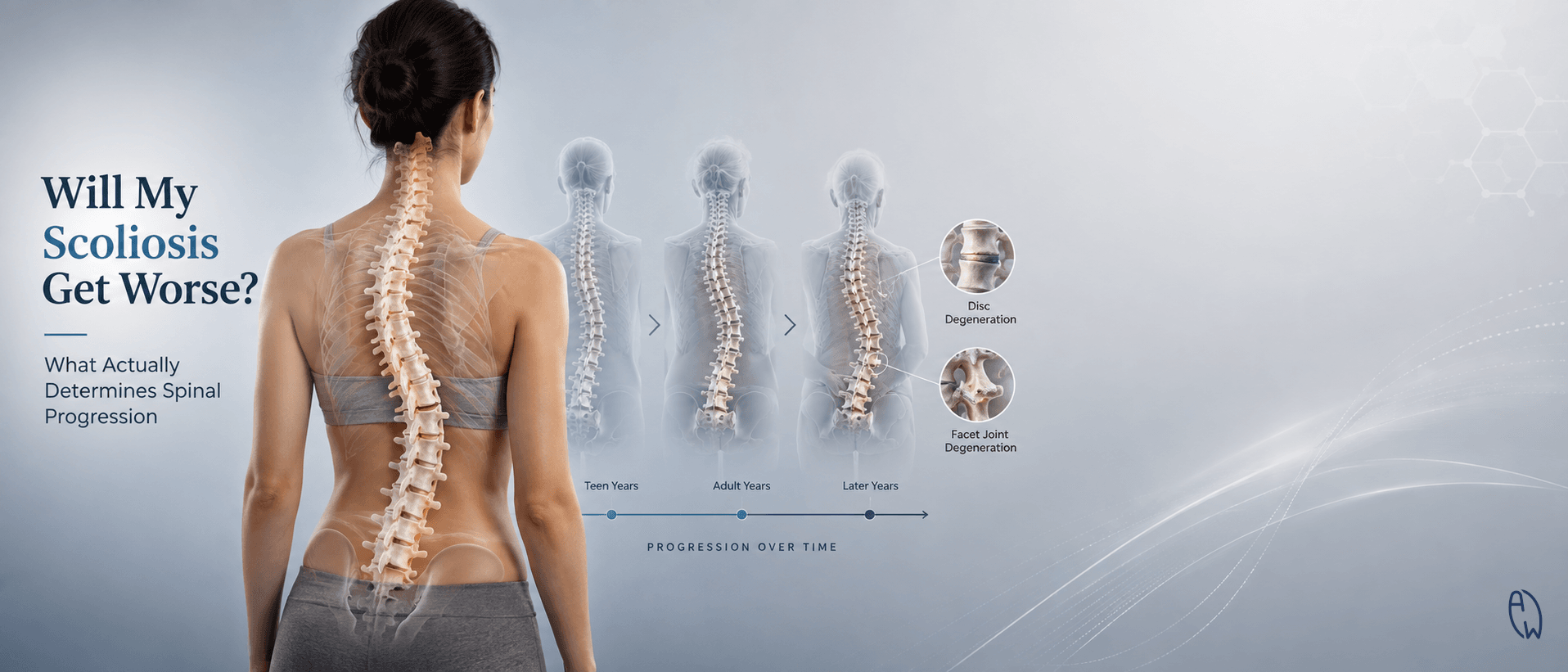
Will My Scoliosis Get Worse? What Actually Determines Spinal Progression
Scoliosis does not always worsen with age. Learn how growth, Cobb angle, spinal degeneration, alignment, and other factors influence scoliosis progression.
Quick Answer: Will My Scoliosis Get Worse?
It can—but not everyone with scoliosis will experience significant progression.
Whether scoliosis gets worse depends on several factors, including your age, stage of growth, Cobb angle, curve pattern, spinal rotation, overall alignment, and the condition of the spinal discs and joints.
For teenagers, rapid growth is one of the biggest factors associated with progression.
For adults, one of the most important factors is degeneration of the spinal discs and facet joints. As these structures gradually wear down, uneven loss of disc height and changes in the joints can alter spinal alignment and potentially cause an existing curve to progress.
The important point is:
Scoliosis progression is not determined by age alone. It is determined by how your spine changes over time.
That is why comparing your Cobb angle, imaging, posture, symptoms, and function over time can tell you much more than a single measurement.
What Is Scoliosis?
Scoliosis is a three-dimensional spinal condition involving an abnormal sideways curvature of the spine along with vertebral rotation and changes in overall alignment.
A Cobb angle measured on a standing spinal X-ray is commonly used to quantify the magnitude of the curve.
🔗 [Cobb Angle in Scoliosis: Measurement, Severity & Treatment] can help you understand what your Cobb angle means and why it matters.
Not all scoliosis behaves the same way.
Scoliosis may be:
-
Adolescent idiopathic scoliosis — developing during childhood or adolescence without a clearly identified cause.
-
Congenital scoliosis — related to vertebral development before birth.
-
Adult scoliosis — an existing curve that persists or progresses into adulthood, or a curve that develops later.
-
Degenerative scoliosis — associated with age-related changes in the discs and spinal joints.
Understanding which type of scoliosis you have matters because progression during growth is different from progression caused by degeneration later in life.
What Actually Determines Scoliosis Progression?
There is no single factor that predicts exactly what will happen to every person's spine.
Instead, several factors interact.
1. Age and Growth
For children and teenagers, growth is one of the most important periods for scoliosis progression.
During rapid growth, an existing curve can become more pronounced. This is why a teenager with scoliosis may need closer monitoring than an adult with a stable curve.
Healthcare professionals may consider:
-
Age
-
Skeletal maturity
-
Growth remaining
-
Cobb angle
-
Curve pattern
-
Previous rate of progression
A teenager's scoliosis should therefore not be judged from one X-ray alone.
The trend over time matters.
This is also why early assessment can be valuable. If a curve shows signs of progression during growth, appropriate options such as observation, scoliosis-specific exercise, or bracing may be considered depending on the individual situation.
2. Cobb Angle and Curve Size
The Cobb angle tells us how large the spinal curve is.
In general, larger curves have a greater risk of progression than very small curves, particularly when other risk factors are present.
But there is an important distinction:
A larger Cobb angle does not automatically mean your scoliosis will rapidly worsen.
For example:
25° → 27° → 30°
suggests a different pattern from:
25° → 25° → 25°
The first shows measurable change over time. The second suggests relative stability.
However, small differences between measurements should also be interpreted carefully because Cobb angle measurements can vary with positioning and measurement technique.
🔗 [Not All Scans Measure Scoliosis Accurately] explains why consistent imaging and measurement are important when monitoring scoliosis.
3. Degeneration: Why Adult Scoliosis Can Progress
This is one of the most important differences between adolescent and adult scoliosis.
As we age, the intervertebral discs and facet joints can gradually degenerate.
Discs can lose height and elasticity. Facet joints can develop arthritic changes. When these changes occur unevenly, the spine may become less balanced.
Imagine a building whose foundation gradually settles more on one side.
The structure above it may begin to compensate.
A similar principle can occur in the spine:
Disc and joint degeneration → asymmetric loading → altered alignment → further curve progression
This does not mean every adult with scoliosis will deteriorate.
Some people remain relatively stable for many years.
But research on adult degenerative scoliosis has identified factors such as disc degeneration, vertebral rotation, and lateral vertebral translation as important factors associated with progression.
This is why an adult who has scoliosis should not assume:
"My curve stopped growing when I turned 18, so it can never change."
Adult scoliosis can change even after skeletal maturity.
🔗 [Adult Scoliosis Treatment: Managing Pain, Mobility & Long-Term Spine Health] explores why degeneration, mobility, muscle strength, and function become increasingly important in adulthood.
4. Can Scoliosis Get Worse After 18?
Yes.
But adult progression is usually different from progression during adolescence.
Teenage progression is strongly influenced by remaining growth.
Adult progression can be influenced by:
-
Disc degeneration
-
Facet-joint degeneration
-
Existing curve magnitude
-
Vertebral rotation
-
Lateral vertebral translation
-
Changes in spinal alignment
-
Muscle weakness and reduced conditioning
-
Other age-related changes affecting the spine
This is why an adult with a longstanding scoliosis curve may gradually notice changes in posture, stiffness, balance, or pain even years after reaching skeletal maturity.
Adult scoliosis is not necessarily "finished" simply because growth has stopped.
5. Curve Pattern and Spinal Rotation Matter
Scoliosis is not simply a sideways bend.
It is a three-dimensional condition.
The vertebrae can rotate, the rib cage can become asymmetric, and the body can develop compensatory changes above and below the main curve.
Two people can have the same Cobb angle but very different spinal structures and movement patterns.
For example:
-
One person may have a relatively flexible curve.
-
Another may have significant vertebral rotation.
-
One may have good overall balance.
-
Another may have noticeable trunk shift.
-
One may have little degeneration.
-
Another may have significant disc and joint changes.
This is why Cobb angle is important—but it is not the entire story.
6. Gravity and Posture: Part of the Biomechanical Picture
Gravity constantly acts on the spine.
When the body is asymmetrical, muscles and joints may need to work differently to maintain balance.
Over many years, changes in movement patterns, muscle endurance, spinal alignment, and degenerative structures can influence how forces are distributed through the spine.
But we should be precise:
Poor posture does not simply cause scoliosis, and gravity alone does not determine whether scoliosis progresses.
Instead, posture and loading are part of a larger biomechanical picture.
For someone who already has scoliosis, improving strength, movement control, and postural awareness may help the body function more efficiently.
🔗 [For Scoliosis, Muscle Balance and Core Strength Matter More than Body Weight] explores how the muscles surrounding the spine and pelvis contribute to spinal support and movement.
7. Pain Does Not Always Mean Your Curve Is Getting Bigger
This is one of the most important things to understand about adult scoliosis.
More pain does not automatically mean your Cobb angle has increased.
Pain can be influenced by:
-
Disc degeneration
-
Joint irritation
-
Muscle fatigue
-
Reduced mobility
-
Nerve irritation
-
Deconditioning
-
Changes in activity
-
Poor sleep
-
Compensatory movement patterns
At the same time, scoliosis can sometimes progress structurally without causing significant pain.
So there are two separate questions:
Is my scoliosis progressing structurally?
This is evaluated using appropriate clinical assessment and comparable imaging.
Is my scoliosis becoming more symptomatic?
This involves looking at pain, stiffness, mobility, neurological symptoms, function, and quality of life.
The two can overlap—but they are not the same thing.
New or worsening symptoms should therefore be assessed rather than automatically attributed to curve progression.
How Do I Know If My Scoliosis Is Getting Worse?
Instead of asking only, "Is my scoliosis worse?", look for measurable changes.
1. Has my Cobb angle changed?
Compare your current measurement with previous measurements made using appropriate imaging and consistent methods.
2. Has my posture changed?
You may notice:
-
Uneven shoulders
-
Rib prominence
-
Waist asymmetry
-
Pelvic asymmetry
-
Trunk shift
-
Changes in overall balance
3. Have my symptoms changed?
Pay attention to:
-
Increasing back pain
-
New or worsening stiffness
-
Leg pain
-
Numbness or tingling
-
Weakness
-
Reduced walking tolerance
-
Changes in daily activities
4. Has my physical capacity changed?
Reduced strength, mobility, or endurance can affect how well your body manages the demands placed on the spine.
5. Has your life stage changed?
Growth, adulthood, menopause, aging, and changes in physical activity can all change the way scoliosis is managed.
Why Consistent Imaging Matters
If you want to know whether scoliosis is actually progressing, you need to compare the spine over time.
Standing spinal X-rays are commonly used to measure the Cobb angle because they show the spine under weight-bearing conditions.
EOS imaging is another option for some patients who require repeated spinal imaging, particularly when long-term monitoring is anticipated.
🔗 [Why We Recommend EOS Imaging] explains how EOS compares with conventional X-rays and why consistent standing imaging matters.
🔗 [EOS Imaging for Scoliosis in Singapore] provides more information about low-radiation standing 3D spinal imaging and scoliosis monitoring.
A single number is useful.
A trend is more useful.
Can You Stop Scoliosis From Getting Worse?
There is no universal treatment that can guarantee scoliosis will never progress.
However, understanding your risk factors early can help you make informed decisions about monitoring and management.
Depending on your age, curve, symptoms, and clinical findings, management may include:
-
Observation and periodic imaging
-
Scoliosis-specific exercises
-
Physiotherapeutic scoliosis-specific exercise (PSSE)
-
Bracing when appropriate
-
Strength and movement training
-
Postural and functional rehabilitation
-
Symptom management
-
Surgical evaluation for severe or progressive curves when indicated
For growing adolescents, bracing is an established treatment option for selected curves at risk of progression.
For adults, treatment is generally more individualized, with attention to pain, degeneration, mobility, balance, function, and overall spinal health.
🔗 [Scoliosis-Specific Exercises (PSSE): Evidence-Based Rehabilitation for Scoliosis] explains how scoliosis-specific exercise differs from general exercise.
🔗 [Bracing for Scoliosis] is another useful resource if you want to understand when bracing may be considered.
When Should You Have Your Scoliosis Reassessed?
Consider getting your scoliosis reassessed if:
-
Your posture has noticeably changed.
-
Your pain has increased or changed.
-
You develop new neurological symptoms.
-
You have not had your spine assessed for several years.
-
You have an old Cobb angle but no recent imaging.
-
You are a teenager going through rapid growth.
-
You are an adult with known scoliosis and increasing stiffness, pain, or functional limitations.
For adults, reassessment can be particularly useful when trying to determine whether you are dealing with a stable longstanding curve or changes associated with degeneration.
So, Will My Scoliosis Get Worse?
Maybe—but it is not inevitable.
Some people have scoliosis that remains relatively stable for years.
Others experience gradual progression.
For teenagers, growth is a major consideration.
For adults, disc and facet-joint degeneration, existing curve magnitude, spinal rotation, vertebral translation, and overall alignment can become increasingly important.
And remember:
Pain is not the same as progression.
Your pain can increase without a major change in Cobb angle.
Your Cobb angle can change without significant pain.
That is why the most useful question is not simply:
"Do I have scoliosis?"
It is:
"How is my scoliosis changing over time?"
Your age, previous Cobb angle, current imaging, symptoms, posture, and function can help create a much clearer picture.
Curious About Whether Your Scoliosis May Be Progressing?
If you are wondering what your scoliosis may be doing over time, write to us.
Tell us:
1. Your approximate age or life stage
Teenager or adult
2. Your last known Cobb angle
If you have it
3. Your current symptoms
Pain, stiffness, numbness, visible posture changes, or other concerns
We can discuss these factors with you and help you understand what may be worth assessing further.
Your scoliosis story is more than one number. Understanding the trend is the first step toward managing your spine for the long term.
Frequently Asked Questions
Can scoliosis get worse after age 18?
Yes. Scoliosis can continue to change after skeletal maturity. In adults, progression may be associated with degeneration of the spinal discs and facet joints, as well as the existing curve and overall spinal alignment.
Does scoliosis always get worse with age?
No. Some curves remain relatively stable for many years. Aging can increase the likelihood of degenerative changes, but it does not mean every person with scoliosis will experience significant progression.
Does a larger Cobb angle mean my scoliosis will get worse?
A larger curve is generally associated with a greater risk of progression, but Cobb angle alone cannot predict exactly what will happen to an individual.
Can scoliosis get worse without pain?
Yes. Structural progression and pain are different things. Some people may have curve progression with few symptoms, while others may experience significant pain without major structural progression.
Can poor posture make scoliosis worse?
Poor posture should not be described as the sole cause of scoliosis progression. However, posture, muscle endurance, movement patterns, and spinal loading can influence how someone functions and feels with an existing curve.
Can exercise stop scoliosis from progressing?
Exercise cannot guarantee that scoliosis will never progress. However, appropriately prescribed scoliosis-specific exercises can support posture, movement control, strength, function, and overall spinal health.
Can bracing prevent scoliosis progression?
Bracing can help reduce the risk of progression in selected growing adolescents with scoliosis. Whether bracing is appropriate depends on factors such as age, skeletal maturity, curve size, curve pattern, and individual risk.
How often should scoliosis be checked?
There is no single schedule that applies to everyone. Growing teenagers generally require closer monitoring than adults with stable curves. Adults may also need reassessment when symptoms or posture change or when degeneration is suspected.
How do I know if my scoliosis is actually getting worse?
The best way is to compare appropriately performed spinal imaging over time while also considering symptoms, posture, neurological function, and overall alignment. A single Cobb angle should not be interpreted in isolation.
Medical Disclaimer
This article is for educational purposes only and does not replace an individual medical assessment. Scoliosis progression varies from person to person. If you experience significant or worsening pain, weakness, numbness, breathing difficulties, or other concerning symptoms, seek appropriate medical evaluation.