Senior Scoliosis Care: Why Custom Bracing and Muscle Recalibration Matter More Than “Straightening the Spine”
Degenerative Scoliosis in the Elderly Requires a Different Approach
Scoliosis in older adults is not the same condition as scoliosis in children or adolescents.
Senior scoliosis—also known as degenerative scoliosis or adult-onset scoliosis—develops due to age-related wear and tear of the spine, including:
-
Disc degeneration
-
Facet joint arthritis
-
Loss of bone density (osteopenia or osteoporosis)
-
Muscle weakness and imbalance
-
Postural collapse over time
For elderly patients, the primary goals of care are pain reduction, functional stability, balance, and quality of life—not cosmetic correction of spinal curves.
At All Well Scoliosis Centre, our approach reflects this reality.
Why Seniors Still Benefit From Wearing a Scoliosis Brace
Many elderly patients ask:
“Isn’t bracing only for children?”
The answer is no—when done correctly and customised properly.
The Purpose of Bracing in Senior Scoliosis Is Different
For seniors, a scoliosis brace is not designed to ‘push the spine straight’ like fixing a dent in a car.
Instead, the brace is meant to:
-
Support spinal load as discs and joints weaken
-
Re-establish upright posture
-
Engage and support remaining core strength
-
Reduce compressive forces on degenerating segments
-
Improve balance and walking confidence
This is especially important for elderly patients who experience:
-
Leaning to one side
-
Height loss
-
Fatigue while standing or walking
-
Back pain caused by collapse, not just curvature
Why ScoliBrace® Is Different: Progressive, X-Ray–Based Correction
Every Senior Spine Is Unique — So Every Brace Must Be
At All Well, we use ScoliBrace®, a progressive, customised scoliosis brace designed based on each individual’s X-ray and spinal biomechanics.
This is critical because:
-
No two degenerative spines collapse in the same way
-
Bone density, disc height, and joint integrity vary widely
-
Muscle compensation patterns differ with age
Not “Curve-by-Curve Correction” — But Whole-Body Lift
Unlike traditional thinking that focuses on correcting each curve individually, ScoliBrace® works by:
-
Finding your remaining core strength
-
Creating a lifting effect through the trunk
-
Reducing spinal compression
-
Encouraging the body to hold itself upright with support
Think of it as supporting the entire structure, not hammering one crooked piece into place.
Why Custom Design Must Be Based on Imaging
Imaging Guides Safe, Effective Care
For elderly scoliosis patients, imaging is not optional—it is essential.
A healthcare provider may use:
-
X-rays → to assess curve magnitude, spinal alignment, collapse patterns
-
DEXA scan (Dual-Energy X-ray Absorptiometry) → to measure Bone Mineral Density (BMD)
-
Determines T-score
-
Diagnoses osteopenia or osteoporosis
-
-
MRI or CT scans → when nerve compression, stenosis, or severe degeneration is suspected
This information ensures:
-
The brace does not overload fragile bones
-
Exercises are safe for bone density levels
-
Decompression is applied with precision
Why Brace Alone Is Not Enough: The Role of Muscle Recalibration
Degenerative Scoliosis Is a Muscle Problem Too
As we age:
-
Core muscles weaken
-
Postural muscles fatigue faster
-
Balance systems decline
Without strengthening and recalibration, a brace alone becomes passive support—not long-term stability.
Why Coming to the Centre Matters
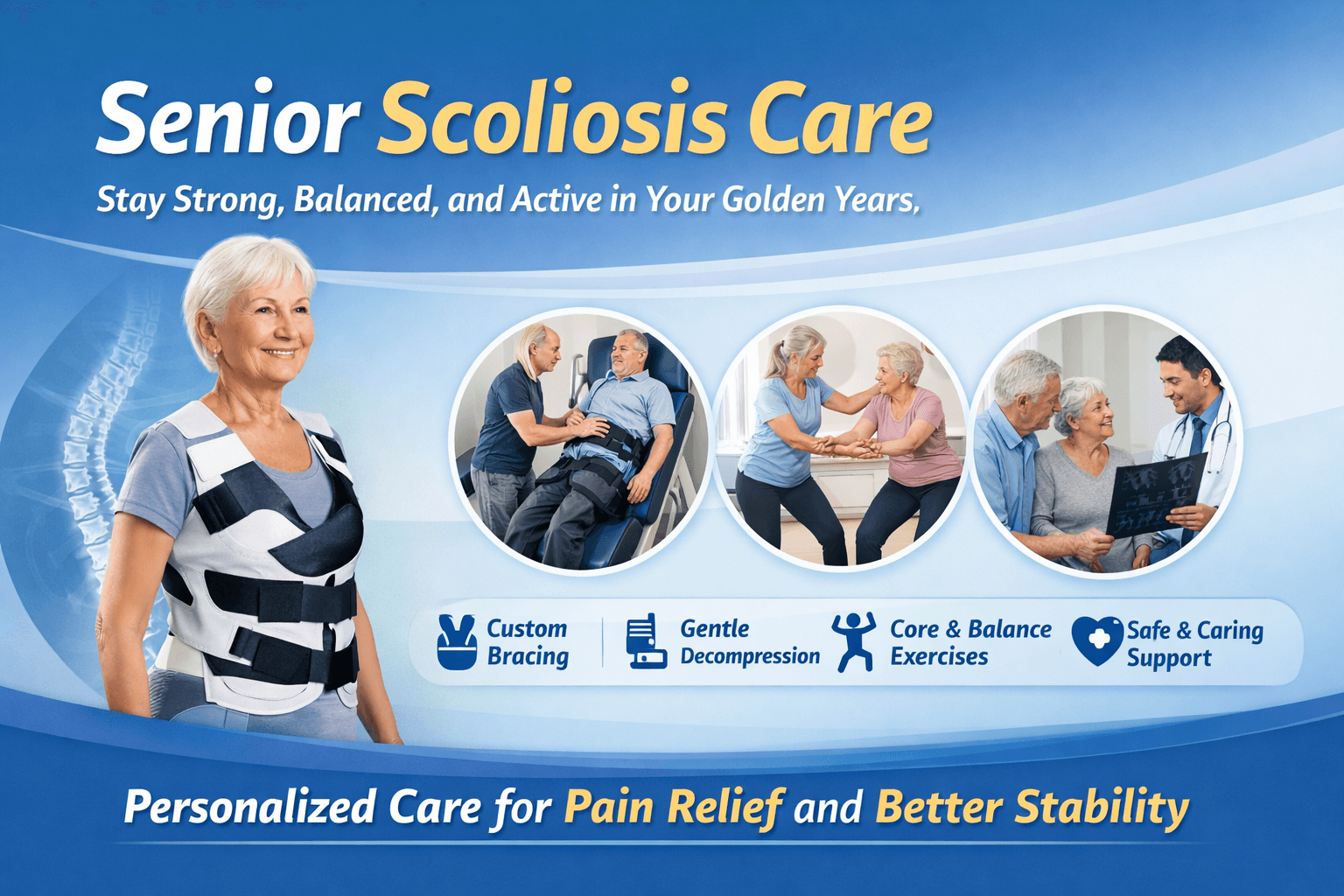
At All Well Scoliosis Centre, bracing is combined with:
-
Targeted exercises to strengthen core and back muscles
-
Postural retraining to reduce mechanical stress
-
Balance and coordination work to reduce fall risk
-
Gentle, precise decompression therapy using specialised machines
This combination allows the brace to work with the body, not replace it.
A Critical Safety Note: Not All Chiropractic Care Is Suitable for the Elderly
We want to be very clear and ethical:
We do NOT prescribe standard spinal manipulation for all elderly patients.
Especially in patients with:
-
Osteopenia (early warning stage of bone weakness)
-
Osteoporosis (significant bone loss and higher fracture risk)
-
Fragile vertebrae (weakened spinal bones)
-
Advanced degenerative changes (age-related wear of discs and joints)
Instead, we use precision-controlled decompression machines designed to:
-
Gently reduce spinal compression
-
Avoid sudden force or rotation
-
Respect bone density limitations
Safety always comes first.
Why Aesthetic Correction Is NOT the Priority for Seniors
In younger patients, aesthetics and curve correction may matter.
In elderly patients, focusing on appearance can be misguided and even harmful.
What Truly Matters Instead:
-
Pain control
-
Upright endurance
-
Walking ability
-
Balance and fall prevention
-
Nerve protection
-
Daily independence
Degenerative scoliosis is a functional condition, not a cosmetic one.
Surgery in Elderly Scoliosis: A Careful Decision
Surgery is not the first line of treatment for most elderly patients.
Why Surgery Carries Higher Risks
Older adults often have:
-
Reduced bone density
-
Slower healing
-
Comorbidities such as heart disease or diabetes
A study published in the Journal of Bone and Joint Surgery (2019) reported:
-
10–15% complication rates in patients over 65
-
While 70–80% experienced pain and function improvement, careful patient selection was critical
Surgeons typically weigh:
-
Frailty and life expectancy
-
Bone quality
-
Patient goals (pain relief vs cosmetic correction)
At All Well, conservative care is prioritised first whenever appropriate.
Monitoring, Prevention, and Long-Term Stability
Regular Monitoring Is Essential
-
Periodic X-rays or MRIs track progression
-
Bone health management reduces fracture risk
-
Early intervention prevents rapid collapse
Addressing Risk Factors
Key contributors to worsening scoliosis in seniors include:
-
Poor posture
-
Weak core muscles
-
Sedentary lifestyle
-
Untreated osteoporosis
Our approach targets all of these factors together—not in isolation.
Our Philosophy at All Well Scoliosis Centre
We believe elderly scoliosis care should be:
-
Individualised
-
Imaging-guided
-
Function-focused
-
Muscle-supported
-
Ethically conservative
We are not here to promise a “perfectly straight spine.”
We are here to help you stand stronger, move better, and live with confidence—safely.
Conclusion
For older adults with scoliosis—whether present since youth or developed through years of wear and tear—the spine can continue to change after age 45 or 50. This is especially common in degenerative scoliosis, where ageing discs, joints, and weakened muscles allow the spine to slowly collapse or lean.
As we age, symptoms such as back pain, stiffness, muscle fatigue, and nerve discomfort may increase. These changes can affect walking, balance, and the ability to enjoy daily activities. That is why care for senior scoliosis must focus on comfort, safety, strength, and function, not just the appearance of the spine.
Treatment options for seniors range from conservative care—such as custom bracing, targeted exercises, posture support, and pain management—to surgery only in severe cases where quality of life or nerve function is seriously affected. The right choice depends on symptoms, curve progression, bone health, and the individual’s overall medical condition.
By addressing scoliosis early and choosing care that is personalised and imaging-guided, older adults can remain active, independent, and more comfortable. Working with a coordinated healthcare team—including spine specialists, rehabilitation professionals, and pain-care providers—helps ensure decisions are safe, balanced, and appropriate for an ageing spine.
This guide is for education only and does not replace medical advice. Please speak with your healthcare provider for personalised recommendations.