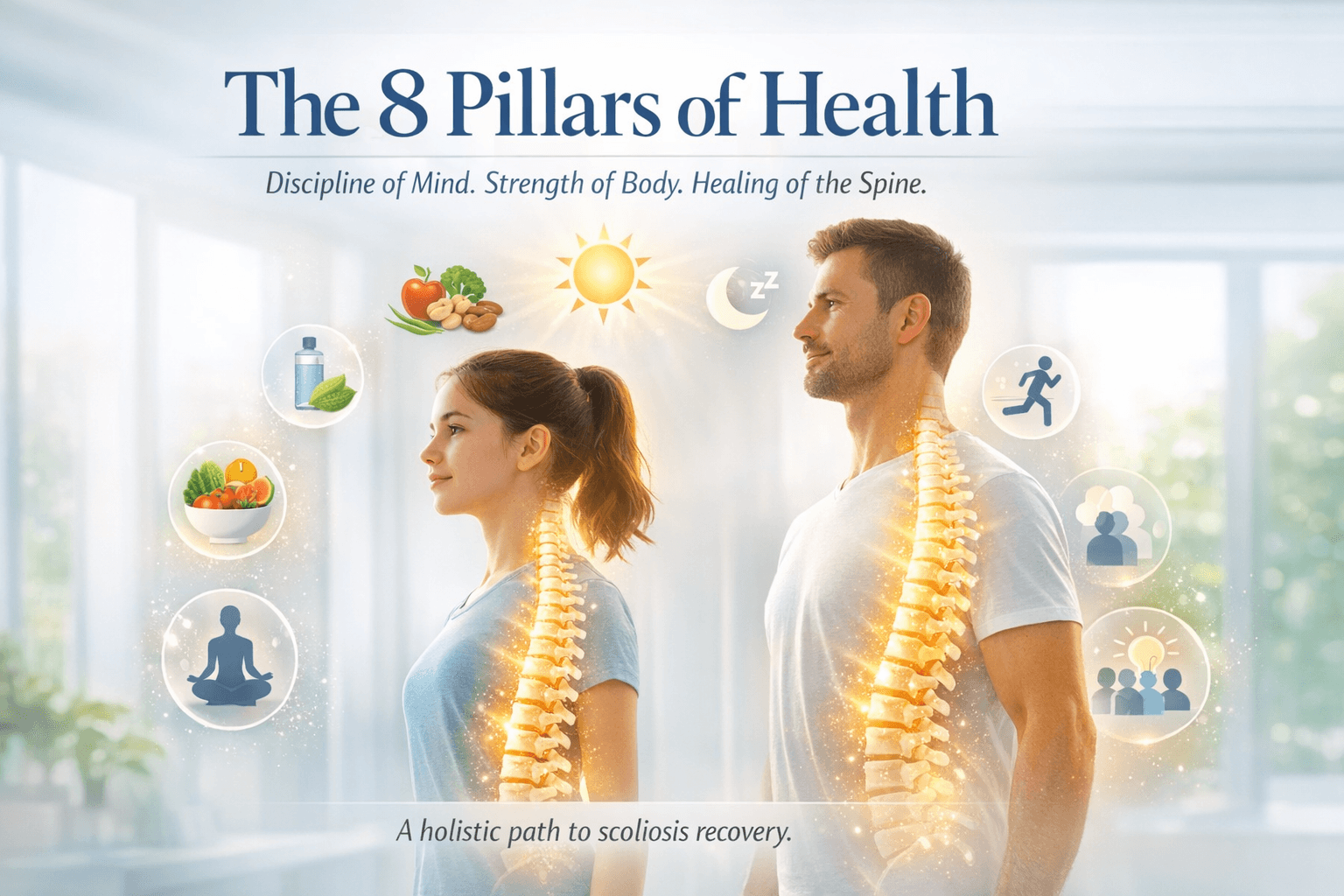
The 8 Pillars of Health: Why Scoliosis Improvement Requires More Than Treatment
Why Many People Struggle to Improve Their Health
One of the greatest paradoxes in modern healthcare is this:
The most powerful healing tools are often free — yet they are the most underused.
Human beings tend to overlook the fundamentals of health because they appear too simple. We search for quick solutions, advanced procedures, or miracle treatments. Yet true healing rarely comes from shortcuts.
The truth is simple but powerful:
Health is built daily through discipline.
This is especially true for people living with scoliosis. At All Well Scoliosis Centre, we often remind patients that improving the spine is not about a single therapy session — it is about building a lifestyle that supports the spine every single day.
And one of the most powerful frameworks to understand this is the 8 Pillars of Health introduced by physician and educator Roger Seheult.
These pillars explain why a disciplined mind, strong body, and grateful heart are the real recipe for a good life.
The 8 Pillars of Health
1. Nutrition: Fueling the Body That Supports Your Spine
Your body is a living, organic system. Every bone, muscle, ligament, and nerve depends on nutrients to function properly.
Without proper nutrition, the body cannot repair itself.
For scoliosis patients, nutrition becomes even more critical because the spine relies on:
-
Protein to build muscle support
-
Calcium and Vitamin D for bone strength
-
Magnesium for muscle relaxation
-
Anti-inflammatory foods for tissue recovery
Many teenagers with scoliosis struggle with poor appetite or extremely low protein intake. Without sufficient nutrients, the muscles that stabilize the spine cannot develop properly.
A weak body cannot support a strong spine.
2. Sleep: The Natural Repair System
Sleep is the body's most powerful healing state.
During deep sleep:
-
Growth hormone is released
-
Muscles recover
-
Tissue repair accelerates
-
The nervous system resets
For growing teenagers with scoliosis, quality sleep is essential because the body remodels bone and muscle during this time.
Poor sleep slows healing and disrupts posture control.
3. Movement: The Language of the Spine
The spine is designed to move.
A sedentary lifestyle weakens the muscles that stabilize the spine and worsens postural imbalance.
Movement helps:
-
Activate core muscles
-
Improve spinal awareness
-
Strengthen postural control
-
Improve circulation to spinal tissues
For scoliosis patients, specific therapeutic movement can retrain the brain and body to maintain better alignment.
Movement is medicine.
4. Sunlight: Nature's Vitamin D
Sunlight plays a vital role in health.
Exposure to natural sunlight helps the body produce Vitamin D, which is critical for:
-
Bone density
-
Immune function
-
Muscle strength
Low Vitamin D levels are increasingly common in modern society due to indoor lifestyles.
For patients dealing with spinal conditions, strong bones are non-negotiable.
5. Breathing: Oxygen Fuels Every Cell
Breathing is something we do automatically, yet most people do it poorly.
Shallow breathing limits oxygen delivery to the body.
Proper breathing:
-
Improves lung capacity
-
Activates the diaphragm
-
Stabilizes the spine
-
Supports the nervous system
Many scoliosis patients develop asymmetrical breathing patterns because of rib cage rotation. Learning correct breathing techniques becomes part of restoring spinal balance.
6. Stress Management: Protecting the Nervous System
Chronic stress affects the body more than most people realize.
High stress levels can:
-
Tighten muscles
-
Increase inflammation
-
Disrupt sleep
-
Reduce healing capacity
When the nervous system remains in a constant "fight or flight" state, the body struggles to repair itself.
Calm minds allow the body to heal.
7. Community and Relationships
Human beings are not designed to heal alone.
Support from family, friends, and healthcare professionals strengthens motivation and accountability.
For scoliosis patients — especially teenagers — emotional support plays a crucial role in maintaining consistency with exercises and lifestyle changes.
Encouragement fuels perseverance.
8. Purpose and Mindset
Perhaps the most powerful pillar of all is mindset.
Without discipline and purpose, the other pillars collapse.
Improving scoliosis requires:
-
Daily commitment
-
Consistent effort
-
Mental resilience
Miracles rarely happen by accident.
They happen when effort meets consistency.
Giving up is not an option.
Your Body Is Organic: It Can Break Down — But It Can Also Heal
The human body is not a machine made of metal.
It is an organic system capable of adaptation, repair, and transformation.
Bones remodel.
Muscles grow stronger.
Posture can improve.
But healing requires participation.
You must choose your path.
You can choose the pain of discipline today, or the pain of regret tomorrow.
Why Lifestyle Matters More Than Any Single Treatment
Many people hope that a single therapy, adjustment, or intervention will fix their spine.
But the reality is this:
No treatment can replace daily habits.
Chiropractic care, rehabilitation exercises, and professional guidance can support the process — but the real work happens outside the clinic.
Improvement occurs when patients commit to strengthening their bodies and supporting their health holistically.
The Truth About Real Transformation
If you wait until your last option comes to your senses, the journey becomes much harder.
But when you start early — when you invest in your body before it collapses under stress — the results can exceed your expectations.
A disciplined mindset.
A strong body.
A grateful heart.
This is the true foundation of long-term health.
Final Message: Healing Requires Effort
At All Well Scoliosis Centre, we believe something very simple:
Your body has the potential to heal.
But miracles only happen when people are willing to work for them.
Consistency.
Discipline.
Faith in the process.
Because the greatest transformation always begins with one decision:
To become stronger than yesterday.
Medical Disclaimer
This article is for educational purposes only and does not constitute medical advice.
Scoliosis varies significantly between individuals. Always consult a qualified healthcare professional before starting any new sport or exercise program, especially if you have scoliosis, spinal conditions, pain, or previous injuries. Participation in sports should be guided by individual assessment and professional recommendation.
The image is shared for educational purposes with patient consent. Individual outcomes vary. Structural correction does not automatically restore full respiratory function. Clinical assessment is required.
Copyright & Content Protection Notice
© 2026 All Well Scoliosis Centre. All rights reserved.
This content is original and protected by copyright law.
No part of this article may be reproduced, distributed, copied, or reused in any form without prior written permission. Unauthorized use, duplication, or content scraping is strictly prohibited.