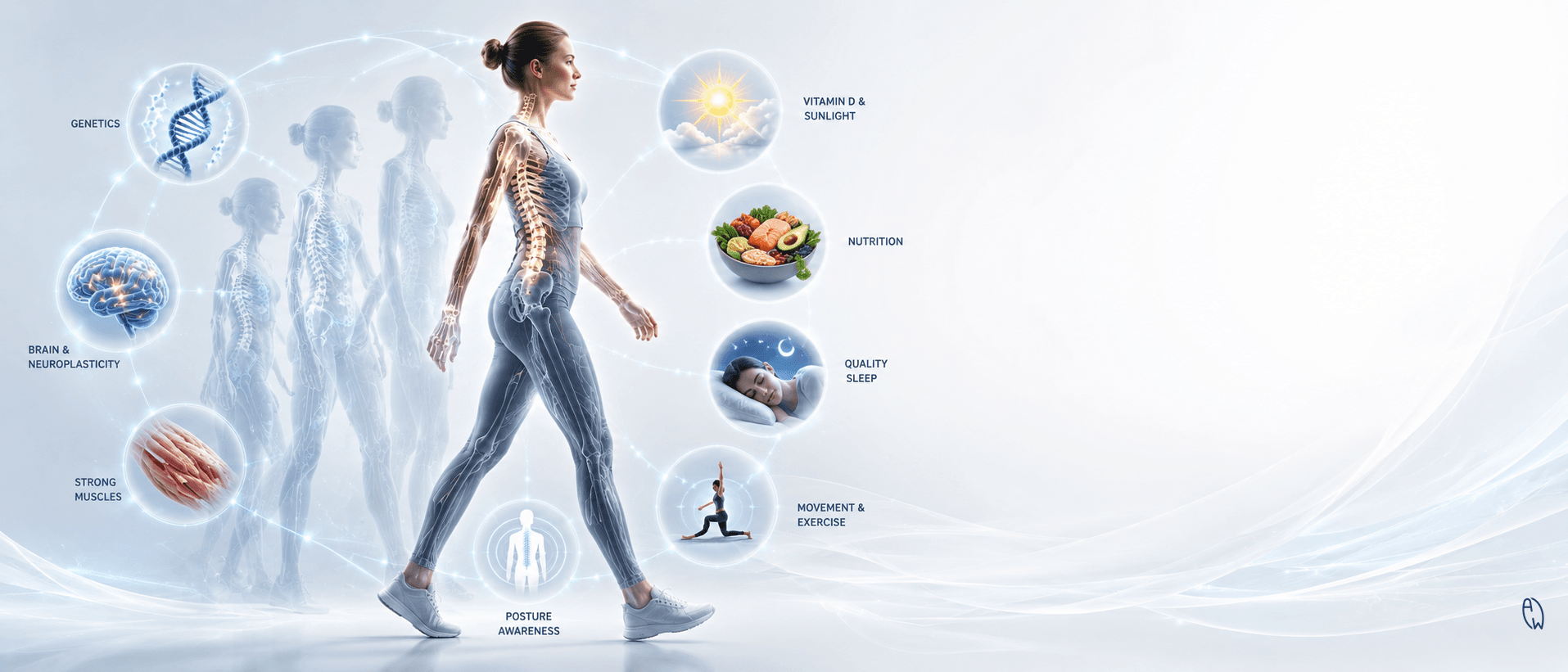
The Genetics of Scoliosis: Why Your DNA Is Only Part of the Story. Part 1
Introduction: Is Your Future Already Written in Your Genes?
Imagine two houses built from exactly the same architectural blueprint.
They have the same foundation, the same materials, and the same design.
One house is carefully maintained. It sits on stable ground, receives regular repairs, and is protected from the elements.
The other experiences repeated flooding, poor maintenance, shifting soil, and years of neglect.
Twenty years later, they no longer look alike.
The blueprint never changed.
The environment did.
Your body works in much the same way.
Every one of us is born with a unique genetic blueprint. Those genes influence how our bones grow, how our muscles develop, how our nervous system communicates, and even how our body responds to growth and healing. But genes are only the beginning of the story. They are not the final chapter.
This is especially true for scoliosis.
When parents discover that their child has scoliosis, one of the first questions they ask is:
"Did my child inherit this?"
The answer is both yes and no.
Yes, because genetics plays an important role in increasing the likelihood of developing scoliosis.
No, because having a genetic predisposition does not guarantee that scoliosis will develop, nor does it determine how severe it will become.
Modern research has transformed the way we understand scoliosis. It is no longer viewed as simply a problem of crooked bones. Instead, scientists increasingly recognise scoliosis as a complex condition involving genetics, muscle development, the nervous system, hormones, growth, and the body's remarkable ability to adapt.
Perhaps the most encouraging discovery is this:
Your DNA influences your body, but it does not completely define your future.
Is Scoliosis Genetic?
The short answer is yes—but not in the way many people imagine.
Unlike certain inherited conditions caused by a single defective gene, Adolescent Idiopathic Scoliosis (AIS) is considered a polygenic condition. This means that many different genes contribute small effects rather than one gene acting as the sole cause.
Over the last two decades, researchers have identified more than 100 genetic regions (known as susceptibility loci) that appear to increase the risk of developing scoliosis. Each individual gene contributes only a small part of the picture, but together they can make the spine more susceptible to developing a curve during periods of rapid growth.
This helps explain why scoliosis often appears to "run in families."
A parent may have had a mild curve that never required treatment. Years later, their child may develop a more noticeable curve during adolescence. Another sibling may never develop scoliosis at all.
The same family.
Similar genes.
Completely different outcomes.
If scoliosis were caused by a single gene, we would expect family members to develop almost identical spinal curves. That is not what clinicians see every day.
Instead, scoliosis behaves more like many other common health conditions, where genetics increases susceptibility but other biological and environmental factors influence the final outcome.
Your Genes Are the Blueprint—Not the Building
One of the biggest misconceptions about genetics is believing that genes determine everything.
In reality, genes are more like instructions than commands.
Imagine receiving a recipe for baking bread.
The recipe tells you what ingredients are needed, but the final loaf still depends on many factors:
-
The quality of the ingredients.
-
The temperature of the oven.
-
How long it is baked.
-
The skill of the baker.
Even with the same recipe, two loaves of bread can turn out very differently.
Your body works in a remarkably similar way.
Genes provide instructions for building your skeleton, muscles, ligaments, and nervous system. However, how those instructions are carried out depends on countless interactions that continue throughout life.
Growth.
Hormones.
Nutrition.
Sleep.
Movement.
Muscle strength.
Bone health.
Stress.
Even the way your brain learns posture.
All of these influence how your body develops and adapts.
This field of science is known as epigenetics, and it is changing how researchers think about many health conditions—including scoliosis.
We will explore epigenetics in more detail later in this article, but for now, remember this simple idea:
Genes may write the blueprint, but your body is constantly editing how that blueprint is expressed.
Scoliosis Is More Than a Spine Problem
For many years, scoliosis was described simply as a sideways curve of the spine.
Although this description is technically correct, it is also incomplete.
A spinal curve is what we see.
It is not necessarily the whole story of why it developed.
Think about what it actually takes to keep your spine upright.
Your spine is supported by more than bones.
It relies on:
-
Deep spinal muscles to provide stability.
-
Ligaments and connective tissues to guide movement.
-
Healthy bones that can tolerate everyday loading.
-
The brain to coordinate posture.
-
The inner ear to maintain balance.
-
Sensory receptors in your muscles and joints that constantly tell your brain where your body is in space.
-
Hormones that regulate growth and bone development.
-
Energy-producing systems that keep muscles functioning throughout the day.
Every second you are standing, sitting, walking, or reaching for something, these systems are communicating with one another.
If one system becomes less efficient, the others often compensate.
Sometimes that compensation works remarkably well.
Sometimes it contributes to the gradual development of asymmetrical movement patterns.
This is one reason why researchers increasingly describe scoliosis as a multifactorial condition rather than simply a spinal disorder.
The spine does not exist in isolation.
It is part of an incredibly sophisticated system that is constantly adapting to the information it receives.
Your Body Is Designed to Adapt
One of the most fascinating characteristics of the human body is that it is never truly static.
Bones continuously remodel themselves.
Muscles become stronger or weaker depending on how they are used.
The brain constantly forms new neural connections.
Even posture changes over time in response to our daily habits.
This ability is called adaptation.
Adaptation is neither good nor bad.
It simply reflects what the body has been repeatedly asked to do.
If you lift weights consistently, your muscles adapt by becoming stronger.
If you spend years looking down at a phone, your neck adapts to that position.
If you practise a musical instrument every day, your brain becomes more efficient at performing those movements.
The body learns through repetition.
The same principle applies to posture and movement.
Every time you stand, sit, walk, exercise, or perform your rehabilitation exercises, your body is gathering information.
Your muscles are learning.
Your nervous system is learning.
Your brain is learning.
This is why scoliosis rehabilitation is about much more than simply correcting a spinal curve.
It is about teaching the entire body a healthier way to move, stabilise, and function over time.
A Different Way to Think About Scoliosis
Learning that scoliosis has a genetic component can be frightening.
Many people immediately wonder whether anything can be done.
If it is "in the genes," does that mean the future is already decided?
Fortunately, modern science suggests otherwise.
While we cannot change the DNA we inherit, we can influence many of the biological systems that interact with those genes every single day.
Nutrition supports bone and muscle health.
Exercise strengthens the structures that stabilise the spine.
Quality sleep helps regulate hormones, repair tissues, and consolidate new movement patterns.
Developing greater awareness of posture allows the brain to recognise and gradually correct unhealthy habits.
Regular monitoring helps us understand how the body is adapting over time rather than relying on assumptions.
None of these interventions can honestly guarantee that scoliosis will stop progressing.
Medicine rarely offers guarantees.
However, they help create the best possible environment for the body to function, adapt, and respond to rehabilitation.
At All Well, this philosophy shapes everything we do.
We cannot promise to change your genes.
What we can do is help you influence the many factors that interact with those genes every single day.
Because while genetics may influence where the story begins, your daily choices help shape what happens next.
Looking Ahead
So, if scoliosis is influenced by many different genes rather than just one, what exactly are scientists studying?
Why do names like LBX1, PAX3, PAX1, and TBX1 appear so often in scoliosis research?
And what do these genes actually do?
In the next section, we'll explore the four genes most commonly associated with scoliosis, how they help build the spine, muscles, and nervous system, and why researchers now believe that genes provide only one piece of a much larger puzzle.