TMJ Disorder: Is Your Jaw the Problem… or Is It Trying to Tell You Something Else?
Have you ever noticed your jaw clicking every time you chew? Do you wake up with a sore jaw, struggle to open your mouth fully, or feel pain when eating? Perhaps you've been living with frequent headaches or constant neck tightness without realizing they could all be connected.
These are common symptoms of Temporomandibular Joint Disorder (TMJ Disorder or TMD), a condition affecting the jaw joint and the muscles responsible for chewing and speaking. While many people assume the problem begins and ends with the jaw, the body often tells a much bigger story.
At All Well Scoliosis Centre, TMJ is not our primary specialty. Our focus is on spinal health, posture, scoliosis, and restoring the body's overall function. Yet, something remarkable happens quite often.
Many patients who initially visit us for neck pain, poor posture, migraines, or scoliosis later tell us:
"My jaw doesn't click as much anymore."
"I can finally open my mouth wider."
"Chewing feels easier."
"The tightness around my jaw has almost disappeared."
These improvements are shared voluntarily by patients—they are not the primary goal of treatment, nor do they mean chiropractic care is a cure for every TMJ disorder. However, they reinforce something we have always believed:
When the body functions better as a whole, many seemingly unrelated symptoms may improve together.
What Is the Temporomandibular Joint (TMJ)?
The temporomandibular joints are located just in front of each ear, connecting your lower jaw (mandible) to your skull. They are among the most frequently used joints in the body, allowing you to:
-
Talk
-
Eat
-
Chew
-
Swallow
-
Laugh
-
Yawn
-
Sing
-
Express emotions through facial movement
Unlike many joints, the TMJ combines both a hinge and a sliding motion, making it one of the body's most complex joints. Every day, it performs thousands of precise movements that depend on healthy muscles, ligaments, cartilage, joints, and nerves working together.
When one part of this system is overloaded or out of balance, discomfort can develop.
Common Symptoms of TMJ Disorder
TMJ disorders don't always begin with jaw pain. Many people spend years treating headaches, neck pain, or ear discomfort without realizing the jaw may be contributing.
Common symptoms include:
-
Difficulty opening the mouth fully
-
Jaw pain or tenderness
-
Clicking, popping, or grinding sounds
-
Pain while chewing
-
Jaw locking
-
Morning jaw stiffness
-
Facial muscle fatigue
-
Neck tightness
-
Frequent headaches or migraines
-
Ear fullness or discomfort
-
Ringing in the ears (tinnitus)
-
Teeth grinding (bruxism)
-
Poor sleep quality
Symptoms may come and go, but recurring discomfort should not simply be ignored.
Why the Jaw Is Closely Connected to the Neck
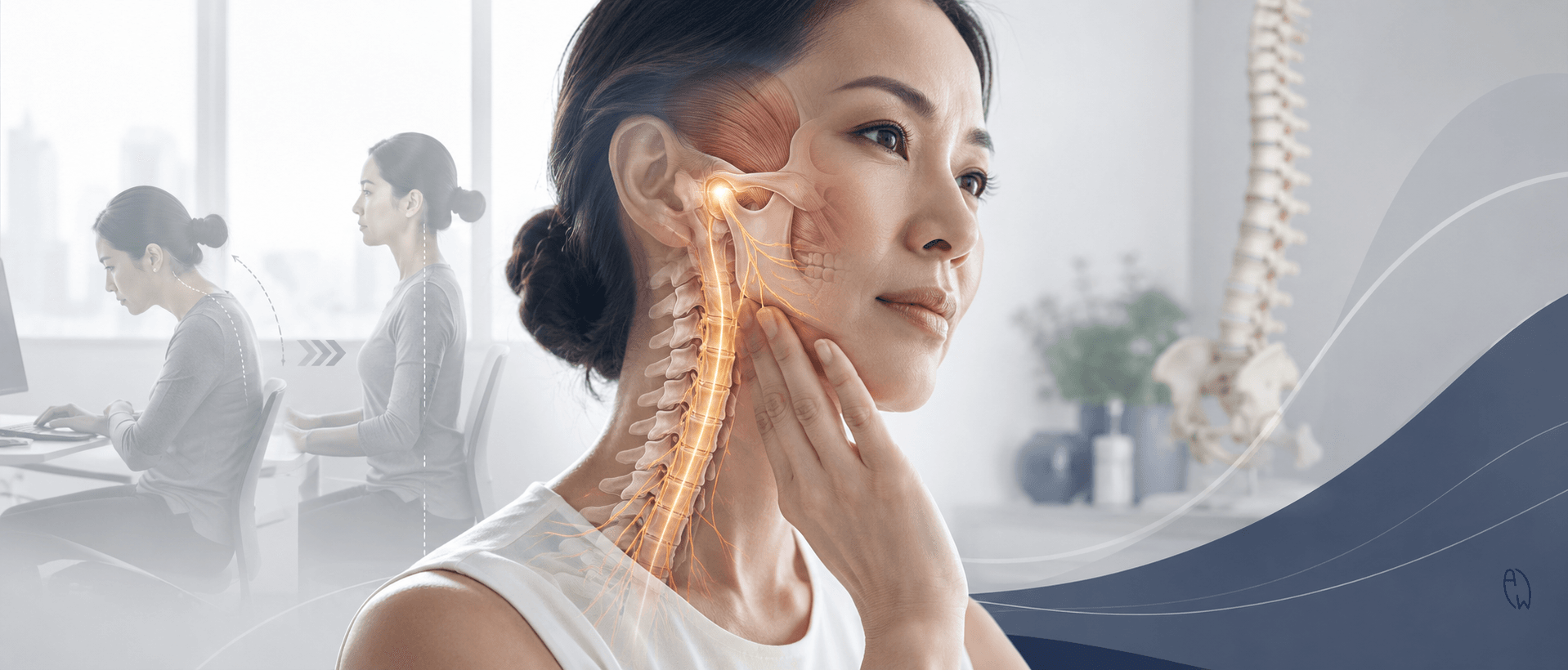
One of the most overlooked aspects of TMJ disorders is the close relationship between the jaw and the upper cervical spine.
The muscles that move your jaw work together with the muscles that stabilize your head and neck. They share neurological pathways through the brainstem, meaning dysfunction in one area may influence the other.
This is one reason why people with TMJ disorders often also experience:
-
Neck pain
-
Shoulder tension
-
Reduced neck movement
-
Chronic headaches
-
Poor posture
Likewise, prolonged neck stiffness and poor posture can place additional stress on the muscles responsible for stabilizing the jaw.
Rather than viewing these as separate problems, modern healthcare increasingly recognizes the importance of understanding how they influence one another.
The Impact of Posture on Jaw Function
Take a moment to notice your posture while reading this.
Is your head sitting directly over your shoulders, or has it drifted forward?
Forward head posture has become increasingly common due to prolonged computer work, studying, and smartphone use. As the head moves forward, the muscles of the neck, shoulders, and jaw must work harder to support its weight.
Over time, this increased muscular demand may contribute to:
-
Jaw clenching
-
Muscle fatigue
-
Neck tightness
-
Headaches
-
Reduced jaw mobility
-
Increased stress on the TMJ
While posture alone does not cause every TMJ disorder, improving spinal alignment and reducing unnecessary strain can help the body move more efficiently.
Our Clinical Observations
Although patients rarely visit our clinic specifically for TMJ disorders, they frequently seek help for:
-
Neck pain
-
Poor posture
-
Migraines
-
Scoliosis
-
Spinal stiffness
As treatment progresses, many begin noticing changes they were not expecting.
Some tell us they can chew more comfortably.
Others notice their jaw clicks less frequently.
Many find they can open their mouth wider.
Some experience fewer headaches, less facial tension, reduced neck tightness, and even improvements in their sleep.
Not everyone reports every improvement, and not everyone notices the same changes. Some patients are naturally more aware of subtle differences than others.
These observations are based on patient feedback and our clinical experience. They should not be interpreted as proof that chiropractic care cures TMJ disorders. Rather, they remind us that improving overall body function may positively influence multiple areas of health.
Looking Beyond the Jaw
One advantage of caring for patients with scoliosis is that we routinely evaluate spinal alignment through clinical examination and imaging when appropriate.
Although scoliosis X-rays are not used to diagnose TMJ disorders, they often reveal valuable information about overall body symmetry, including:
-
Head position
-
Cervical alignment
-
Shoulder balance
-
Cranio-cervical relationships
-
Overall spinal posture
When the body's foundation shifts, the muscles responsible for maintaining balance often compensate.
The jaw is no exception.
This is why we believe it is important to understand why a problem developed rather than simply asking where it hurts.
How Chiropractic Care May Help
Our approach is not about chasing symptoms.
Instead, we focus on restoring healthy movement throughout the body.
A chiropractic assessment may include evaluating:
-
Jaw movement
-
Neck mobility
-
Head posture
-
Muscle tension
-
Upper cervical function
-
Overall spinal biomechanics
Depending on each individual's needs, care may include:
Soft Tissue Therapy
Gentle myofascial release and trigger point therapy may help reduce tension in the muscles surrounding the jaw, temples, face, and upper neck.
Cervical Spine Adjustments
The upper cervical spine shares close biomechanical and neurological relationships with the jaw. Restoring movement where appropriate may help improve muscle coordination and reduce strain.
Gentle TMJ Mobilisation
Controlled manual techniques may improve jaw mobility, reduce mechanical restriction, and encourage smoother movement.
Corrective Exercises
Specific exercises may help strengthen deep neck stabilizers, improve jaw control, and encourage healthier movement patterns.
Posture and Lifestyle Education
Simple daily habits can make a significant difference, including:
-
Reducing prolonged forward head posture
-
Limiting excessive gum chewing
-
Choosing softer foods during painful flare-ups
-
Becoming aware of daytime jaw clenching
-
Improving workstation ergonomics
-
Managing stress effectively
Our goal is not simply to help a jaw move better today, but to help the body function better over time.
References: https://pmc.ncbi.nlm.nih.gov/articles/PMC10025577/
TMJ, Teeth Grinding, and Sleep
Many people grind or clench their teeth while sleeping without realizing it.
Over time, this may contribute to:
-
Morning jaw pain
-
Worn teeth
-
Facial muscle soreness
-
Headaches
-
Interrupted sleep
Some research also suggests an association between TMJ disorders, teeth grinding, and sleep-disordered breathing, including obstructive sleep apnoea. While these conditions do not always occur together, poor sleep can increase muscle tension, and chronic jaw dysfunction may contribute to discomfort during sleep.
If you experience loud snoring, pauses in breathing, excessive daytime fatigue, or wake up gasping for air, further evaluation by a sleep physician or dentist is important.
Improving jaw mechanics may help some people feel more comfortable, but it is not a treatment for obstructive sleep apnoea.
Working Together with Dentists
TMJ disorders can arise from many different causes, including:
-
Dental bite problems
-
Arthritis
-
Trauma
-
Joint degeneration
-
Disc displacement
-
Muscle imbalance
-
Poor posture
-
Cervical spine dysfunction
Because every case is different, no single healthcare professional has every answer.
At All Well Scoliosis Centre, we believe patients receive the best care when healthcare providers work together. We frequently collaborate with dentists and refer patients whenever dental assessment or additional investigation is appropriate.
A comprehensive approach often leads to better long-term outcomes than focusing on one structure alone.
Our Philosophy: Build a Better Foundation
Healthcare often focuses on treating the area that hurts.
If your jaw hurts, the jaw becomes the centre of attention.
But the human body doesn't work in isolated parts.
The spine forms the structural foundation of the body and protects the spinal cord—the primary communication pathway of the nervous system. Every movement you make, every muscle that contracts, and every joint that functions depends on clear communication between the brain and the rest of the body.
When movement becomes restricted, posture deteriorates, or muscles compensate over time, those changes can influence many different regions—not just where symptoms appear.
Rather than asking, "How do we stop the jaw from hurting?", we often ask a different question:
"Why is the jaw under so much stress in the first place?"
Sometimes the answer lies in the jaw itself.
Sometimes it lies in the neck.
Sometimes it involves posture, breathing, sleep, stress, or movement habits.
That is why our focus has always been on helping people build a stronger foundation.
Because when your spine moves well, your muscles work more efficiently, and your nervous system communicates more effectively, the entire body has a better opportunity to function as it was designed.
Our goal isn't simply to relieve one symptom.
It's to help you move better, stand better, sleep better, and enjoy a healthier quality of life.
When Should You Seek Professional Assessment?
Consider seeking professional advice if you experience:
-
Persistent jaw pain
-
Difficulty opening or closing your mouth
-
Jaw locking
-
Pain while chewing
-
Clicking associated with pain or reduced movement
-
Frequent headaches accompanied by jaw symptoms
-
Ongoing neck pain with jaw discomfort
-
Teeth grinding that affects your sleep or daily life
Early assessment can help identify contributing factors before symptoms become more severe.
Final Thoughts
TMJ disorders are often more than a jaw problem.
They involve the complex interaction between joints, muscles, posture, breathing, sleep, and the nervous system.
While chiropractic care is not the right solution for every TMJ disorder, many people benefit from an approach that looks beyond the site of pain and considers how the entire body is functioning.
At All Well Scoliosis Centre, our philosophy has always remained the same:
Don't just chase symptoms. Build a stronger foundation.
When the spine functions well, the nervous system communicates more efficiently, movement becomes more balanced, and the body is better equipped to heal, adapt, and perform at its best.
Sometimes, that means your jaw feels better too.