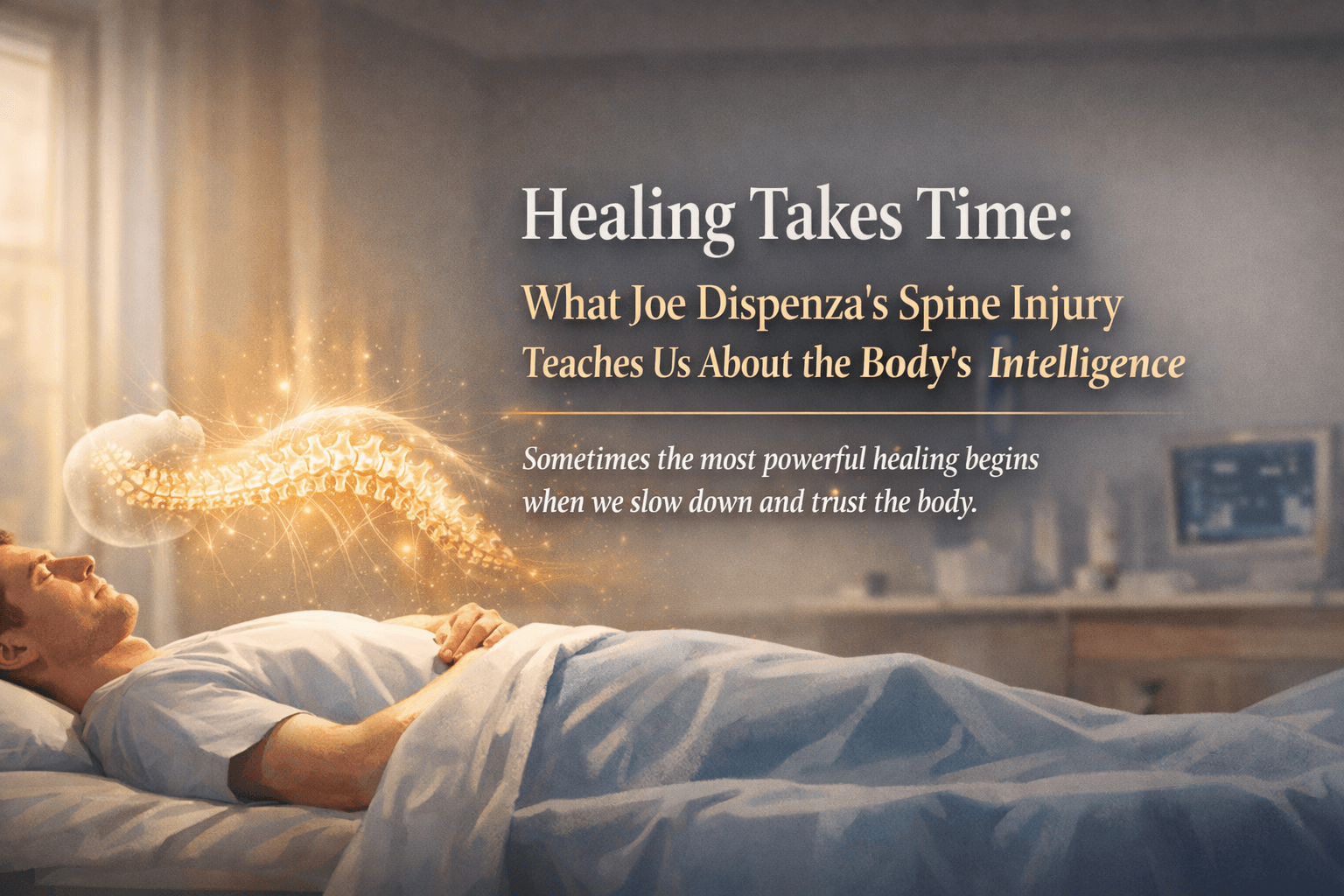
When Joe Dispenza Broke His Spine: The Lesson About Healing, Patience, and Becoming the Change
Modern health culture moves fast. Social media feeds us endless advice — new diets, new supplements, new “biohacks.” But one of the most powerful healing stories in modern wellness began with something much slower: a man lying still with a broken spine, learning to trust his body again.
The story of Joe Dispenza is not just about injury. It is about patience, self-awareness, and rediscovering the intelligence of the human body.
And in many ways, it reminds us of something we often forget in modern healthcare:
The body is not a machine to constantly patch — it is a living system designed to heal.
The Accident That Changed Everything
In 1986, during a triathlon cycling event, Joe Dispenza was struck by a car from behind.
The impact shattered several vertebrae in his spine.
Doctors diagnosed him with multiple compression fractures in his thoracic spine and recommended spinal fusion surgery, a procedure where metal rods would stabilize his spine.
But the surgery carried significant risks. It could permanently alter his mobility.
Instead of immediately accepting the procedure, he made a difficult decision:
He chose to give his body time to heal.
For weeks, he lay immobilized, unable to move normally.
No quick fix.
No instant recovery.
Just time.
The Moment He Turned Inward
During this period of forced stillness, Dispenza began doing something many people rarely do in modern life:
He shut out the noise of the outside world.
No constant advice.
No endless opinions.
Instead, he focused on one thing:
Understanding his body.
He began mentally visualizing each vertebra in his spine — imagining how it should align, how it should heal, and how the nervous system communicates with the rest of the body.
Whether people fully agree with his methods or not, one message from his experience resonates deeply:
Healing requires attention.
Not distraction.
Reference: Evolve Your Brain: The Science of Changing Your Mind
Healing Is Not Passive
Many people think healing is something that happens to them.
But Dispenza's story suggests something different:
Healing can also be something we participate in.
He spent hours each day visualizing his spine repairing itself — focusing on structure, function, and alignment.
Over time, his pain began to decrease.
His mobility slowly returned.
After months of recovery and rehabilitation, he eventually returned to normal physical activity — without undergoing the spinal surgery doctors had recommended.
But the deeper transformation was not physical.
It was mental.
The Mind–Body Connection and Spine Healing
The mind–body connection is complex and still not fully understood. Rather than thinking of it as a simple on–off switch, it may be more accurate to see it as something that influences the odds of recovery.
Take scoliosis as an example. It is fundamentally a structural and physical condition, but a person's mindset can still influence their journey. If someone feels pessimistic and believes nothing can improve, they may be less motivated to stay consistent with the habits that support recovery. On the other hand, when a person believes that improvement is possible, they are often more willing to stay engaged in their care.
Part of this relationship lies in how the body responds to mental and emotional states. Our mindset can influence physiological processes such as stress levels, nervous system activity, and inflammation. Another important factor is behavior. When patients believe their body is capable of improving, they are more likely to remain committed to their rehabilitation, whether that means practicing corrective exercises, maintaining good posture, or staying consistent with therapy.
This does not mean mindset alone can fix structural problems. However, a hopeful and proactive outlook can support the healing process and encourage the daily actions that make recovery possible.
At the end of the day, believing in the body's ability to heal does not replace proper care—but it can strengthen the journey. When we respect how the body functions and give it the right environment to recover, we are reminded that the human body is an extraordinary, living system designed to repair and adapt.
Stop Following Every Health Influencer
Today, millions of people search online for the perfect health protocol.
-
The best diet
-
The best supplement
-
The newest exercise trend
-
The latest influencer advice
But here is the uncomfortable truth:
No one understands your body better than you can learn to understand it.
Health should not be about constantly chasing the next trend.
It should start with fundamentals.
Go Back to the Fundamentals of the Human Body
Instead of endlessly patching symptoms, we must ask deeper questions:
-
How does the spine protect the nervous system?
-
How do muscles stabilize joints?
-
How does movement nourish tissues?
-
How does breathing influence the nervous system?
-
How does sleep regulate hormones and repair cells?
When we understand how organs function, healing becomes logical.
The body stops being something mysterious.
It becomes something intelligent and responsive.
Your Body Is Not an Object
Modern medicine sometimes treats the body like a machine:
Pain appears → patch it
Inflammation appears → suppress it
Degeneration appears → replace it
But the human body is not a dead object needing repair.
It is an adaptive living system.
Your bones respond to load.
Your muscles respond to use.
Your nervous system responds to awareness.
The body is constantly adjusting.
The problem is not that the body cannot heal.
Often, the problem is that we never give it the environment to do so.
Sometimes Healing Requires Shutting the World Out
One of the most powerful lessons from Dispenza's story is simple:
Sometimes you must disconnect to reconnect with yourself.
Turn off the noise.
Ignore the endless opinions.
Focus on:
-
Movement
-
Breathing
-
Sleep
-
Nutrition
-
Nervous system regulation
-
Structural health
Healing is rarely dramatic.
More often, it is quiet, slow, and deeply personal.
Be the Movement, Not Just a Follower
The world does not need more people copying health trends.
It needs people who live the fundamentals.
People who understand:
-
How their body moves
-
How their spine supports their life
-
How their habits shape their health
Your healing journey can inspire others — not because you followed a trend, but because you became the change.
Enjoy the Process of Becoming Healthier
Healing is not just about eliminating pain.
It is about rediscovering what your body is capable of.
When you slow down enough to listen to your body:
You start noticing things.
Your posture improves.
Your breathing deepens.
Your energy stabilizes.
And most importantly, you regain something modern life often takes away:
Ownership of your own health.
The Real Lesson From Joe Dispenza's Story
Whether someone agrees with all of his theories or not, the core lesson of Joe Dispenza's recovery remains powerful:
Healing is not always about doing more.
Sometimes it is about focusing deeper.
Understanding the body.
Respecting its design.
And trusting that when the fundamentals are right, the body knows how to repair itself.
Be the change.
Be the movement.
Start with the fundamentals.
Because the most powerful health transformation doesn't come from copying someone else.
It comes from understanding your own body.
Medical Disclaimer
This article is for educational purposes only and does not constitute medical advice.
Scoliosis varies significantly between individuals. Always consult a qualified healthcare professional before starting any new sport or exercise program, especially if you have scoliosis, spinal conditions, pain, or previous injuries. Participation in sports should be guided by individual assessment and professional recommendation.
The image is shared for educational purposes with patient consent. Individual outcomes vary. Structural correction does not automatically restore full respiratory function. Clinical assessment is required.
Copyright & Content Protection Notice
© 2026 All Well Scoliosis Centre. All rights reserved.
This content is original and protected by copyright law.
No part of this article may be reproduced, distributed, copied, or reused in any form without prior written permission. Unauthorized use, duplication, or content scraping is strictly prohibited.