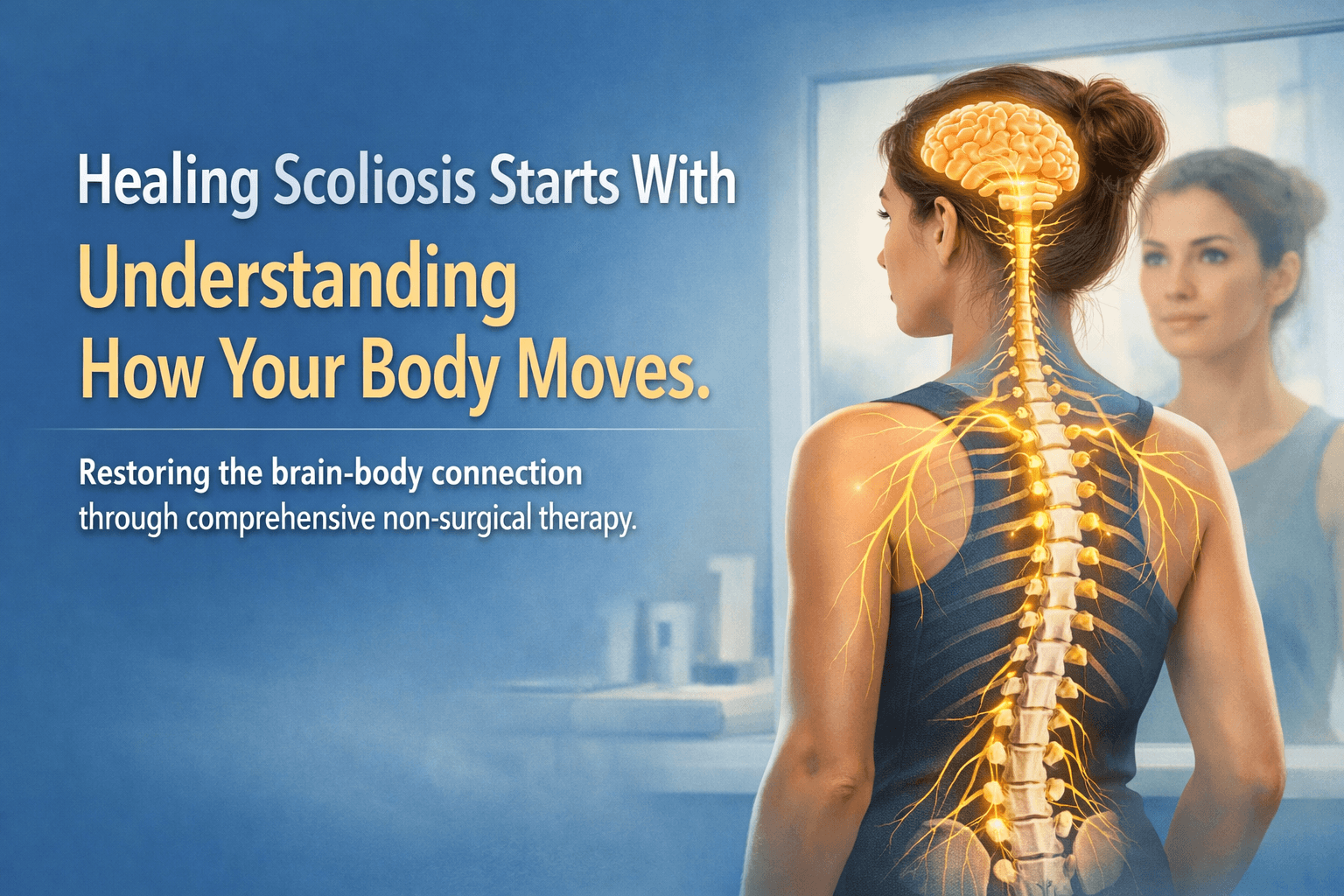
Why We Believe in Comprehensive Non-Surgical Scoliosis Therapy: Re-Educating the Brain–Body Connection
Understanding Scoliosis Beyond the Curve
Scoliosis is often misunderstood as simply a structural curve of the spine. In reality, it is a complex condition involving muscles, posture, movement patterns, and neurological control. When the spine changes shape, the body does not just adjust structurally—it adapts neurologically.
The brain continuously communicates with the body through the nervous system. When a spinal curve develops, the brain gradually learns new movement patterns to compensate for the imbalance. These compensations may help the body function temporarily, but over time they can create pain, stiffness, weakness, and further postural distortion.
This is why many practitioners who focus on long-term spinal health believe in comprehensive non-surgical scoliosis therapy. The goal is not only to address the curve but to retrain the body’s neurological control of posture and movement.
The Importance of Educating the Neuro-Muscular System
The human body is remarkably intelligent. Every movement—standing, walking, breathing, bending—is controlled by signals between the brain and muscles.
When scoliosis develops, the body often learns incorrect movement patterns. For example:
-
One side of the spine may become overactive while the other becomes weak
-
The pelvis may rotate to compensate for spinal imbalance
-
Breathing patterns may shift due to rib cage rotation
If these patterns are not corrected, the brain continues to reinforce them.
Comprehensive non-surgical therapy focuses on neuro-muscular re-education. Patients learn how to:
-
Recognize their spinal alignment
-
Activate the correct muscles
-
Improve body awareness
-
Correct posture during daily activities
Once patients understand how their body moves, correcting those patterns becomes far easier.
Pain Is the Body’s Warning System
Pain is not an enemy. Biologically, humans are given pain as a protective signal.
Pain tells us that something is wrong and that the body needs attention. When pain appears in scoliosis, it often indicates:
-
muscle imbalance
-
nerve irritation
-
joint stress
-
poor movement mechanics
Modern medicine can provide fast relief through pain medication. However, medication works primarily by numbing neurological signals. While this can be helpful for short-term relief, it does not address the underlying cause.
When the warning signal is constantly suppressed, the body may continue compensating until the problem becomes more complex.
Over time, untreated compensation patterns can lead to:
-
chronic muscle fatigue
-
joint degeneration
-
nerve compression
-
reduced mobility
The Human Tendency to Seek Quick Solutions
Human nature often gravitates toward the fastest solution. When pain becomes overwhelming, it is understandable that many patients look for immediate answers.
In modern healthcare, specialization exists because communities seek different options. Some people pursue surgery, while others search for conservative care that allows them to remain active and preserve natural spinal movement.
Neither decision should be judged lightly. Each patient walks a personal journey.
However, comprehensive non-surgical scoliosis therapy exists because many patients want alternatives before surrendering to invasive procedures.
A Real Story That Reflects the Complexity of Decisions
Not long ago, I received an email from a patient who once struggled with brace compliance and home exercises while living overseas. Feeling exhausted from daily pain medication, she eventually chose spinal fusion surgery after a surgeon assured her that it would solve her problem.
Years later, she wrote:
“After my scoliosis surgery, I thought the hardest part was behind me. I was trying to get back to normal life… until one morning on the staircase, the pain was so immense I screamed. The rods had poked through my skin. I had to rush for emergency surgery to change the metalwork. Recovery was long. Now, six years later, my posture is straight—too straight. I feel like I’m walking with a board behind me. I cannot do many activities I used to enjoy. No yoga, no extreme sports. I’m 35 now and thinking about reversal surgery. What is your opinion?”
Stories like this remind practitioners of an important truth: every treatment decision carries consequences.
The Ethical Responsibility of a Practitioner
As healthcare providers, it can be tempting to respond emotionally and say, “I told you so.”
But ethically, that is never the right response.
Patients make decisions based on the information, circumstances, and emotional state they have at the time. Pain, fear, fatigue, and hope all influence medical choices.
The only responsible response is compassion.
A practitioner can only say:
You made the best decision you could with the information you had at that moment. Life is a journey, and every step teaches us something.
There are no guarantees in medicine. Even the most established treatments cannot promise perfect outcomes.
Science Evolves, and So Do Treatment Approaches
Medical science is constantly evolving. What is considered the best option today may change as new research, technologies, and rehabilitation approaches emerge.
Comprehensive non-surgical scoliosis care continues to grow because many patients want to:
-
preserve spinal mobility
-
avoid invasive procedures
-
improve functional movement
-
build long-term strength and awareness
Instead of focusing only on structural correction, this approach emphasizes function, stability, and neurological control.
Taking Responsibility for Your Health Journey
Ultimately, every patient is responsible for the decisions they make about their body.
Before any surgery, patients must sign consent forms acknowledging potential risks and outcomes. These documents exist because every medical intervention carries uncertainty.
This reality does not mean surgery is always wrong. In some cases, it is necessary.
However, it does mean that patients deserve to understand all available options, including conservative therapy that may improve function, reduce pain, and strengthen the body’s natural support system.
Finding Peace in the Decisions We Make
Life is not purely data, statistics, or black-and-white answers. Humans evolve, and so does science.
What matters most is finding peace with the choices we make and learning from the experiences that shape our journey.
As practitioners, our role is not to force decisions—but to educate, guide, and empower patients so they can understand their bodies and take an active role in their healing process.
When patients learn how their body truly works, they gain something far more powerful than temporary relief:
They gain control over their own health.
Conservative (Non‑Surgical) Scoliosis Treatment Research
1. Comparative Efficacy of Conservative Interventions for Adolescent Idiopathic Scoliosis
Jun Ren et al. — Systematic review & network meta‑analysis of randomized controlled trials
This 2025 paper synthesizes evidence from 54 trials (nearly 4,000 participants) assessing different conservative interventions (brace + PSSE, manual therapy, mind‑body exercise) and finds moderate evidence for benefits in Cobb angle and functional outcomes — with no serious adverse events from conservative care.
Citation:
Ren J, Wang S, Li M, et al. Comparative efficacy of conservative interventions for adolescent idiopathic scoliosis: a systematic review and network meta‑analysis. Syst Rev. 2025;14:156. doi:10.1186/s13643‑025‑02893‑1.
2. Conservative Treatment of Adolescent Idiopathic Scoliosis: Effectiveness of Bracing & SEAS Exercise
Trofimchuk et al. — Journal of Orthopaedic Surgery and Research
This 2025 study showed that rigid bracing combined with Scientific Exercise Approach to Scoliosis (SEAS) can significantly reduce curve progression and improve function and self‑perception among patients, highlighting the value of personalized conservative management.
Citation:
Trofimchuk V, Atepileva A, Karibzhanova D, et al. Conservative treatment of adolescent idiopathic scoliosis: the effectiveness of rigid bracing. J Orthop Surg Res. 2025;20:464. doi:10.1186/s13018‑025‑05743‑x.
3. Digital Physiotherapeutic Scoliosis‑Specific Exercises (PSSE)
This randomized clinical trial found that a digitally supported home‑based PSSE program reduced the Cobb angle more effectively than conventional PSSE, supporting tailored exercise as a viable conservative strategy.
Citation:
Digital Physiotherapeutic Scoliosis‑Specific Exercises for Adolescent Idiopathic Scoliosis: A Randomized Clinical Trial. JAMA Netw Open. 2024;7(10):e2830349.
4. Research Quality in Scoliosis Conservative Treatment: State of the Art
A foundational literature review examining conservative treatment research quality, noting early RCTs supporting bracing and scoliosis‑specific exercise over observation.
Citation:
Zaina F, Romano M, et al. Research quality in scoliosis conservative treatment: state of the art. Scoliosis & Spinal Disorders. 2015;10:21.
🧠 Surgical Outcome & Risk References
5. Operative vs Nonoperative Treatment for Adult Symptomatic Lumbar Scoliosis (5‑Year Follow‑Up)
Justin S Smith et al. — J Neurosurg Spine (NIH‑sponsored study)
This major 5‑year study compared surgical vs non‑operative approaches for adult scoliosis. While surgery achieved greater functional improvements and Cobb correction, the study also documented substantial rates of serious adverse events over time — important data for patient decision‑making.
Citation:
Smith JS, Kelly MP, Yanik EL, et al. Operative versus nonoperative treatment for adult symptomatic lumbar scoliosis at 5‑year follow‑up. J Neurosurg Spine. 2021;35(1):67‑79. doi:10.3171/2020.9.SPINE201472.
6. Long‑Term Outcomes of Spinal Fusion in Adolescent Idiopathic Scoliosis
Pishnamaz M, Migliorini F, et al.
This published literature review summarizes long‑term results of spinal fusion surgery in AIS patients, including outcomes and complications, providing context for surgical decision trade‑offs.
Citation:
Pishnamaz M, Migliorini F, Blume C, et al. Long‑term outcomes of spinal fusion in adolescent idiopathic scoliosis: a literature review. Eur J Med Res. 2024;29:534.
7. Failure of Nonoperative Care in Adult Scoliosis and Risk for Surgery
This observational cohort study tracked nonoperative adults with scoliosis and analyzed factors predicting crossover to surgery, demonstrating that many patients linked lower quality‑of‑life scores with eventual surgical treatment.
Citation:
Clohisy JC, Smith JS, Kelly MP, et al. Failure of nonoperative care in adult symptomatic lumbar scoliosis: incidence, timing, and risk factors for conversion to surgery. Spine. 2023;39(4):498‑508. doi:10.3171/2023.5.SPINE2326.
Keywords:
scoliosis lifestyle, scoliosis and muscle weakness, scoliosis surgery risk, spinal stability scoliosis, scoliosis posture correction, scoliosis progression prevention, scoliosis patient stories, conservative scoliosis treatment
Medical Disclaimer
This article is for educational purposes only and does not constitute medical advice.
Scoliosis varies significantly between individuals. Always consult a qualified healthcare professional before starting any new sport or exercise program, especially if you have scoliosis, spinal conditions, pain, or previous injuries. Participation in sports should be guided by individual assessment and professional recommendation.
The image is shared for educational purposes with patient consent. Individual outcomes vary. Structural correction does not automatically restore full respiratory function. Clinical assessment is required.
Copyright & Content Protection Notice
© 2026 All Well Scoliosis Centre. All rights reserved.
This content is original and protected by copyright law.
No part of this article may be reproduced, distributed, copied, or reused in any form without prior written permission. Unauthorized use, duplication, or content scraping is strictly prohibited.