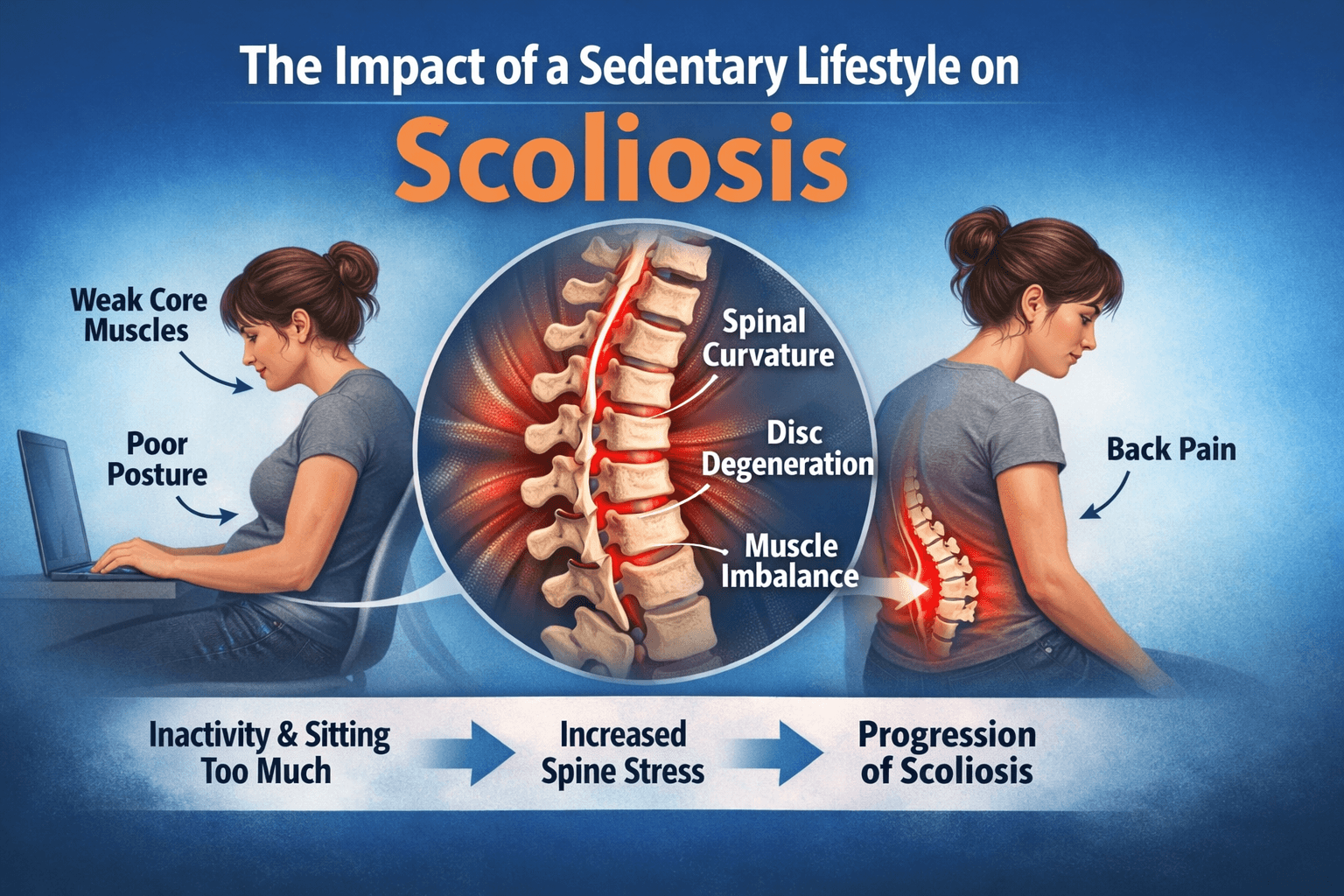
The Impact of a Sedentary Lifestyle on Scoliosis
Living with scoliosis requires more than just monitoring spinal curvature—it demands an active, well-balanced lifestyle. A sedentary lifestyle, combined with poor nutrition, can significantly worsen scoliosis progression and overall spinal health.
How a Sedentary Lifestyle Affects the Spine
A lack of movement weakens the core muscles that support the spine, directly affecting spinal alignment. When these muscles are underused, they lose strength and stability, allowing the spinal curve to progress more easily. Over time, this can lead to increased back pain, reduced mobility, and a higher risk of degenerative changes such as disc desiccation.
Muscle Imbalances and Spinal Instability
Inactivity contributes to muscle imbalances, where certain muscle groups become tight while others weaken. These uneven forces act on the spine, pulling it further out of alignment. Without proper muscular support, the spine becomes less stable, increasing the likelihood of curve progression and discomfort.
The Hidden Risk: Being Too Underweight
While much attention is often placed on excess weight, being too skinny can be equally harmful for scoliosis patients.
When the body lacks adequate muscle mass, it cannot provide the structural support needed to stabilize the spine. Muscle plays a critical role in holding the spine upright and maintaining alignment. Without it, the spine is more vulnerable to worsening curvature.
This is especially concerning in teenagers, where growth demands higher nutritional intake.
Low Protein Intake and Poor Muscle Development
Many adolescents with scoliosis struggle to meet even the minimum protein intake required for healthy muscle development. Protein is essential for:
-
Building and repairing muscle tissue
-
Supporting bone health
-
Maintaining overall strength and posture
Without sufficient protein, the body cannot build the muscle support system needed to protect the spine. This leads to weaker postural control and increases the risk of scoliosis progression.
Loss of Appetite in Scoliosis Patients
A growing concern in clinical practice is patients with poor appetite, especially those with more pronounced spinal curves.
In some cases, scoliosis affecting the lower spine (lumbar region) may contribute to:
-
Pressure on the stomach and intestines
-
Reduced appetite
-
Digestive discomfort
When patients eat less due to discomfort, it creates a cycle of poor nutrition, muscle loss, and reduced spinal support—further worsening their condition.
Core Strength and Postural Stability
A strong core is essential for maintaining spinal alignment. The core muscles—including the abdominals, obliques, and lower back—act as a natural brace for the spine.
Regular, targeted exercise helps:
-
Improve posture
-
Enhance spinal stability
-
Reduce muscle imbalances
-
Support long-term scoliosis management
Without consistent activity, patients often develop poor posture habits, making it harder for the spine to stay aligned.
Weight Balance: Not Too Much, Not Too Little
Optimal scoliosis care is not just about weight loss or gain—it is about balance.
-
Excess weight increases spinal load
-
Insufficient weight reduces muscular support
Maintaining a healthy body composition with adequate muscle mass is key to protecting the spine.
Early Detection and Lifestyle Intervention
Early detection of scoliosis allows for timely intervention. Combining proper monitoring with:
-
Structured exercise programs
-
Adequate nutrition
-
Postural awareness
can significantly slow progression and improve quality of life.
Finding the Right Approach
Every scoliosis case is different. A personalized program that includes movement, nutritional guidance, and posture correction is essential.
The goal is not just to treat the curve—but to strengthen the body’s ability to support and stabilize the spine naturally.
Conclusion
A sedentary lifestyle, combined with poor nutrition and low muscle mass, can accelerate scoliosis progression.
Too little movement weakens the spine.
Too little nutrition prevents the body from building the support it needs.
For scoliosis patients, especially teenagers, staying active and eating well is not optional—it is essential.
Building strength, maintaining a healthy weight, and ensuring proper nutrient intake are the foundations of long-term spinal health.
Keywords:
scoliosis sedentary lifestyle, scoliosis and muscle weakness, underweight scoliosis risk, protein intake scoliosis, scoliosis teenagers nutrition, spinal stability scoliosis, scoliosis posture correction, scoliosis progression prevention
Medical Disclaimer
This article is for educational purposes only and does not constitute medical advice.
Scoliosis varies significantly between individuals. Always consult a qualified healthcare professional before starting any new sport or exercise program, especially if you have scoliosis, spinal conditions, pain, or previous injuries. Participation in sports should be guided by individual assessment and professional recommendation.
The image is shared for educational purposes with patient consent. Individual outcomes vary. Structural correction does not automatically restore full respiratory function. Clinical assessment is required.
Copyright & Content Protection Notice
© 2026 All Well Scoliosis Centre. All rights reserved.
This content is original and protected by copyright law.
No part of this article may be reproduced, distributed, copied, or reused in any form without prior written permission. Unauthorized use, duplication, or content scraping is strictly prohibited.