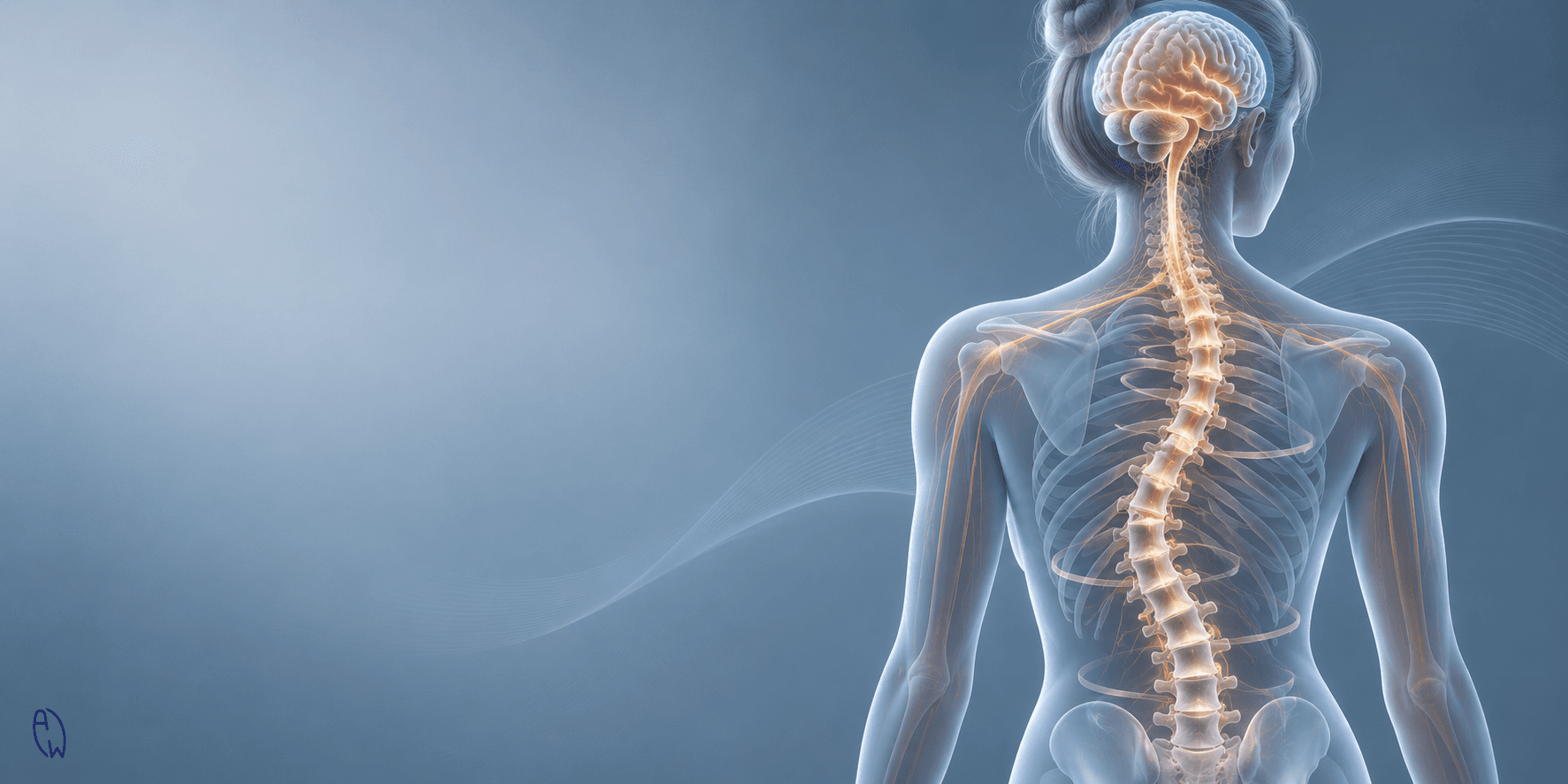
Why Do I Feel Crooked Even When I Stand Straight? Understanding the Brain–Spine Connection
Your eyes may tell you that you are standing straight, but your brain may be telling you something different. Here's why.
Have you ever stood in front of a mirror, straightened your shoulders and adjusted your hips, yet still felt that your body was leaning to one side?
This is a surprisingly common experience among people with scoliosis.
Most people think scoliosis is simply a problem with the shape of the spine. But there is much more happening beneath the surface.
Your spine does not work independently of your brain. Your brain constantly receives information from your eyes, inner ear, muscles and joints to understand where your body is in space.
This is where the connection between scoliosis, proprioception and body awareness becomes important.
1. Your spine is more than a collection of bones
Think of your spine as the central support structure of your body. It allows you to stand, bend and rotate while protecting an important part of your nervous system.
The spinal cord travels through the spinal canal, carrying information between the brain and the rest of the body. Nerve roots branch out to communicate with muscles and other structures.
This means the spine has two important roles:
-
Structural: Supporting the body and distributing mechanical loads.
-
Neurological: Protecting the spinal cord and providing a pathway for communication between the brain and body.
This is why understanding spinal health requires more than looking at an X-ray. We also need to consider how the nervous system coordinates movement, posture and balance.
2. Why do you feel crooked even when you stand straight?
The answer may lie in something called proprioception.
Proprioception is your body's ability to sense its position and movement without having to look at it.
For example, you can close your eyes and still know whether your arm is raised or lowered. You can walk without constantly looking at your feet.
Your brain achieves this by processing information from several systems:
-
Visual system: Helps you understand your position in relation to your surroundings.
-
Vestibular system: Located in the inner ear, it helps detect head movement, gravity and orientation.
-
Proprioceptive system: Provides information from muscles, tendons and joints about body position and movement.
Together, these systems help your brain understand where your body is positioned.
Now imagine someone who has lived with scoliosis for several years.
Their spinal alignment, trunk rotation, muscle activity and weight distribution may have gradually changed. Their nervous system continuously receives information from this altered physical environment.
Consequently, the position that feels normal to them may not necessarily look symmetrical.
When they consciously attempt to straighten themselves, they may feel uncomfortable or as though they are leaning in the opposite direction.
What feels straight and what looks straight are not always the same thing.
Research has identified differences in proprioception and postural control in some individuals with adolescent idiopathic scoliosis (AIS). However, these findings do not mean that everyone with scoliosis has a neurological disorder.
3. What does research tell us about the brain and scoliosis?
The relationship between scoliosis and the nervous system has been investigated in several scientific studies.
A 2022 systematic review and meta-analysis, Timely Revisit of Proprioceptive Deficits in Adolescent Idiopathic Scoliosis, examined 11 case-control studies involving 1,121 participants.
The researchers found that adolescents with idiopathic scoliosis demonstrated greater proprioceptive difficulties than individuals without scoliosis.
Another systematic review published in PLOS ONE in 2024, Neurophysiological, Balance and Motion Evidence in Adolescent Idiopathic Scoliosis, examined neurological function, balance and movement.
The research discussed differences involving:
-
Sensory integration.
-
Postural control.
-
Balance regulation.
-
Movement coordination.
These findings suggest that scoliosis may involve more than structural changes to the spine.
However, researchers have not established whether these neurological differences contribute to scoliosis development, develop as a consequence of the spinal deformity, or involve both processes.
The relationship is still being investigated.
4. Why simply looking in the mirror cannot correct scoliosis
One of the biggest misconceptions about scoliosis is that correcting it simply means making both shoulders level, aligning the hips and standing symmetrically.
But scoliosis is a three-dimensional spinal deformity involving:
Lateral curvature: The spine bends sideways.
Vertebral rotation: The vertebrae rotate around their own axes, contributing to rib prominence and trunk asymmetry.
Sagittal changes: The natural front-to-back spinal curves, including thoracic kyphosis and lumbar lordosis, may also change.
This explains why someone may look relatively straight from the front but still have noticeable trunk rotation when viewed from behind.
A mirror provides visual feedback, but it cannot independently tell you whether you have corrected the underlying three-dimensional spinal pattern.
Pulling one shoulder backwards or shifting the pelvis may improve appearance temporarily without addressing the underlying rotation.
The objective is not simply to look straight. It is to understand and control your individual three-dimensional spinal alignment.
5. Why scoliosis-specific exercises are different from ordinary posture exercises
Not every crooked posture is scoliosis.
Postural asymmetry can result from habitual positioning, muscle imbalance, pelvic asymmetry or other functional factors. Structural scoliosis requires a different assessment.
For someone with structural scoliosis, simply strengthening the weaker-looking side or stretching the tighter-looking side may not address the specific curve pattern.
This is why scoliosis-specific exercises, known as Physiotherapeutic Scoliosis-Specific Exercises (PSSE), are important.
Two recognised approaches are Schroth and ScoliBalance®.
Schroth method
The Schroth method uses individualised exercises designed around the patient's spinal curve pattern.
Its principles include:
-
Three-dimensional postural correction.
-
Rotational angular breathing.
-
Muscle activation and elongation.
-
Stabilisation of the corrected position.
ScoliBalance®
ScoliBalance is a scoliosis-specific exercise programme developed by Dr Jeb McAviney and the ScoliCare team.
It focuses on helping patients understand and practise their individual three-dimensional correction strategy.
Patients learn to:
-
Recognise their spinal curve and trunk rotation.
-
Understand the direction of their individual correction.
-
Coordinate breathing with corrective positioning.
-
Activate the muscles needed to maintain correction.
-
Incorporate their correction into everyday activities.
Both approaches aim to improve postural awareness and active three-dimensional correction, although their teaching frameworks and exercise strategies differ.
The important principle is that scoliosis exercises should be individualised.
Two people may have completely different curve patterns. A correction appropriate for one patient may not be appropriate for another.
6. Why breathing matters in scoliosis correction
Breathing is often overlooked in spinal rehabilitation.
In thoracic scoliosis, vertebral rotation can change the shape of the rib cage and affect how different areas of the chest expand.
Scoliosis-specific breathing techniques aim to encourage directed rib cage expansion while maintaining a corrected posture.
In the Schroth method, this is known as rotational angular breathing.
Breathing is not treated as an isolated exercise. It is coordinated with three-dimensional correction.
The goal is to help patients maintain their corrective position while performing everyday activities such as sitting, standing, walking and breathing.
7. Why I chose spinal rehabilitation as my speciality
My interest in spinal rehabilitation comes from understanding that scoliosis management should not begin and end with the question of whether someone needs surgery.
The spine is an extraordinary structure. It supports the body, protects the nervous system and allows us to move through life.
I chose to specialise in spinal rehabilitation because I believe in the value of recognising spinal problems early, understanding their individual characteristics and providing appropriate conservative management.
This does not mean every case can avoid surgery. Some curves continue to progress despite appropriate treatment, and surgery remains necessary for certain patients.
However, early identification, appropriate monitoring, evidence-based bracing and scoliosis-specific rehabilitation can play an important role in managing selected patients and reducing the risk of progression.
I also believe patients should understand their own bodies.
They should know why their spine curves in a particular direction, why their trunk rotates and how to perform their corrective exercises correctly.
A patient who understands their correction becomes an active participant in their rehabilitation, rather than simply relying on someone else to correct their posture.
8. How CLEAR, ScoliBrace and ScoliBalance complement one another
At All Well Scoliosis Centre, we believe scoliosis management requires an individualised approach rather than relying on one treatment modality.
Our approach incorporates different methods that address different aspects of scoliosis.
CLEAR Institute protocol
CLEAR combines scoliosis-specific chiropractic procedures, positioning, mechanical techniques and neuromuscular rehabilitation.
Its Mix-Fix-Set framework includes preparation, individually selected corrective procedures and active rehabilitation.
ScoliBrace®
ScoliBrace is a customised three-dimensional corrective brace designed around the patient's individual spinal curve and trunk rotation.
It provides external corrective forces to help manage spinal progression, particularly in growing patients.
ScoliBalance®
ScoliBalance focuses on teaching patients individualised corrective exercises, postural awareness, breathing coordination and active muscular control.
These approaches have different roles. Bracing provides external support, rehabilitation develops active control, and CLEAR incorporates additional mechanical and neuromuscular treatment strategies.
When clinically appropriate, these methods can be combined as part of an individualised treatment plan.
It is important to recognise that the evidence supporting each component varies, and research on a combined programme does not automatically establish the effectiveness of every individual treatment.
Frequently Asked Questions
1. Why do I feel like I am leaning to one side even when I stand straight?
Your brain uses information from your eyes, inner ear, muscles and joints to understand your body position. Changes in spinal alignment, muscle activity and sensory feedback may influence how you perceive your posture.
2. Can scoliosis affect balance?
Research has identified differences in proprioception and postural stability in some people with scoliosis. However, not everyone experiences balance difficulties.
3. Can scoliosis affect the nervous system?
The spine protects the spinal cord and nerve roots. Research has also identified differences in sensory processing and postural control in some people with AIS. This does not mean uncomplicated scoliosis automatically involves nerve damage.
4. Why can't I correct my scoliosis by looking in the mirror?
A mirror provides visual feedback, but scoliosis involves three-dimensional changes, including vertebral rotation. Making your shoulders and hips look symmetrical does not necessarily correct the underlying spinal pattern.
5. Is ScoliBalance better than Schroth?
Both are individualised scoliosis-specific exercise approaches. They use different teaching frameworks, and there is insufficient direct comparative evidence to establish that one is universally superior.
6. Can scoliosis-specific exercises prevent surgery?
Exercises may improve postural control, function and other clinical outcomes. When combined with appropriate bracing in selected growing patients, conservative management can help control curve progression. However, no exercise programme guarantees that surgery will never be necessary.
The Bigger Picture: Scoliosis Is More Than a Crooked Spine
When someone tells me, "I feel crooked even though I am standing straight," I think it is important to look beyond what we can see.
We need to understand what the spine is doing, how the muscles are responding and how the brain interprets information from the body.
Scoliosis is a three-dimensional condition. Managing it requires more than asking someone to stand straight or strengthen their back.
It requires an understanding of spinal structure, rotation, breathing, movement and body awareness.
At All Well Scoliosis Centre, our philosophy is to help patients understand their individual spinal condition and actively participate in their rehabilitation.
Because the ultimate goal is not simply to look straighter in a mirror.
It is to understand your body, develop better control of your movement and learn how to manage your spine throughout life.
Scientific References
-
Lau, K. K. L., et al. (2022). Timely Revisit of Proprioceptive Deficits in Adolescent Idiopathic Scoliosis: A Systematic Review and Meta-Analysis. Global Spine Journal. DOI: 10.1177/21925682211066824.
-
Neurophysiological, Balance and Motion Evidence in Adolescent Idiopathic Scoliosis: A Systematic Review. (2024). PLOS ONE, 19(5), e0303086. DOI: 10.1371/journal.pone.0303086.
-
Simoneau, M., et al. (2006). Altered Sensory-Weighting Mechanisms Is Observed in Adolescents with Idiopathic Scoliosis. Experimental Brain Research.
-
Marchese, R., Du Plessis, J., Pooke, T., & McAviney, J. (2024). The Improvement of Trunk Muscle Endurance in Adolescents with Idiopathic Scoliosis Treated with ScoliBrace® and the ScoliBalance® Exercise Approach. Journal of Clinical Medicine, 13(3), 653. DOI: 10.3390/jcm13030653.
-
Morningstar, M. W., Woggon, D., & Lawrence, G. (2004). Scoliosis Treatment Using a Combination of Manipulative and Rehabilitative Therapy: A Retrospective Case Series. BMC Musculoskeletal Disorders, 5, 32. DOI: 10.1186/1471-2474-5-32.
-
Woggon, D., et al. (2015). Patient-Reported Side Effects Immediately After Chiropractic Scoliosis Treatment. Scoliosis and Spinal Disorders. DOI: 10.1186/s13013-015-0053-8.
-
Nalda, A., Mirenzi, R., Doueihi, N., & McAviney, J. (2025). A Non-Surgical Multimodal Approach to Severe Thoracic Adolescent Idiopathic Scoliosis Combining ScoliBrace and Scoliosis-Specific Rehabilitation Therapies: A Case Series. Healthcare, 13, 1522.