Why Do Some People With Scoliosis Have Poor Balance?
Understanding the Hidden Connection Between the Spine, Brain, and Balance System
Many people think scoliosis is simply a sideways curvature of the spine. However, for some individuals, scoliosis can affect much more than posture. Patients frequently report symptoms such as:
-
Feeling unsteady when walking
-
Frequent tripping or stumbling
-
Dizziness or lightheadedness
-
Motion sickness
-
Poor coordination
-
Fear of falling
-
Difficulty standing on one leg
-
Feeling "crooked" even after treatment
These symptoms often leave patients wondering:
"Why does my balance feel off?"
The answer may involve a complex interaction between the spine, muscles, joints, eyes, inner ear, and brain.
Balance Is More Than Just Strong Muscles
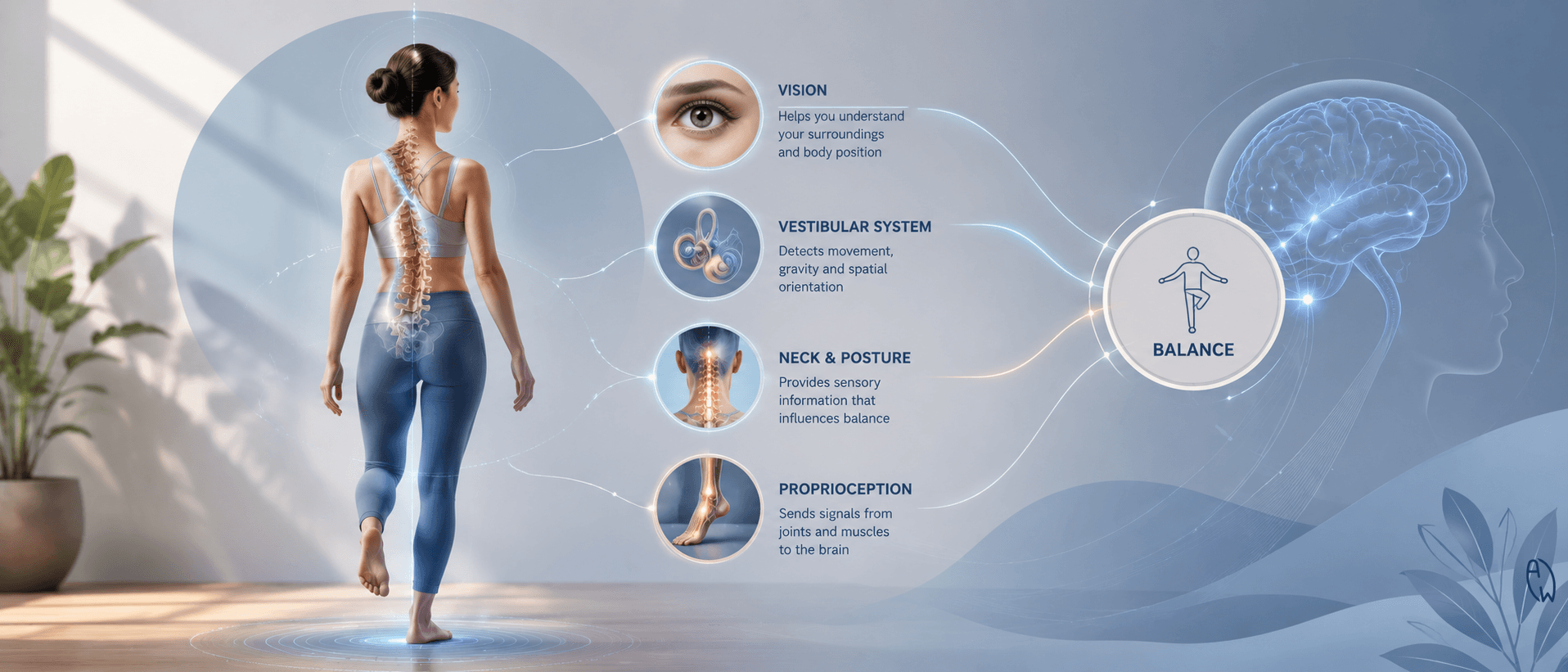
Many people assume balance depends primarily on muscle strength. While strength is important, balance actually depends on three major systems working together:
1. Vision
Your eyes provide information about your environment and body position.
2. Vestibular System
Located in the inner ear, this system detects head movement, gravity, and spatial orientation.
3. Proprioception
Often called the body's "sixth sense," proprioception tells your brain where your joints and muscles are positioned without needing to look.
The brain continuously combines information from all three systems to keep you upright and stable.
When one system becomes less reliable, the brain must work harder to compensate.
For some people with scoliosis, several of these systems can be affected simultaneously.
How Scoliosis Changes Your Center of Gravity
A healthy spine helps distribute body weight evenly.
In scoliosis, the spine bends and rotates, causing the body's center of gravity to shift.
Instead of the head, shoulders, ribs, pelvis, and legs stacking evenly over each other, the body must constantly make adjustments to stay upright.
This creates a chain reaction of compensations throughout the body.
Over time, these compensations can affect balance, coordination, and movement efficiency.
Imagine trying to balance a tower of blocks that is leaning to one side. The tower can remain standing, but it requires constant adjustments.
Your nervous system faces a similar challenge every day.
The Hidden Role of Proprioception
One of the most overlooked aspects of scoliosis is its effect on proprioception.
Proprioception allows you to know where your body is in space without looking.
For example:
-
Walking in the dark
-
Climbing stairs
-
Reaching for an object
-
Standing on one leg
All rely heavily on proprioceptive feedback.
Why Proprioception Can Be Altered in Scoliosis
When the spine curves and rotates:
-
Joints become asymmetrical
-
Muscles pull unevenly
-
Ligaments experience unequal tension
-
Weight distribution changes
As a result, sensory receptors throughout the body send altered information to the brain.
The brain receives a less accurate "map" of body position.
This can create:
-
Unsteadiness
-
Clumsiness
-
Poor coordination
-
Increased sway while standing
The larger the curve and the longer it has existed, the more the nervous system may adapt to these altered signals.
Muscular Imbalances Can Affect Stability
Scoliosis creates predictable muscular asymmetries.
Typically:
-
Muscles on the convex side become tight and overworked
-
Muscles on the concave side become weaker and less active
The body develops compensation patterns to keep itself upright.
What Happens Over Time?
As scoliosis progresses:
-
Some muscles become chronically fatigued
-
Core stability decreases
-
Movement becomes less efficient
-
Balance reactions become slower
The muscles responsible for stabilizing the trunk can no longer work together as effectively.
This increases the effort required simply to maintain posture.
Many adults with scoliosis report feeling exhausted after standing for long periods because their muscles are constantly working harder than necessary.
Can Scoliosis Affect the Vestibular System?
The vestibular system is located in the inner ear and helps detect:
-
Head movement
-
Acceleration
-
Gravity
-
Spatial orientation
It works closely with the eyes and neck to maintain balance.
Researchers have long been interested in the relationship between scoliosis and vestibular function because some patients experience:
-
Dizziness
-
Motion sickness
-
Poor balance
-
Spatial disorientation
While scoliosis does not directly cause inner ear disease, severe postural distortions and long-term compensation patterns may interfere with how vestibular information is processed.
Some studies have suggested that vestibular asymmetries may contribute to postural abnormalities, while others propose that spinal deformities may alter how vestibular signals are interpreted by the brain.
The relationship is complex and likely differs from person to person.
Why Neck Posture Matters
Many scoliosis patients develop forward head posture or altered neck alignment.
The neck contains thousands of sensory receptors that help the brain determine:
-
Head position
-
Body orientation
-
Movement direction
These receptors work closely with the vestibular system and visual system.
When neck posture changes significantly:
-
Sensory input becomes altered
-
Balance processing may become less efficient
-
Dizziness can become more noticeable
This is one reason some patients experience:
-
Neck tension
-
Headaches
-
Poor balance
-
Motion sensitivity
The neck acts as an important bridge between the spine and the balance system.
The Connection Between Vision and Scoliosis
Balance is heavily influenced by vision.
The brain constantly compares visual information with signals coming from the vestibular and proprioceptive systems.
If posture becomes asymmetrical, the visual system may adapt.
Some patients unconsciously tilt their heads or shift eye position to compensate for body asymmetry.
Over time, the brain may learn to accept these altered visual references as "normal."
When posture begins changing through treatment, the visual system may need time to readjust.
This is one reason why some people feel temporarily "off" during periods of postural correction.
Brain Adaptation: The Nervous System Learns Your Curve
One fascinating concept is neuroplasticity.
Neuroplasticity refers to the brain's ability to adapt and create new neural pathways.
If someone has lived with scoliosis for years, the brain gradually learns that curved posture as normal.
The nervous system develops movement patterns around the spinal curve.
The brain effectively creates a customized operating system for that body.
When posture changes through:
-
Rehabilitation
-
Bracing
-
Exercise
-
Surgery
the brain must update its internal map.
This process can take time.
Some patients report:
-
Temporary balance changes
-
Feeling uneven despite straighter posture
-
Coordination challenges
-
Motion sensitivity
These experiences may reflect the brain adapting to new body mechanics.
Why Some People With Scoliosis Experience Motion Sickness
Motion sickness occurs when the brain receives conflicting information from:
-
Vision
-
Vestibular system
-
Proprioceptive system
For example:
Your eyes may tell your brain one thing while your inner ear reports something different.
If proprioceptive feedback is already less precise because of scoliosis-related asymmetries, sensory conflict may increase.
This could help explain why some scoliosis patients report:
-
Car sickness
-
Seasickness
-
Sensitivity to amusement rides
-
Dizziness during movement
Not everyone with scoliosis experiences motion sickness, but it appears more common in certain individuals.
The Link Between Scoliosis and Falls Risk
Falls become increasingly important as people age.
This is particularly relevant for adults with scoliosis and degenerative scoliosis.
Several factors can increase fall risk:
-
Altered center of gravity
-
Poor proprioception
-
Vestibular changes
-
Reduced muscle strength
-
Chronic pain
-
Fatigue
-
Slower reaction times
When multiple systems become less efficient simultaneously, maintaining balance becomes much more challenging.
For older adults, a single fall can lead to:
-
Fractures
-
Hospitalization
-
Reduced independence
-
Loss of confidence
This is why balance assessment is often just as important as measuring the Cobb angle.
Why Pain and Fatigue Make Balance Worse
Pain demands attention.
When the brain is constantly processing discomfort, fewer resources remain available for:
-
Postural control
-
Movement planning
-
Balance reactions
Fatigue compounds the problem.
Muscles that are already compensating for spinal asymmetry become less responsive when tired.
Many patients notice:
-
More stumbling late in the day
-
Increased unsteadiness after prolonged standing
-
Poorer balance during periods of stress or fatigue
This is not simply a muscle problem.
It is a whole nervous system problem.
Can Balance Improve?
In many cases, yes.
Improving balance often involves addressing multiple systems simultaneously:
Spinal Alignment
Reducing abnormal loading patterns may improve body mechanics.
Proprioceptive Training
Exercises can help the brain develop a more accurate body map.
Vestibular Rehabilitation
Specific exercises may improve balance and motion sensitivity.
Neck Posture Correction
Optimizing cervical alignment may improve sensory integration.
Strength and Stability Training
Building stronger stabilizing muscles supports more efficient movement.
Consistent Movement Practice
Repetition helps the brain create new motor patterns through neuroplasticity.
The goal is not simply to strengthen muscles but to improve communication between the brain and body.
Final Thoughts
Poor balance in scoliosis is often much more than a spinal issue.
The spine, muscles, joints, eyes, vestibular system, and brain work together as a single integrated system. When scoliosis alters posture and movement, the nervous system must continuously adapt.
For some people, this adaptation works remarkably well. For others, symptoms such as dizziness, motion sickness, poor coordination, and increased falls risk may appear.
Understanding these connections helps explain why balance problems can occur even when muscle strength seems normal.
Scoliosis is not always just a story about bones and curves—it is also a story about how the brain interprets the body and how the body navigates the world around it.