Why Is Scoliosis Three-Dimensional? Understanding the True Nature of the Spine
When most people think of scoliosis, they picture a spine that bends sideways.
While that image is familiar, it only tells part of the story.
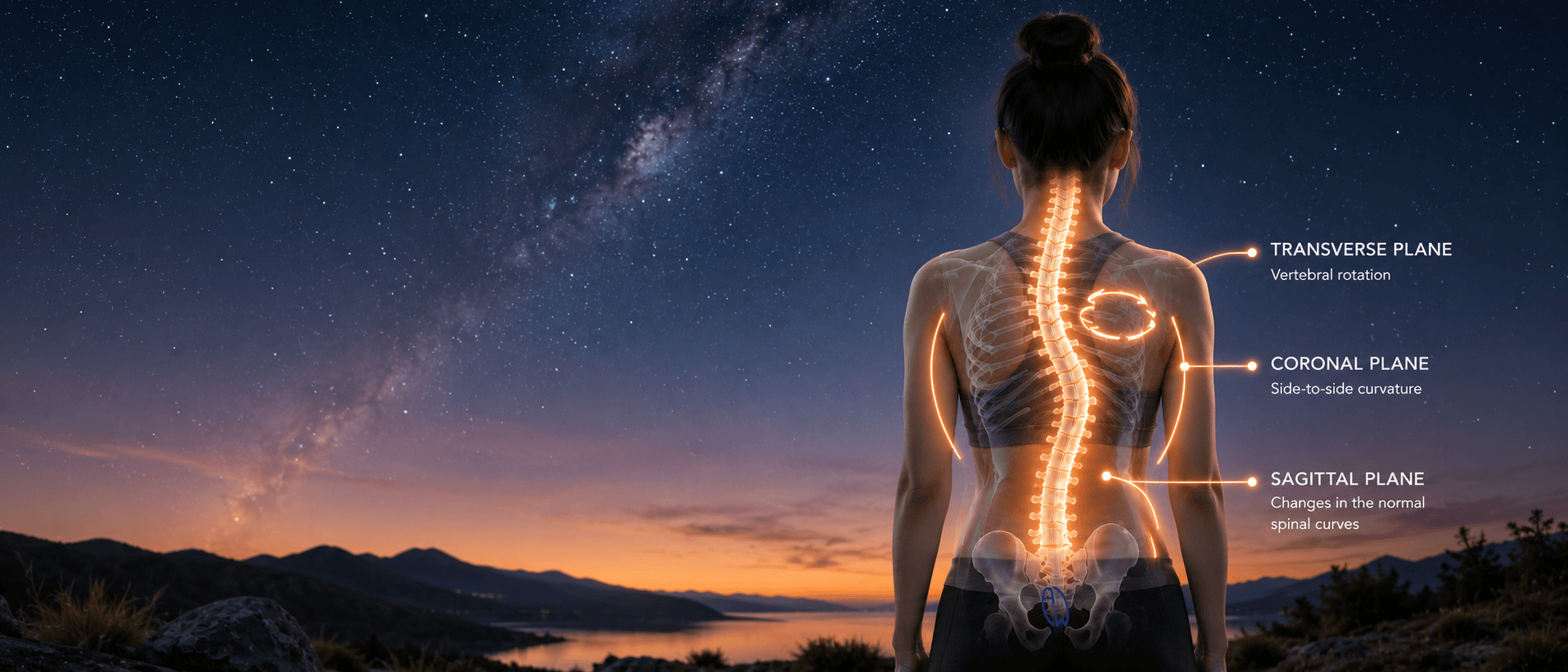
Scoliosis is actually a three-dimensional (3D) condition. The spine doesn't simply curve from left to right—it also twists around itself and changes its natural front-to-back alignment. These combined changes create the visible body asymmetry commonly seen in scoliosis, such as uneven shoulders, a rib hump, and an uneven waistline.
Understanding scoliosis as a three-dimensional condition has transformed how healthcare professionals diagnose, monitor, and manage spinal curves. Today, specialists know that successful scoliosis care requires addressing all three dimensions of the spine—not just the sideways curve seen on an X-ray.
The Spine Is Naturally a Three-Dimensional Structure
The human spine was never designed to be a perfectly straight column.
Instead, it is a dynamic three-dimensional structure that provides stability, flexibility, shock absorption, and balance. Every movement we make—walking, bending, twisting, lifting, or even breathing—depends on the spine functioning properly in three anatomical planes.
A healthy spine maintains balance in all three planes simultaneously.
When scoliosis develops, it disrupts each of them.
The Three Anatomical Planes of Scoliosis
1. Coronal (Frontal) Plane – The Sideways Curve
The coronal plane is the view most people are familiar with.
The coronal plane is named after the coronal suture of the skull, which is the line where the frontal and parietal bones grow together.
"Coronal" comes from the Latin word corona, meaning "crown" or "garland". The plane runs parallel to this suture, essentially marking the line where a crown would sit on someone's head. It divides the body into front (anterior) and back (posterior) sections.
Looking at the spine from behind, scoliosis appears as a sideways curve that may resemble a "C" or an "S" shape.
This is the dimension measured using the Cobb angle, which remains the international standard for diagnosing and monitoring scoliosis.
Generally, scoliosis is classified as:
Cobb Angle Classification
10°–20° – >> Mild
20°–40° – >> Moderate
Over 40°– >> Severe
The Cobb angle is extremely useful for monitoring curve progression.
However, it only measures the spine in one plane.
It does not tell us how much the spine has rotated or whether its normal front-to-back curves have changed.
2. Sagittal Plane – The Loss of Natural Spinal Curves
The sagittal plane is a vertical, front-to-back divider that slices the body into left and right sections. It is considered "the plane" of primary locomotion because it facilitates the forward and backward movements we use most, such as walking, running, lunging, and squatting.
When viewed from the side, a healthy spine naturally forms gentle curves that help distribute body weight efficiently.
These include:
-
Cervical lordosis (neck)
-
Thoracic kyphosis (mid-back)
-
Lumbar lordosis (lower back)
These curves function like a suspension system, helping the spine absorb forces during everyday activities.
In many people with scoliosis, these natural curves become altered.
Common findings include:
-
Reduced thoracic kyphosis (hypokyphosis)
-
Flattening of the upper back
-
Reduced lumbar lordosis
-
Poor weight distribution
-
Reduced spinal flexibility
Rather than maintaining its healthy "S-shaped" profile, the spine often becomes flatter.
Although this change is less obvious than the sideways curve, it plays a significant role in scoliosis progression.
Why Does Flattening Matter?
The sagittal profile is more important than many people realize.
Research has shown that when the thoracic spine loses its normal kyphosis and becomes flatter, the vertebrae become more susceptible to rotational forces.
In simple terms, a flatter spine is mechanically less stable.
As the spine loses its normal curves, it becomes easier for the vertebrae to rotate, contributing to the progression of scoliosis.
This is one reason why scoliosis should never be viewed as simply a sideways curve.
3. Transverse (Axial) Plane – The Hidden Twist
Perhaps the most misunderstood part of scoliosis is the rotational component.
As the spine bends sideways, each vertebra also begins to rotate around its vertical axis.
Imagine a spiral staircase.
Instead of each vertebra stacking neatly one above another, they gradually twist.
This vertebral rotation is what truly makes scoliosis a three-dimensional condition.
Specifically, the transverse plane is dedicated to rotational and twisting movements. If a movement requires your body to pivot or turn, it happens in this plane. Common examples include:
-
Shaking your head "no"
-
Twisting your torso to swing a golf club or tennis racket
-
Turning a doorknob
In geometry and physics, a plane is a flat, perfectly level 2D surface that extends infinitely in all directions. Anatomists borrow this term to create fixed, imaginary cross-sections so we can easily map where organs lie or how limbs move.
Why Does the Rib Hump Develop?
Many parents first notice scoliosis because one side of their child's back appears higher during a forward bend.
This is called a rib hump, and it is one of the classic signs of structural scoliosis.
The ribs themselves are not growing not level.
Instead, every rib is attached directly to a thoracic vertebra.
When the vertebra rotates, the attached rib rotates with it.
As a result:
-
One side of the rib cage moves backward.
-
The opposite side moves forward.
-
One shoulder blade becomes more prominent.
-
The chest may also appear asymmetrical.
This explains why doctors often perform the Adam's Forward Bend Test, where rotational deformities become much easier to observe.
Why Two Patients Can Have the Same Cobb Angle but Look Completely Different
One of the biggest misconceptions about scoliosis is that the Cobb angle tells the whole story.
It doesn't.
Consider two patients who both have a 30-degree scoliosis.
Patient A
-
30° Cobb angle
-
Minimal vertebral rotation
-
Well-maintained sagittal alignment
Patient B
-
30° Cobb angle
-
Significant vertebral rotation
-
Flattened thoracic spine
-
Prominent rib hump
-
Uneven shoulders
Although both have the same Cobb angle, Patient B may appear much more asymmetrical and may experience greater functional limitations.
This is why experienced scoliosis clinicians evaluate much more than just the degree of the curve.
Scoliosis Is a Structural Three-Dimensional Deformity
The three dimensions of scoliosis work together.
Coronal Plane
The spine curves sideways, creating the familiar "C" or "S" shape.
Sagittal Plane
The spine loses its normal front-to-back curves, often becoming flatter than it should be.
Transverse (Axial) Plane
The vertebrae rotate, pulling the rib cage with them and creating the characteristic rib hump and trunk asymmetry.
These three changes occur together, making scoliosis a complex structural condition rather than a simple postural problem.
Why Modern Scoliosis Treatment Focuses on All Three Dimensions
Because scoliosis is a three-dimensional condition, treatment should also be three-dimensional.
Focusing only on reducing the Cobb angle may overlook important factors such as spinal rotation, posture, muscle balance, breathing mechanics, and overall function.
Modern scoliosis management aims to improve:
-
Side-to-side spinal alignment
-
Vertebral rotation
-
Natural spinal curves
-
Postural balance
-
Muscle coordination
-
Core stability
-
Breathing mechanics
-
Long-term spinal function
The goal is not simply to make the X-ray look straighter but to improve how the spine functions as a whole.
Frequently Asked Questions
Is scoliosis just a sideways curve?
No.
Although the sideways curve is the most visible feature on an X-ray, scoliosis also involves spinal rotation and changes to the spine's natural front-to-back curves. This is why scoliosis is considered a three-dimensional condition.
Why do people with scoliosis develop a rib hump?
The rib hump occurs because the vertebrae rotate. Since the ribs are attached directly to the spine, they rotate together with the vertebrae, causing one side of the rib cage to become more prominent.
Can good posture correct scoliosis?
Maintaining good posture is beneficial for spinal health, but it cannot reverse structural scoliosis. Structural scoliosis involves changes in bone alignment, vertebral rotation, muscle balance, and spinal biomechanics that require individualized assessment and management.
Why is vertebral rotation important?
Vertebral rotation contributes to many of the visible changes associated with scoliosis, including rib prominence, uneven shoulders, waist asymmetry, and trunk imbalance. It is one of the defining characteristics that distinguishes structural scoliosis from simple poor posture.
Conclusion
Scoliosis is far more than a sideways bend of the spine.
It is a three-dimensional structural condition involving:
-
Coronal Plane: Side-to-side spinal curvature measured by the Cobb angle.
-
Sagittal Plane: Alteration of the spine's natural front-to-back curves, often resulting in flattening of the thoracic spine.
-
Transverse (Axial) Plane: Rotation of the vertebrae that causes the rib hump, shoulder asymmetry, and trunk imbalance.
Recognizing scoliosis as a three-dimensional condition has fundamentally changed modern scoliosis care. Rather than focusing on a single measurement, today's best practice is to assess and manage the spine in all three planes to support better posture, balance, function, and long-term spinal health.
At All Well Scoliosis Centre, our comprehensive non-surgical approach combines the CLEAR Protocol®, ScoliBalance®, and ScoliBrace® to address the complex three-dimensional nature of scoliosis. Every treatment plan is individualized to help patients improve spinal alignment, movement, and quality of life while supporting long-term spinal health.