Why We Insisted on a ScoliBrace: A Real Case Study of a Teenager Who Didn't Believe His Scoliosis Could Get Worse
When Parents Care More About Scoliosis Than Their Teenager Does
One of the hardest parts of treating adolescent scoliosis isn't the curve itself.
It's convincing a teenager that the curve matters.
Parents often come to our clinic worried about their child's future. They have researched scoliosis, read about spinal fusion surgery, and spent countless nights wondering whether the curve will worsen during growth.
Their teenager, however, is usually worried about something entirely different.
School.
Friends.
Gaming.
Sports.
Social media.
Anything except scoliosis.
This case study follows the journey of a 17-year-old boy whose mother was deeply concerned about his scoliosis progression, while he simply wished everyone would stop talking about it.
His story highlights why we sometimes recommend a ScoliBrace even when treatment is already producing positive results.
More importantly, it demonstrates why delaying action can sometimes make the road to correction more difficult.
The 45-Minute Journey He Never Wanted to Make
When this young man first arrived at All Well Scoliosis Centre, he was not motivated.
Every visit required approximately 45 minutes of travel from home.
To him, attending treatment felt like a punishment.
Instead of studying, playing games, spending time with friends, or simply relaxing after school, he had to travel across Singapore to exercise.
And scoliosis rehabilitation is not passive treatment.
Patients sweat.
They stretch.
They strengthen.
They balance.
They work muscles they never knew existed.
Many teenagers describe intensive scoliosis rehabilitation as a "mini version of National Service."
He certainly did.
Every session came with complaints.
Some days he questioned why he had scoliosis.
Some days he blamed genetics.
Some days he blamed his mother.
Some days he blamed us.
He often asked why everyone was pushing him so hard.
What he really wanted was for scoliosis to be something permanent that nobody expected him to change.
If it couldn't change, then there was no reason to work for it.
As clinicians, we understood exactly how he felt.
Because we have heard the same frustration from many teenagers over the years.
The Challenge Many Parents Face
His mother faced a situation familiar to many parents of teenagers with scoliosis.
She could see the potential consequences.
He could not.
Parents often understand that untreated scoliosis may continue progressing during growth.
Teenagers usually see only today's inconvenience.
The reality is that the part of the brain responsible for long-term planning and understanding future consequences—the frontal lobe—is still developing during adolescence.
This is why many teenagers struggle to appreciate how today's decisions can affect their future health.
To them, surgery is something distant.
Back pain is something distant.
Curve progression is something distant.
The inconvenience of today's treatment feels much more real.
Why We Recommended a ScoliBrace Early
After assessing his condition, we discussed the option of a ScoliBrace with his mother.
Our recommendation was not because treatment wasn't working.
It was because we were concerned about consistency.
A corrective scoliosis brace can provide support between treatment sessions.
It helps maintain corrective positioning while the patient continues growing.
Most importantly, it provides protection during the periods when teenagers are not under direct supervision.
I explained to his mother:
"If he prefers doing his exercises at home, a brace can help support the spine throughout the day. Even if his exercises aren't perfect, the brace continues working while he studies, sleeps, or goes about his daily activities."
The brace was never intended to replace treatment.
The brace was intended to support treatment.
Why His Mother Chose to Wait
His mother made a reasonable decision.
She wanted to know whether the treatment itself was making a difference before introducing a brace.
Many parents ask the same question:
"How do we know the brace is necessary?"
Rather than forcing the decision, we respected the family's wishes and continued monitoring his progress closely with X-rays.
This decision ultimately became one of the most educational moments in his scoliosis journey.
The X-Ray That Changed His Mind
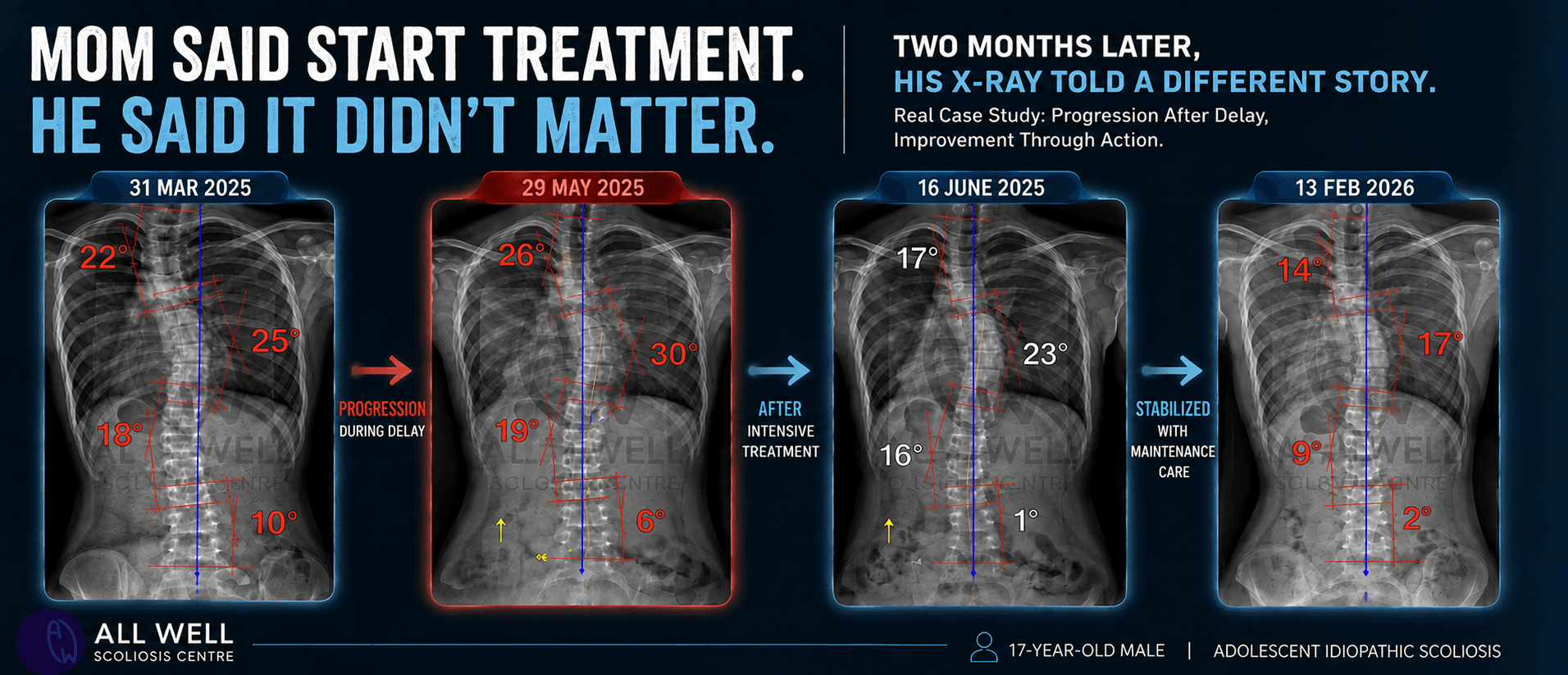
31 March 2025
His initial X-ray showed:
-
22° upper thoracic curve
-
25° main thoracic curve
-
18° lumbar compensation
-
10° pelvic imbalance
At this stage, conservative treatment options remained highly appropriate.
29 May 2025
Two months later, before intensive treatment began, the follow-up X-ray showed progression.
The upper curve increased from 22° to 26°.
The main thoracic curve increased from 25° to 30°.
For the first time, scoliosis became real.
Not because we explained it.
Not because his mother warned him.
Not because Google said so.
Because he could see it with his own eyes.
The curve had worsened.
The delay had consequences.
That X-ray changed everything.
When He Finally Decided to Take Action
After seeing the progression, his attitude slowly changed.
He agreed to participate more seriously in his intensive scoliosis rehabilitation program.
The same exercises he previously resisted suddenly felt more meaningful.
The same appointments became more important.
The same effort finally had a purpose.
The Results After Intensive Treatment
By June 2025, significant improvements were visible.
The upper thoracic curve reduced from 26° to 17°.
The main thoracic curve reduced from 30° to 23°.
The pelvis became more balanced.
His posture improved.
More importantly, he began understanding that scoliosis is not always a passive condition.
Sometimes intervention matters.
Sometimes effort matters.
Sometimes consistency matters.
Why We Still Believe the ScoliBrace Was Important
Many parents look at these results and ask:
"If the curve improved, why would you still recommend a brace?"
The answer is simple.
Improvement and stabilization are not the same thing.
Reducing a curve is one challenge.
Maintaining that improvement during growth is another.
A ScoliBrace can help:
-
Reduce the risk of progression
-
Support corrective positioning
-
Protect gains achieved during treatment
-
Improve long-term stability
-
Provide support between appointments
For many growing teenagers, the brace acts as an insurance policy for the hard work they have already invested.
One Year Later: Stability Matters
By February 2026, the follow-up X-ray showed further improvement and stabilization.
The upper thoracic curve measured 14°.
The main thoracic curve measured 17°.
The lumbar compensation reduced to 9°.
The pelvis remained balanced.
These results were not created overnight.
They were the result of multiple factors working together:
-
Family support
-
Consistent monitoring
-
Intensive rehabilitation
-
Maintenance care
-
Patient participation
-
Timely intervention
A Message to Parents
If you are currently struggling with a teenager who refuses to wear a brace, skips exercises, complains about treatment, or insists that scoliosis doesn't matter, you are not alone.
Many of the successful patients we see today were not motivated at the beginning.
Some resisted every recommendation.
Some argued with their parents.
Some wanted to quit.
What often changes their perspective is not another lecture.
It is understanding the consequences through education, monitoring, and objective evidence.
We Are Not Miracle Workers
I often tell parents the same thing.
I am not a magician.
I am not a carpenter who can simply cut out a curve and put the spine back together.
The spine is a living structure made of bones, discs, muscles, ligaments, nerves, and movement patterns that have developed over years.
Conservative scoliosis treatment requires time, effort, and commitment.
Surgery remains an important option for some patients, and we are not against it.
However, surgery is not the only option.
Our role is not to provide false hope.
Our role is to show families that there may be another path worth exploring before reaching that point.
The Lesson From This Case
The biggest change in this patient's journey was not the X-ray.
It was his mindset.
Once he understood that scoliosis could worsen, he became willing to participate in preventing it.
And once his mother had objective evidence to guide decisions, she could make informed choices about treatment and bracing.
For many families, that is where meaningful scoliosis management begins.
Not with perfect compliance.
Not with a miracle.
But with understanding.