Why We Shrink With Age: The Science Behind Posture, Spine & Muscle Loss
Have you noticed that your parents look shorter than before? Or maybe you have started to notice subtle changes in yourself — your shoulders rounding forward, your back becoming more curved, or standing tall requiring more effort than it used to.
Many people assume losing height is simply a normal part of getting older.
While some height change is expected with age, the real story is more complex.
Age-related height loss is not only about the spine “wearing out.” It is influenced by a combination of changes happening in the:
-
Spinal discs
-
Bones
-
Muscles
-
Hormones
-
Nervous system
-
Daily movement habits
Understanding why we lose height is the first step toward protecting posture, mobility, independence, and quality of life.
Why Do Humans Lose Height As We Age?
Research shows that adults commonly experience gradual height loss as they get older. After midlife, many people lose approximately ¼ to ½ inch (0.6–1.3 cm) per decade, although the amount varies significantly between individuals.
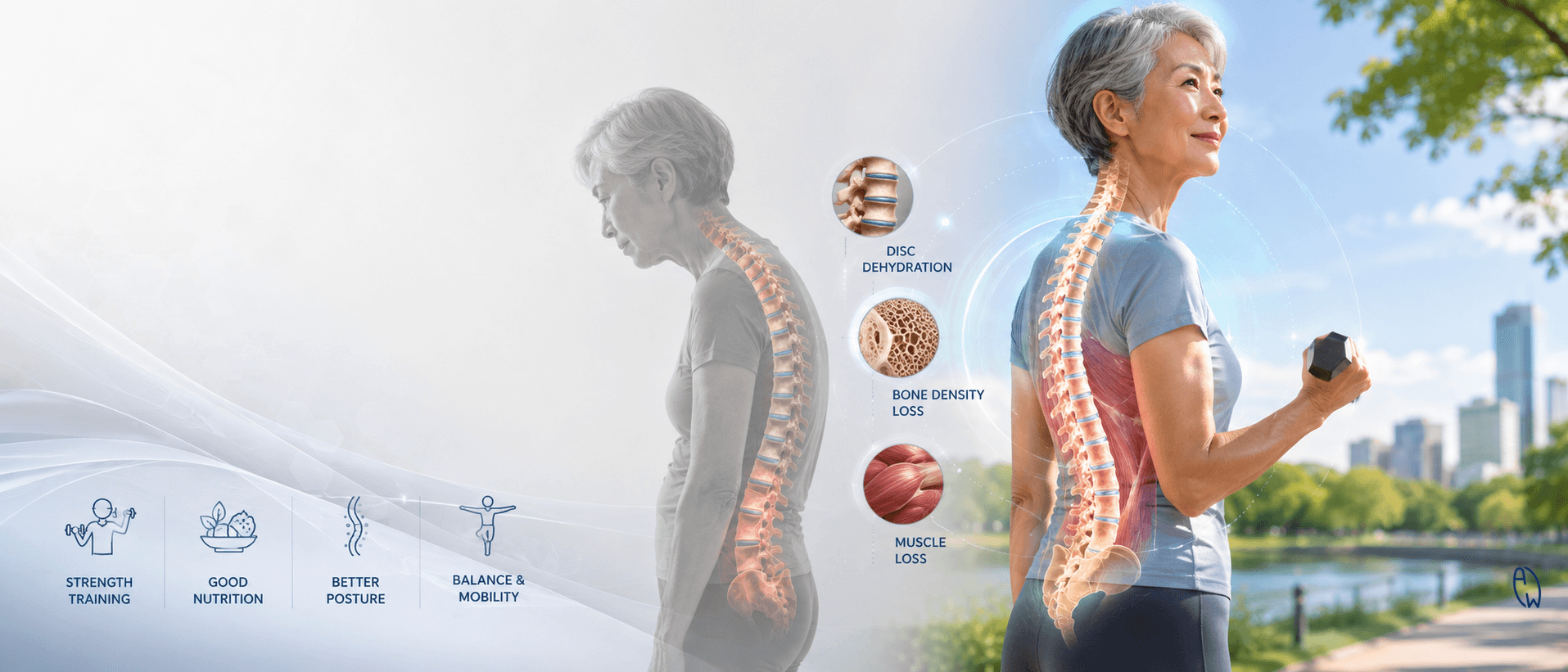
Three major systems contribute to this change:
-
Intervertebral disc compression — the spine loses some of its cushioning
-
Bone density reduction — the vertebrae become structurally weaker
-
Sarcopenia — muscle loss reduces postural support
Together, these changes can cause the spine to compress, posture to shift forward, and overall height to decrease.
1. Intervertebral Disc Compression: The Spine Slowly Loses Its Cushion
Between each spinal bone (vertebra) sits an intervertebral disc — a cushion-like structure that absorbs shock and allows movement.
When we are younger, these discs contain a high percentage of water, allowing them to remain thick, flexible, and resilient.
However, with age:
-
Disc hydration gradually decreases
-
Discs become thinner and less elastic
-
The space between vertebrae reduces
-
The spine may lose some of its overall height
Think of your spinal discs like a sponge.
A hydrated sponge is full and springy.
A dehydrated sponge becomes thinner and less able to absorb pressure.
As multiple discs throughout the spine lose height over decades, the accumulated effect contributes to measurable height changes.
However, disc ageing is only one piece of the puzzle.
2. Bone Density Loss: When the Spine Becomes Structurally Weaker
Bones are not fixed structures — they are living tissue.
Throughout life, your body constantly removes old bone and rebuilds new bone.
However, around our 30s and 40s, bone breakdown may gradually begin to exceed bone formation.
This process can be influenced by:
-
Ageing
-
Reduced physical activity
-
Hormonal changes
-
Nutrition
-
Muscle strength
When bone density decreases, especially in the vertebrae, the spine becomes more vulnerable.
In osteoporosis, weakened vertebrae may develop compression fractures. Sometimes these fractures happen gradually and may not create obvious symptoms immediately.
Over time, this may contribute to:
-
Loss of height
-
Increased upper back rounding (kyphosis)
-
Forward-flexed posture
-
Reduced mobility
Protecting bone health is not only about preventing fractures — it is also about preserving posture and movement.
3. Sarcopenia: The Hidden Muscle Loss That Changes Your Posture
One of the most overlooked reasons we appear to “shrink” with age is not only the spine.
It is muscle.
Age-related muscle loss, known as sarcopenia, can begin as early as our 30s and 40s.
You might notice it when:
“The stairs feel steeper.”
“The grocery bags feel heavier.”
“Opening jars becomes harder.”
“Standing straight feels tiring.”
These small changes may be early signs that the muscles responsible for strength, stability, and posture are changing.
Adults can lose approximately 3–5% of muscle mass per decade after age 30, with faster decline later in life when strength is not maintained.
Why Muscle Matters for Posture
Muscles do much more than create movement.
They help:
✓ Keep your spine upright
✓ Stabilise balance
✓ Support joints
✓ Maintain metabolism
✓ Protect independence with age
Your core, back, hip, and leg muscles act like the support system around your skeleton.
When these muscles weaken, your body has less ability to resist gravity.
The result?
Posture may gradually change:
-
Head moves forward
-
Shoulders become rounded
-
Upper back curve increases
-
Walking pattern changes
-
Balance decreases
Sometimes the spine has not dramatically shortened — but the body appears shorter because posture has collapsed forward.
The Midlife Muscle Wake-Up Call
Muscle loss is often associated with elderly people, but the process starts decades earlier.
By retirement age, years of gradual muscle decline may already have occurred.
For men, sarcopenia commonly becomes noticeable during the 40s and 50s.
For women, muscle and bone changes may accelerate during perimenopause and menopause as declining oestrogen affects muscle maintenance and bone metabolism.
Midlife is an important opportunity.
Not because the body is failing.
Because this is the time to build strength reserves for the decades ahead.
Can We Slow Down Height Loss and Posture Changes?
The encouraging answer: many factors can be influenced.
We cannot completely stop biological age-ing, but research consistently shows that movement, strength training, and nutrition affect how well we age.
1. Strength Training: Build Your Internal Support System
Walking is excellent for cardiovascular health.
But maintaining muscle requires resistance.
Strength training helps support:
-
Muscle mass
-
Bone strength
-
Balance
-
Postural endurance
Examples include:
-
Resistance exercises
-
Functional movements
-
Core strengthening
The goal is not simply looking fit.
The goal is maintaining the ability to move confidently throughout life.
2. Train Posture, Not Just Muscles
Good posture is not just “standing straight.”
Posture requires communication between your:
-
Brain
-
Nervous system
-
Muscles
-
Joints
-
Balance system
Your body needs both strength and awareness.
Effective posture training focuses on:
-
Spinal mobility
-
Muscle endurance
-
Coordination
-
Balance
-
Movement habits
A strong body must also know how to organise itself.
3. Eat for Strength: Preferred Protein Choices for Healthy Ageing
As we age, the body becomes less efficient at building and repairing muscle — a process called anabolic resistance.
This means adequate high-quality protein becomes increasingly important for maintaining muscle, supporting recovery, and preserving strength.
Protein is not just for athletes.
It is one of the building blocks of healthy ageing.
Whey Protein
Whey protein is one of the most researched protein sources because it provides all essential amino acids and is naturally rich in leucine, which plays an important role in muscle protein synthesis.
Preferred options include:
-
Unsweetened whey concentrate or isolate
-
Minimally processed whey when available
-
Grass-fed or pasture-raised sources based on personal preference
Whey may be helpful for people who struggle to meet protein needs through food alone.
Whole Food Animal Protein Sources
Eggs
Eggs provide complete protein, essential amino acids, healthy fats, and nutrients such as choline.
Fish
White-fleshed fish options include:
-
Cod
-
Haddock
-
Grouper
-
Halibut
-
Tilapia
-
Bass
White fish is naturally lean and provides a high protein-to-calorie ratio.
Fatty fish such as:
-
Salmon
-
Sardines
-
Mackerel
provide higher amounts of omega-3 fatty acids.
Including both lean fish and fatty fish creates better nutritional variety.
Chicken & Turkey Breast
A 100 g serving of cooked chicken or turkey breast provides approximately 30 g of protein, making poultry an efficient lean protein source.
Lean Beef
Lean beef provides:
-
Complete protein
-
Iron
-
Zinc
-
Vitamin B12
-
Creatine
Lean cuts are generally defined as containing:
-
Less than 10 g total fat
-
Less than 4.5 g saturated fat
per 100 g cooked serving.
Dairy Protein Sources
Plain Greek Yogurt
A 100 g serving provides approximately 9 g of protein, depending on the product.
Cottage Cheese
One cup (226 g) of low-fat cottage cheese provides approximately:
-
28 g protein
-
163 calories
-
2.5 g fat
Cottage cheese contains casein, a slower-digesting protein that provides a steady release of amino acids.
Beef Protein Options
Hydrolyzed beef protein powder may be an alternative for people who do not tolerate dairy-based protein.
However, whole foods should remain the foundation whenever possible.
Plant-Based Protein Choices
Plant proteins can also support muscle health.
Soy-based foods are among the most complete plant proteins because they contain all essential amino acids.
Examples:
Tofu
An 85 g serving provides approximately:
-
9 g protein
-
71 calories
-
3.5 g fat
Other soy options include:
-
Edamame
-
Tempeh
Some soybean crops may be genetically modified depending on the source. People who prefer avoiding genetically modified ingredients can choose certified organic soy products where available.
Ageing Is Natural. Losing Strength Does Not Have to Be.
Your spine, bones, and muscles tell the story of how your body has adapted over decades.
Height loss is not caused by one single factor.
It is the combined effect of:
-
Disc changes
-
Bone density changes
-
Muscle changes
-
Posture habits
-
Movement patterns
Healthy age-ing is not about chasing a younger body.
It is about preserving:
✓ Strength
✓ Confidence
✓ Balance
✓ Independence
✓ The ability to keep doing what you love
The earlier we care for our muscles, bones, and posture — the better we prepare our body for the years ahead.