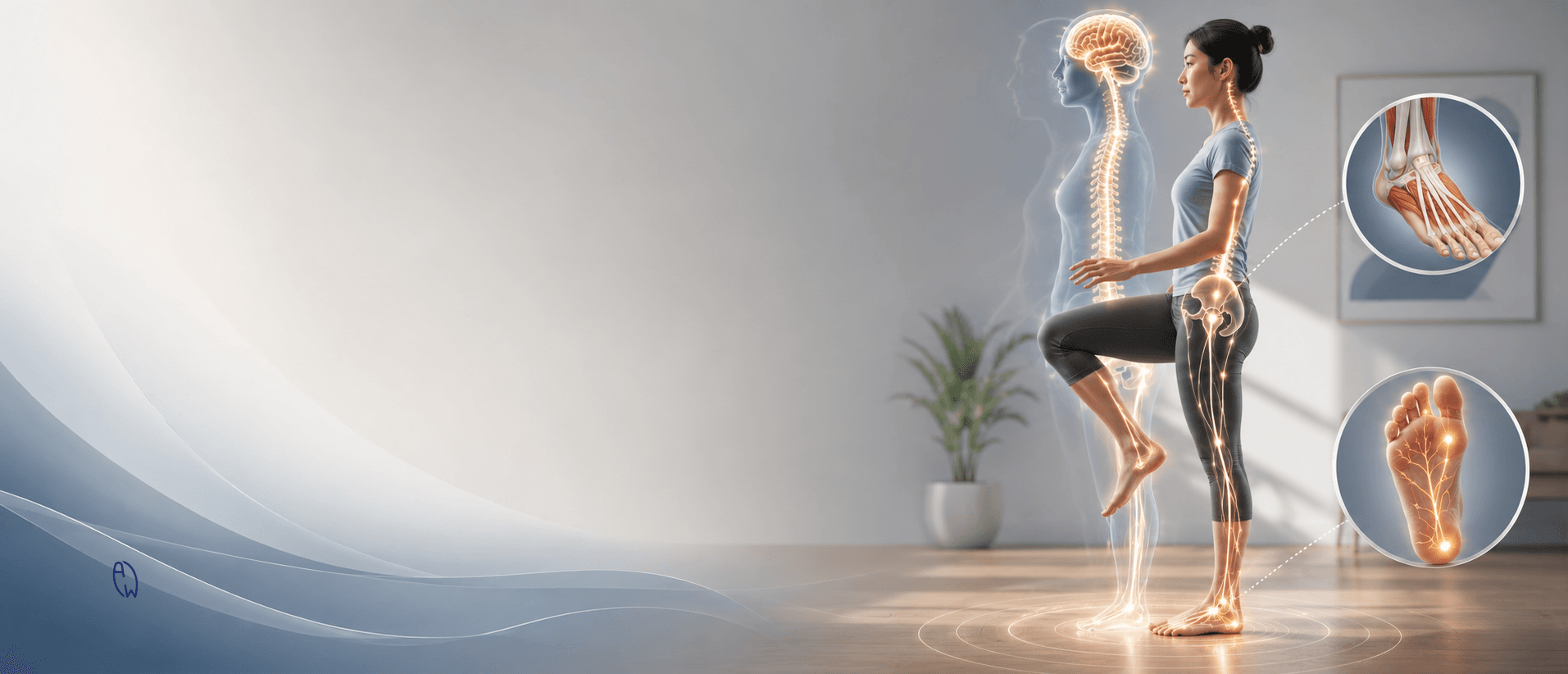
Why Do We Teach Scoliosis Exercises Barefoot? The Science Behind Foot Strength, Heel Lifts, and Whole-Body Balance
Why Do We Ask You to Remove Your Shoes?
One of the most common questions we hear at All Well Scoliosis Centre is:
"Why do I have to remove my shoes before doing my exercises?"
It may seem like a small detail, but it is actually a very intentional part of your rehabilitation.
The answer is not because shoes are "bad."
The answer is because your feet are the foundation of your body.
Just as a building depends on a stable foundation, your spine depends on the quality of information and support coming from the feet. Every step you take influences your ankles, knees, hips, pelvis, and ultimately your spine.
When treating scoliosis, we are not simply trying to improve a spinal curve. We are helping your entire body learn to move with better balance, coordination, and efficiency.
That journey begins at your feet.
Your Feet Are One of the Most Important Sensory Organs in Your Body
Most people think of the feet simply as structures for walking.
In reality, they are highly sophisticated sensory organs.
Each foot contains:
-
26 bones
-
33 joints
-
More than 100 muscles, tendons and ligaments
-
Thousands of sensory receptors constantly communicating with your brain
Every moment you stand, these receptors tell your brain:
-
How your weight is distributed
-
Whether you're leaning left or right
-
How stable the ground is
-
How much pressure is under each foot
-
Whether your body needs to adjust
Your brain then makes tiny corrections throughout your entire body.
This process is known as proprioception—your body's ability to sense where it is in space without looking.
For someone living with scoliosis, proprioception is incredibly important.
Many people with scoliosis have unknowingly adapted to asymmetrical movement patterns over many years. Their brain has accepted those compensations as "normal."
Our goal is to gently retrain that system.
Why We Prefer Barefoot Exercises
Modern shoes are designed for comfort.
Many contain:
-
Thick cushioning
-
Shock absorption
-
Motion control
-
Elevated heels
-
Arch support
These features can be useful during daily life, sports, or long periods of walking.
However, during rehabilitation, they may reduce the amount of sensory information reaching the brain.
Think of it this way.
If you wear thick gloves all day, your fingertips become less aware of what they're touching.
The same principle applies to your feet.
A thick shoe can reduce the amount of sensory feedback coming from the ground.
When we ask you to exercise barefoot, we are allowing your feet to "wake up."
Instead of relying on your shoes to absorb every movement, your own muscles begin doing the work.
This helps activate the small intrinsic muscles of the feet that are essential for stability and balance.
Barefoot Training Builds Better Body Awareness
Exercising barefoot demands greater control.
Every shift in body weight becomes more noticeable.
Every movement requires more attention.
Your body can no longer rely on thick soles to hide poor movement habits.
Instead, it begins to strengthen:
-
Foot muscles
-
Ankle stability
-
Balance
-
Coordination
-
Postural control
-
Movement precision
Most importantly, your brain receives clearer information from the ground.
That information allows it to make better postural corrections.
Over time, these improved movement patterns begin carrying over into everyday life.
What Does Research Say?
Growing research supports the importance of intrinsic foot muscle activation and sensory feedback.
Studies by Kelly and colleagues have shown that exercises performed barefoot can strengthen the intrinsic muscles of the foot, which contribute to arch stability and balance.
Research by Ridge et al. has demonstrated that minimalist or barefoot-style training can increase intrinsic foot muscle size and improve foot function when introduced gradually.
Anthropological research by Holowka and Lieberman also suggests that natural foot movement enhances sensory feedback and encourages more efficient movement strategies.
While barefoot exercise is not appropriate for every person or every situation, these findings support the idea that allowing the foot to move naturally can improve strength, balance, and proprioception when prescribed appropriately.
This aligns with one of our rehabilitation goals: helping the body rely more on its own muscles and nervous system rather than external support whenever appropriate.
Then Why Do We Sometimes Prescribe a Heel Lift?
Patients often ask another excellent question.
"If barefoot is so important, why do you prescribe a heel lift?"
The answer lies in understanding the difference between supporting comfort and guiding alignment.
A heel lift at All Well Scoliosis Centre is not prescribed simply to make your foot feel more comfortable.
It is prescribed because it may temporarily improve how your hips, pelvis, and spine work together.
We Don't Only Look at Your Feet
When deciding whether someone requires a heel lift, we assess much more than the foot.
We evaluate:
-
Pelvic alignment
-
Hip mechanics
-
Functional leg length
-
Weight distribution
-
Standing posture
-
Walking pattern
-
Overall spinal balance
Sometimes what appears to be a "short leg" is actually caused by pelvic rotation or muscular imbalance rather than a true difference in bone length.
That distinction is extremely important.
Without assessing the entire body, simply adding a heel lift may not address the real cause of the imbalance.
Why Do We Usually Prescribe Only One Heel Lift?
Many patients notice that only one shoe receives a heel lift.
This is intentional.
Scoliosis rarely affects the body symmetrically.
One side of the pelvis often functions differently from the other.
Adding lifts to both shoes would simply raise your height without helping correct that asymmetry.
Instead, we prescribe a carefully measured lift based on your individual biomechanics.
Every patient is different.
There is no standard measurement.
The height of the heel lift depends on detailed clinical assessment of your pelvis, hips, leg length, posture, and spinal alignment.
Heel Lifts Are Meant to Be Temporary
One of the biggest differences in our rehabilitation philosophy is this:
Our goal is never lifelong dependence.
As your body develops better muscle control, stronger balance, and improved alignment through rehabilitation, we regularly reassess whether the heel lift is still necessary.
When your body demonstrates that it can maintain better alignment independently, we gradually reduce or remove it.
The aim is to help your body become stronger—not permanently reliant on external support.
How Is This Different From Orthotics?
Patients often compare our heel lifts with custom orthotics prescribed by podiatrists.
Both approaches have value, but they often have different objectives.
A podiatrist may prescribe orthotics to reduce pain, improve comfort, or manage foot-specific conditions such as plantar fasciitis, flat feet, or arthritis.
Our focus is different.
We ask:
"How can we improve the mechanics of the entire body?"
Rather than only accommodating how your foot functions today, we encourage your brain and body to develop healthier movement patterns over time.
Neither approach is universally better. They simply serve different clinical purposes.
We Believe the Body Can Learn
At All Well Scoliosis Centre, we often say:
We are born perfectly imperfect.
No human body is perfectly symmetrical.
Small asymmetries exist in almost everyone.
The important question is not whether imperfections exist.
The important question is whether we recognise them early enough to help the body adapt more efficiently.
The human nervous system is remarkably adaptable.
With the right movement, repetition, and guidance, the brain can build new pathways and improve how muscles coordinate with one another.
This ability is known as neuroplasticity.
Rehabilitation is not about forcing perfection.
It is about helping the body function better.
Babies Teach Us an Important Lesson
One of the best examples comes from watching babies learn to walk.
Whenever it is safe, paediatricians often encourage babies to spend time barefoot.
Why?
Because babies need to experience the ground beneath their feet.
Those tiny nerve endings on the soles of the feet continuously send information to the brain.
This sensory input helps babies develop:
-
Balance
-
Coordination
-
Foot strength
-
Body awareness
-
Confidence during movement
When shoes are necessary for protection or hygiene, flexible barefoot-style shoes are often recommended because they allow more natural movement than rigid footwear.
Babies are not born knowing how to balance.
They learn through experience.
The same principle applies during rehabilitation.
Scoliosis Rehabilitation Is About Relearning Movement
Many people think scoliosis treatment is simply about straightening the spine.
In reality, rehabilitation involves retraining how the brain coordinates movement.
We help patients become more aware of:
-
How they stand
-
How they sit
-
How they walk
-
How they breathe
-
How they balance
-
How they move through daily life
As awareness improves, healthier movement patterns gradually become automatic.
That is why we spend so much time teaching body awareness—not just exercises.
Frequently Asked Questions
Should I walk barefoot all day?
Not necessarily.
Barefoot exercise is a rehabilitation tool. It does not mean everyone should spend all day without shoes. The right footwear depends on your environment, activity, medical history, and individual needs.
Can barefoot exercises replace orthotics?
No.
Some people genuinely require orthotics for specific medical conditions. Barefoot rehabilitation and orthotic management can complement each other when used appropriately.
Will I need my heel lift forever?
Usually not.
If your heel lift is prescribed to improve functional alignment rather than compensate for a permanent structural difference, we reassess it regularly. As your body becomes stronger and more balanced, it may be reduced or removed.
Why don't you prescribe heel lifts for both feet?
Because scoliosis and pelvic imbalance are rarely symmetrical. Each prescription is based on your individual biomechanics rather than applying the same solution to both sides.
Looking Beyond the Spine
Scoliosis affects much more than the spine.
It influences balance, coordination, muscle activation, breathing, walking mechanics, and how the brain interprets movement.
That is why our rehabilitation approach combines the CLEAR Protocol®, ScoliBalance®, and ScoliBrace® to address the entire movement system rather than focusing solely on the spinal curve.
Our goal is to improve:
-
Foot stability
-
Pelvic balance
-
Neuromuscular coordination
-
Core control
-
Postural awareness
-
Functional movement
-
Long-term independence
Because lasting spinal change begins with a stronger foundation.
Final Thoughts
Removing your shoes during rehabilitation is not a small detail—it is part of a larger strategy to improve how your brain and body communicate.
Barefoot exercises encourage stronger foot muscles, richer sensory feedback, and better proprioception. Temporary heel lifts, when clinically indicated, help guide alignment while your body learns healthier movement patterns.
At All Well Scoliosis Centre, we believe rehabilitation is not about making your body dependent on supports. It is about helping your body rediscover its own ability to balance, adapt, and move efficiently.
Every step begins at your feet.
And every better step begins with greater awareness.