Following Intensive Care: Why Stability Matters
After intensive scoliosis care, the next crucial step is stability. But what does that mean for exercises and treatment?
Core Exercise vs. Scoliosis-Specific Exercise
Traditional/Core Exercise >>> Planks, general flexibility, general core strengthening
Scoliosis-Specific Exercise >>> Asymmetrical exercises tailored to your curve size, isometric exercises, reactive exercises, self-corrective exercises
Traditional core exercises strengthen muscles but do not address the 3D rotation of the spine caused by scoliosis. Scoliosis-specific exercises target both curve and rotation, giving you a real opportunity to reduce the curve.
Fragmented vs. Coordinated Care
A multimodal approach is needed to reduce scoliosis curves:
-
Therapy
-
Chiropractic
-
Traction
-
Rehabilitation
-
Exercise
-
Vibration & percussion
-
Bracing & brace design
-
Self-correction exercises
-
Isometrics
Fragmented Approach:
-
Requires multiple specialists.
-
Care can conflict, slowing progress or reducing results.
Coordinated Approach:
-
One doctor certified in all modalities manages care.
-
Every treatment works together, creating results impossible with fragmented care.
Slowing Progression vs. Actively Reducing Your Curve
Slowing Progression
-
Focuses on preventing worsening.
-
Traditional approach: nothing changes until surgery is considered.
Managing Reduction
-
Focuses on actively reducing the curve.
-
Mindset: maximizing curve improvement, not just preventing worsening.
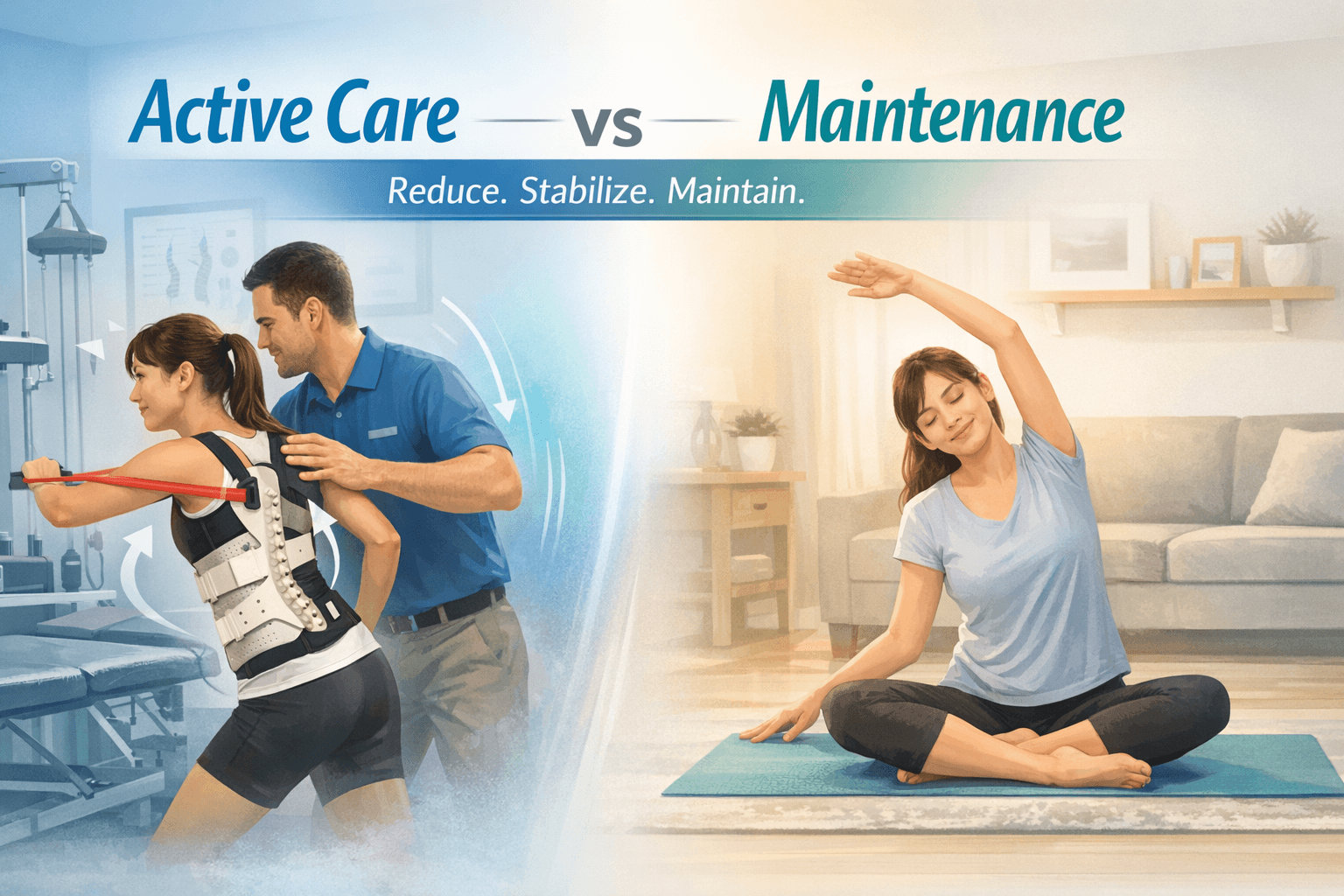
How Active Care Works
-
Active Care Phase – Targeting reduction:
-
Curve reduction is evaluated every 90 days.
-
Braces may be adjusted; intensives may be repeated.
-
Think of it like orthodontics: adjusting braces until optimal results are achieved.
-
-
Post-Active Care Maintenance – Preventing regression:
-
Gradual weaning of treatments, exercises, and braces.
-
Dose of care reduced while monitoring for stability.
-
The smaller your curve, the less intensive your maintenance plan.
-
Important: There is no permanent cure. Maintenance is lifelong. Regression may require another round of intensive care, but proper monitoring and exercises keep curves manageable.
This approach communicates clearly to patients the difference between traditional care and scoliosis-specific, coordinated care, while emphasizing active reduction, long-term maintenance, and realistic expectations.
Medical Disclaimer
This article is for educational purposes only and does not constitute medical advice.
Scoliosis varies significantly between individuals. Always consult a qualified healthcare professional before starting any new sport or exercise program, especially if you have scoliosis, spinal conditions, pain, or previous injuries. Participation in sports should be guided by individual assessment and professional recommendation.
The image is shared for educational purposes with patient consent. Individual outcomes vary. Structural correction does not automatically restore full respiratory function. Clinical assessment is required.
Copyright & Content Protection Notice
© 2026 All Well Scoliosis Centre. All rights reserved.
This content is original and protected by copyright law.
No part of this article may be reproduced, distributed, copied, or reused in any form without prior written permission. Unauthorized use, duplication, or content scraping is strictly prohibited.