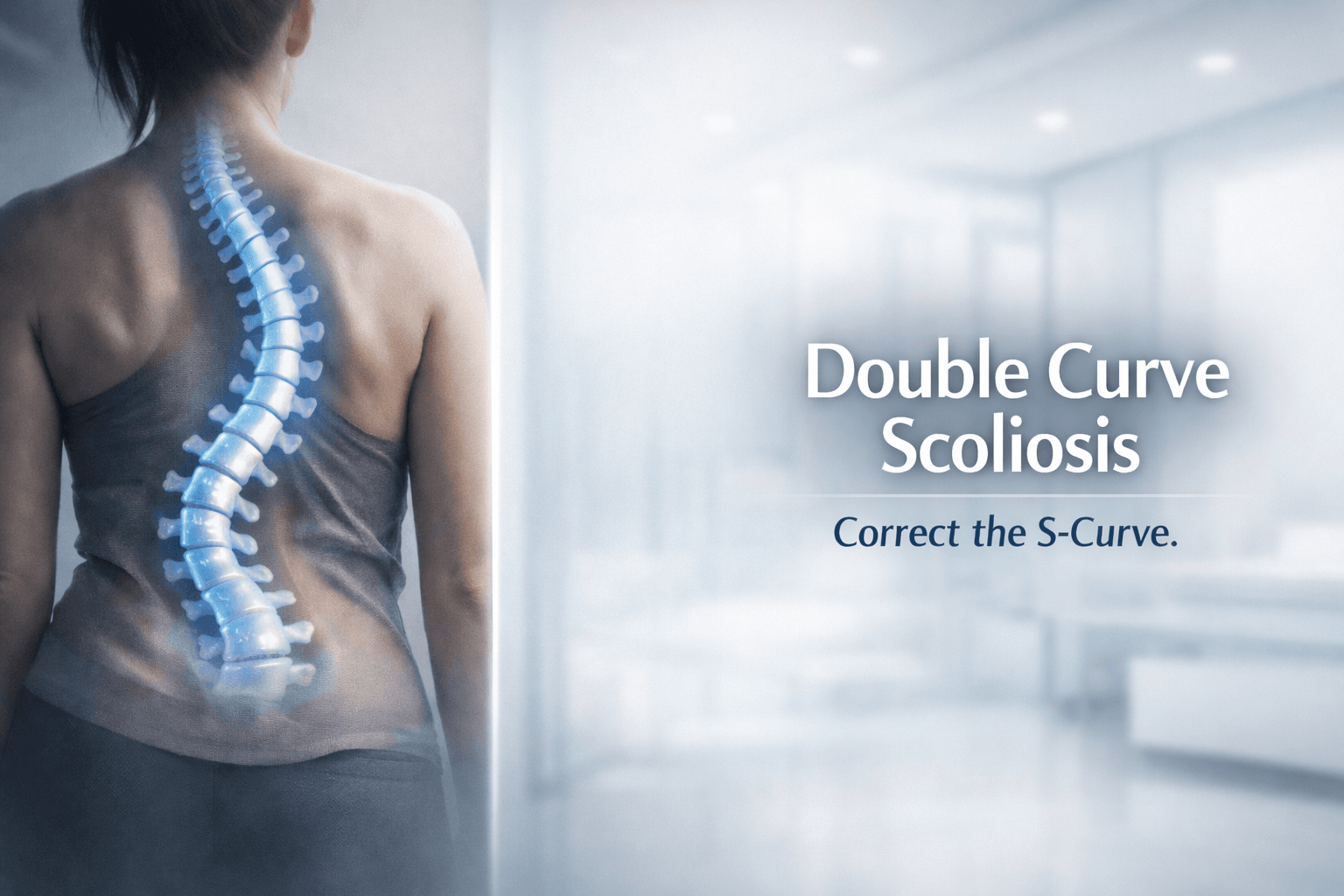
Double Curve Scoliosis Treatment: A CLEAR Approach to S-Shaped Scoliosis
Understanding S-Shaped Scoliosis (Double Curve Scoliosis)
S-shaped scoliosis—also known as double curve scoliosis—is a more complex spinal condition where the spine develops two abnormal curves bending in opposite directions, forming an “S” shape.
Unlike a single C-shaped curve, this condition affects multiple regions of the spine, commonly the thoracic (upper/mid-back) and lumbar (lower back).
Scoliosis is not just a sideways bend. It is a 3-dimensional deformity, meaning the spine also rotates. This rotational component contributes to rib humps, asymmetry, and muscular imbalance.
Why Double Curve Scoliosis Is More Challenging
An S-curve scoliosis is more difficult to manage compared to a single curve because:
-
There are two curves to correct, not one
-
Each curve may behave differently (flexible vs rigid)
-
One curve becomes dominant (major) while the other compensates (minor)
-
Muscles are pulled in opposite directions, increasing imbalance and fatigue (CLEAR Scoliosis Institute)
As scoliosis progresses, the spine becomes more rigid and less responsive to treatment, making early intervention critical.
The CLEAR Method: A Modern Conservative Approach
The CLEAR Institute (Chiropractic Leadership, Educational Advancement, and Research) focuses on non-surgical, structural correction of scoliosis through a multi-modal, customized treatment system.
Instead of “watch and wait,” the CLEAR approach is proactive and corrective, targeting the spine’s structure and function simultaneously.
Core Principles of CLEAR Treatment
-
Treat the Spine in 3 Dimensions
CLEAR addresses:
-
Lateral curvature
-
Rotation
-
Sagittal balance
-
-
Focus on the Major Curve First
In double curve scoliosis:
-
The primary (dominant) curve is corrected first
-
Then the secondary curve is addressed progressively
-
-
Reduce Spinal Rigidity
Increasing flexibility is key to achieving correction, especially in advanced cases.
Components of CLEAR-Based Scoliosis Treatment
A CLEAR-based program typically combines several modalities for maximum effect:
1. Chiropractic BioPhysics & Structural Adjustments
-
Targets vertebral misalignment
-
Improves joint mobility
-
Reduces abnormal spinal stress
2. Mirror-Image Exercises
-
Patient-specific exercises designed to counteract the exact curve pattern
-
Retrains neuromuscular control
3. Spinal Traction Therapy
-
Helps reshape the spine over time
-
Addresses both curvature and rotation
4. Corrective Bracing (When Needed)
-
Custom braces support spinal correction
-
Particularly useful in growing adolescents
5. Home Care Program
-
Daily exercises are essential for long-term success
-
Reinforces in-clinic corrections
This integrated approach is key because scoliosis is not just a bone issue—it involves muscles, ligaments, and neurology.
Treatment Goals for S-Shaped Scoliosis
CLEAR-based care aims to:
-
Reduce Cobb angle (curve severity)
-
Improve spinal symmetry
-
Restore functional movement
-
Decrease pain and muscular imbalance
-
Prevent further progression
Because scoliosis is progressive by nature, the goal is not just symptom relief—but long-term structural change.
When Should You Start Treatment?
The best time to treat scoliosis is:
-
Early (especially during growth spurts)
-
Before curves become rigid
-
When flexibility is still present
However, adults can still benefit significantly from:
-
Pain reduction
-
Postural improvement
-
Functional rehabilitation
CLEAR Method vs Traditional Approach
Traditional Approach -> Observe (“wait and see”)
CLEAR Method -> Proactive correction
Traditional Approach -> Focus on curve monitoring
CLEAR Method -> Focus on curve reduction
Traditional Approach -> Surgery for severe cases
CLEAR Method -> Conservative first
Traditional Approach -> 2D understanding
CLEAR Method -> 3D correction model
Clinical Insight: What Many Patients Don’t Realize
In double curve scoliosis, the secondary curve is not random—it develops as the body tries to maintain balance.
If you only treat symptoms (pain, tight muscles), you miss the root cause.
True correction requires:
-
Identifying the dominant curve
-
Understanding compensation patterns
-
Applying targeted, structured care
Final Thoughts: A Strategic Approach to S-Curve Scoliosis
S-shaped scoliosis is complex—but not untreatable.
With the right strategy, especially using a CLEAR-based model:
-
You don’t just manage scoliosis
-
You actively influence its trajectory
The key is precision, consistency, and early intervention.
Medical Disclaimer
This article is for educational purposes only and does not constitute medical advice.
Scoliosis varies significantly between individuals. Always consult a qualified healthcare professional before starting any new sport or exercise program, especially if you have scoliosis, spinal conditions, pain, or previous injuries. Participation in sports should be guided by individual assessment and professional recommendation.
The image is shared for educational purposes with patient consent. Individual outcomes vary. Structural correction does not automatically restore full respiratory function. Clinical assessment is required.
Copyright & Content Protection Notice
© 2026 All Well Scoliosis Centre. All rights reserved.
This content is original and protected by copyright law.
No part of this article may be reproduced, distributed, copied, or reused in any form without prior written permission. Unauthorized use, duplication, or content scraping is strictly prohibited.