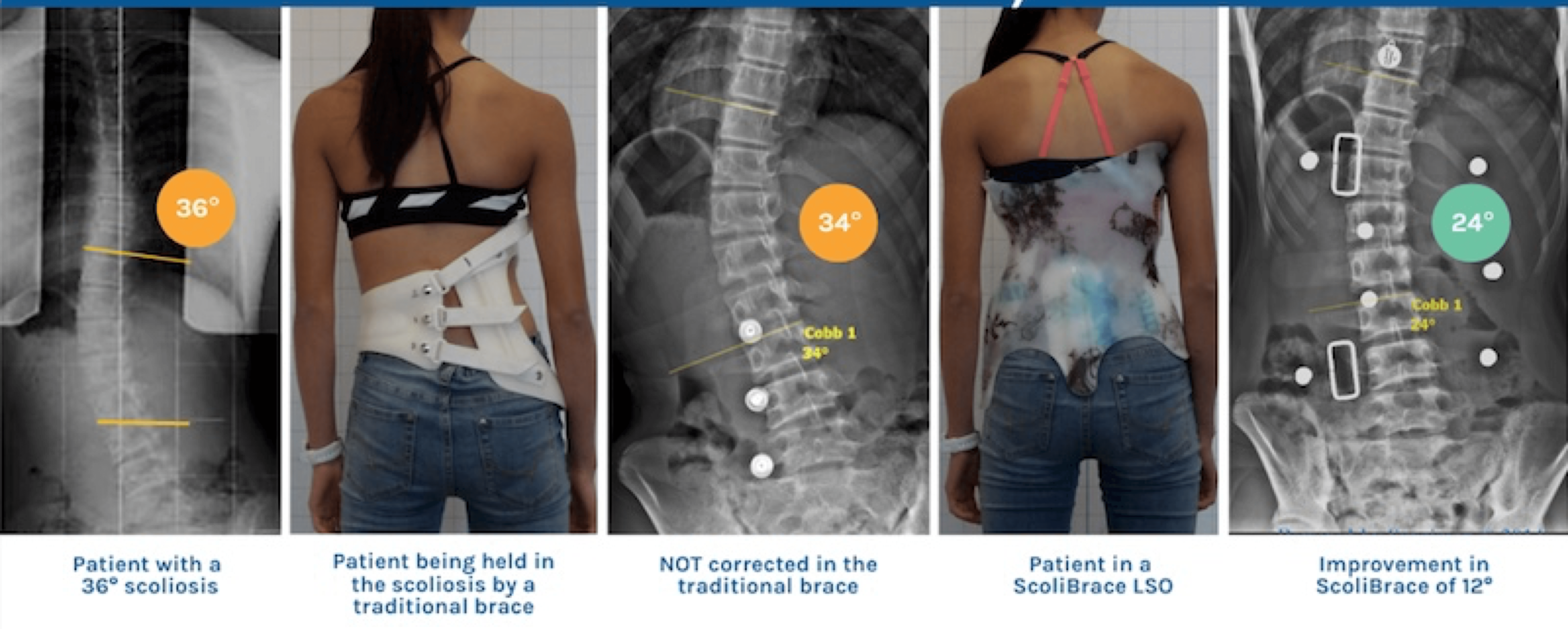
Understanding Different Scoliosis Brace Options (and Why Technology Matters in Modern Correction)
Scoliosis bracing is one of the most important non-surgical treatment options for managing spinal curvature, especially in adolescents and growing spines. The type of brace used can significantly influence comfort, compliance, and long-term correction outcomes.
However, not all braces are created equal. Each design has different levels of control, adaptability, and ability to address the spine in three dimensions.
Below is an overview of commonly used scoliosis brace types, and how modern advancements—such as ScoliBrace technology—are changing the way we approach spinal correction.
How Scoliosis Bracing Is Chosen
The selection of a brace is not random. It depends on several key factors, including:
-
The type and pattern of the spinal curve
-
The severity of scoliosis
-
The patient’s age and growth potential
-
Daily lifestyle demands and compliance ability
-
Long-term treatment goals (stabilisation vs active correction)
Because every scoliosis case is unique, professional assessment by a scoliosis specialist is essential to determine the most appropriate brace design.
Common Types of Scoliosis Braces
1. Boston Brace
The Boston Brace is one of the most widely used traditional scoliosis braces. It is a rigid, custom-moulded plastic brace that wraps around the torso.
-
Designed to apply pressure against spinal curves
-
Primarily focuses on stopping progression
-
Commonly used for thoracic and lumbar curves
-
Typically worn for long hours daily
While effective in stabilising curves, its design is largely based on two-dimensional correction principles.
2. Chêneau Brace
The Chêneau Brace is a more advanced rigid brace that introduces three-dimensional correction principles.
-
Custom-designed based on curve pattern
-
Uses “voids and pressure zones” for correction
-
Targets rotation, not just side curvature
-
Usually worn 20–23 hours per day
It is more individualised compared to older brace designs, but modification after fabrication can still be limited.
3. Milwaukee Brace
The Milwaukee Brace is one of the earliest scoliosis brace designs and is now rarely used.
-
Includes a neck ring and pelvic support
-
Extends from pelvis to neck
-
Primarily used for high thoracic or cervical curves
Due to its bulkiness and discomfort, it has largely been replaced by more modern and patient-friendly designs.
4. Providence Brace
The Providence Brace is a night-time brace designed for overcorrection in lying down positions.
-
Worn during sleep only
-
Uses side-bending corrective forces
-
Focuses on curve reduction while lying supine
-
Often used for specific curve types
While convenient, it is not suitable for all scoliosis patterns.
5. SpineCor Brace
The SpineCor Brace is a dynamic bracing system that uses elastic components instead of rigid plastic.
-
Allows greater movement and flexibility
-
Uses tension-based correction
-
Designed to support daily activities with less restriction
However, because it relies on soft dynamic tension, control of structural correction can be more limited compared to rigid 3D systems.
The Modern Advancement: ScoliBrace
Among today’s scoliosis brace options, ScoliBrace represents one of the most advanced corrective systems available.
Unlike traditional braces that mainly focus on stopping progression, ScoliBrace is designed with a true 3D corrective approach, aiming not only to support the spine but actively guide it toward a more optimal alignment.
Key Advantages of ScoliBrace:
-
Fully custom-made using 3D scanning and CAD technology
-
Addresses scoliosis in all three planes (front, side, and rotation)
-
Designed for active correction, not just containment
-
More low-profile and comfortable for daily wear
-
Engineered for improved compliance and aesthetics
Why Adjustability Matters in Real Treatment
One important but often overlooked advantage of ScoliBrace is ongoing adaptability during treatment.
As the spine responds and improves, adjustments can be made to further guide correction. This allows the brace to evolve with the patient’s progress.
In contrast, many traditional rigid braces are more static—once fabricated, they are harder to modify meaningfully as the spine changes. This can limit long-term optimisation of correction.
Why We Choose ScoliBrace in Practice
From a clinical perspective, the goal of bracing should not only be to “hold” the spine, but to actively encourage better alignment over time.
ScoliBrace stands out because it combines:
-
Advanced 3D correction principles
-
Individualised digital design
-
Adjustability as the spine improves
-
A more modern, patient-friendly experience
This makes it one of the most comprehensive bracing systems currently available for scoliosis management.
Final Thoughts
Scoliosis treatment is never one-size-fits-all. Each brace system has its own strengths and limitations, and the best outcomes come from choosing the right tool for the right patient at the right stage.
However, with advancements in 3D imaging, digital design, and biomechanical understanding, modern systems like ScoliBrace are helping shift scoliosis care from simple support toward active structural correction.
If you are exploring scoliosis bracing options, a detailed clinical assessment is the best first step to determine what approach will give the most meaningful long-term results.