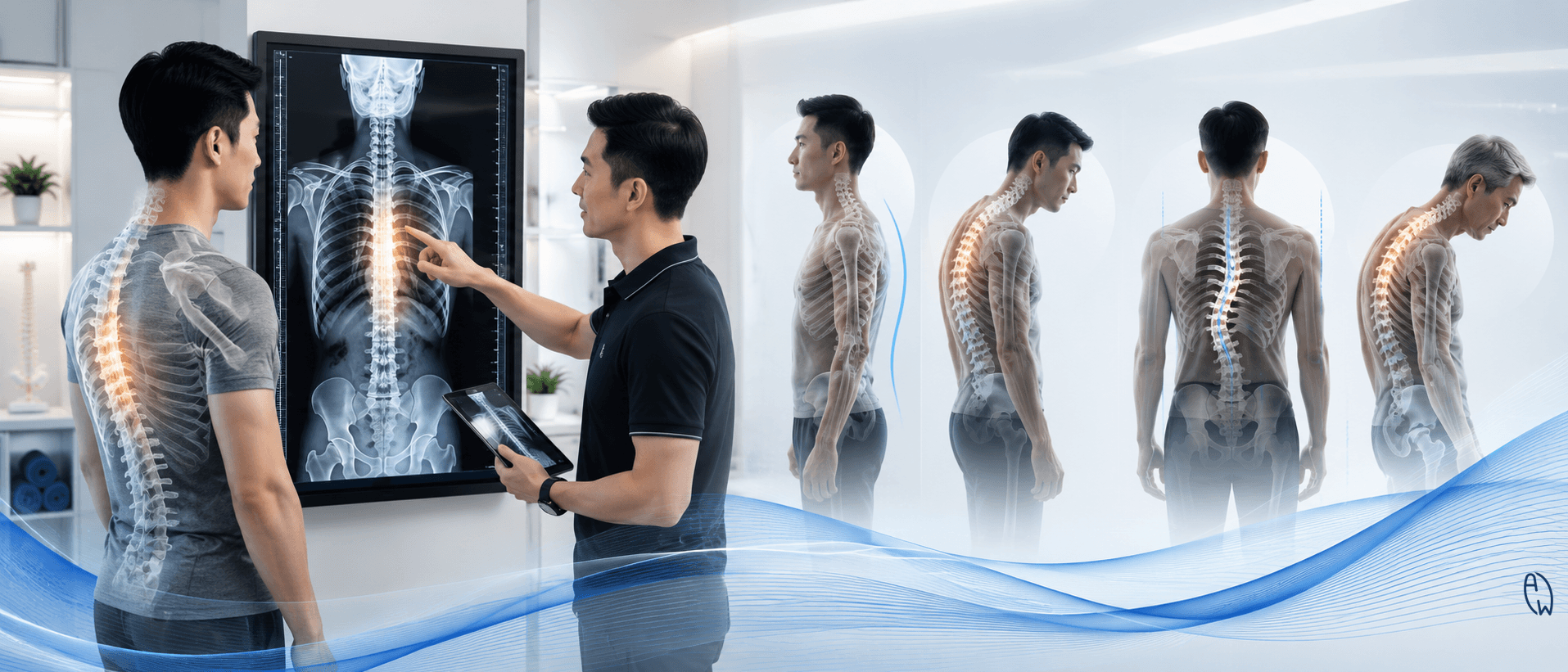
Hunchback vs Hyperkyphosis vs Dowager's Hump vs Thoracic Scoliosis: What's the Difference?
Many people use these terms interchangeably, but they describe different conditions. Understanding the difference can help you make more informed decisions about treatment.
Hunchback
"Hunchback" is a non-medical term used to describe a noticeably rounded upper back. It describes how the posture looks but does not explain why it developed.
Hyperkyphosis
Hyperkyphosis is the medical term for an excessive forward curve of the thoracic spine. While everyone has a natural thoracic curve, an exaggerated curve may contribute to forward head posture, rounded shoulders, muscle fatigue, reduced spinal mobility, and breathing changes.
Dowager's Hump
Dowager's hump commonly refers to a pronounced rounded upper back seen in some older adults, often associated with osteoporosis, vertebral compression fractures, or age-related spinal degeneration. However, some people also use the term to describe a fatty pad at the base of the neck, which is a different condition.
Thoracic Scoliosis
Unlike hyperkyphosis, thoracic scoliosis is a sideways curvature of the spine accompanied by vertebral rotation.
Some people with thoracic scoliosis also develop increased thoracic kyphosis, while others do not. They may instead notice uneven shoulders, a prominent rib hump, or an asymmetrical waist.
Because scoliosis is a three-dimensional spinal condition, treatment differs from that of a simple postural hunchback. If you notice spinal asymmetry together with a rounded upper back, a professional assessment can help determine whether scoliosis may also be contributing to your posture.
7 Common Mistakes People Make When Trying to Fix a Hunchback
Many people spend months—or even years—trying to improve their posture without lasting success. Often, it's not because they lack motivation, but because they are treating the symptom instead of the underlying cause.
1. Stretching the Same Muscles Every Day
Stretching may temporarily reduce discomfort, but if your muscles continue supporting the same rounded posture, the tightness usually returns.
2. Buying a Posture Corrector Without Strengthening
Posture braces may provide temporary awareness or support for selected individuals, but they cannot replace strong postural muscles or healthy movement habits.
3. Trying to "Sit Up Straight" All Day
Good posture should feel natural—not forced. Constantly pulling your shoulders back can create unnecessary muscle fatigue and is rarely sustainable.
4. Ignoring Your Breathing
The rib cage and thoracic spine work together. Improving breathing mechanics often helps restore thoracic mobility and overall movement quality.
5. Expecting One Exercise to Fix Everything
There is no single miracle exercise for a hunchback. Lasting improvement usually combines mobility, strengthening, movement retraining, and healthier daily habits.
6. Overlooking Other Spinal Conditions
Not every rounded upper back is caused by poor posture. Hyperkyphosis, thoracic scoliosis, Scheuermann's disease, osteoporosis, and degenerative spinal changes may require different rehabilitation approaches.
7. Expecting Results Overnight
Your posture developed gradually over months or years. Improving posture also requires patience, consistency, and repetition.
Frequently Asked Questions About Hunchback Posture
Can You Fix a Hunchback Without Surgery?
In many cases, yes.
If the rounded posture is primarily postural and remains flexible, many people can improve through a combination of thoracic mobility, strengthening, posture retraining, and healthier daily habits.
If structural changes are present, rehabilitation may not completely reverse the spinal shape, but it can often improve function, movement, breathing, and quality of life.
Why Is My Upper Back Always Tight?
The muscles in your upper back are not always tight because they are short.
Often, they are tight because they are working continuously to support your head and shoulders against gravity.
Unless the underlying posture changes, these muscles continue performing the same job, which is why stretching often provides only temporary relief.
Can a Hunchback Cause Neck Pain?
Yes.
As the thoracic spine rounds forward, the head often moves in front of the shoulders. This increases the workload placed on the neck muscles and may contribute to neck pain, upper trapezius tension, headaches, and shoulder discomfort.
Can Poor Posture Affect Breathing?
Yes.
Excessive thoracic rounding may reduce rib cage mobility, making deep breathing less efficient. Improving thoracic mobility and posture can often help restore more comfortable breathing mechanics.
Can Sitting Too Much Cause a Hunchback?
Prolonged sitting does not permanently change your spine overnight, but spending many hours each day in a flexed posture may contribute to muscle weakness, reduced thoracic mobility, and progressive postural changes over time.
Can Scoliosis Cause a Hunchback?
Sometimes.
People with thoracic scoliosis may also develop increased thoracic kyphosis, but scoliosis and hyperkyphosis are different conditions.
If you notice a rounded upper back together with uneven shoulders, a rib hump, or spinal asymmetry, an assessment is recommended to determine whether scoliosis may also be present.
Do I Need an X-ray?
At All Well Scoliosis Centre, we generally recommend a standing spinal X-ray before beginning rehabilitation.
While posture assessment, movement analysis, and physical examination provide valuable information, they cannot show us the exact shape and alignment of your spine. An X-ray helps us identify which spinal segments are involved, distinguish between postural and structural changes, and assess conditions such as hyperkyphosis, thoracic scoliosis, vertebral rotation, or degenerative changes.
We often tell our patients with a smile: we don't have Superman's X-ray vision, and our hands aren't sensors that can see through the body. Rather than guessing, we prefer to base treatment on objective imaging whenever appropriate.
Just as an orthopaedic surgeon would not plan surgery without imaging, we believe rehabilitation should begin with a clear understanding of the spine we're treating. This allows us to develop a more precise, individualized rehabilitation plan while tracking progress over time.
When Should You Seek Professional Assessment?
Consider seeking a professional assessment if:
-
Your rounded upper back continues to worsen.
-
Neck or upper back pain persists despite self-care.
-
You notice uneven shoulders or a rib hump.
-
Standing upright becomes increasingly difficult.
-
You experience numbness, weakness, or tingling.
-
You have a history of osteoporosis or vertebral fractures.
-
You experience breathing difficulties or reduced exercise tolerance.
A comprehensive assessment helps identify whether your posture is primarily postural, structural, or influenced by another spinal condition.
Key Takeaways
✓ A hunchback posture is rarely caused by a single tight muscle.
✓ Stretching alone often provides temporary relief but rarely addresses the underlying mechanical problem.
✓ Good posture depends on spinal mobility, muscle strength, breathing mechanics, movement control, and healthy daily habits working together.
✓ Thoracic scoliosis and hyperkyphosis are different conditions, although they may occur together.
✓ The earlier postural changes are addressed, the greater the opportunity to improve movement, comfort, and long-term spinal health.
✓ Maintaining healthy bones and muscles is just as important as posture exercises. Adequate protein intake, regular resistance training, and bone health become increasingly important as we age, particularly for adults at risk of osteoporosis.
Final Thoughts
A hunchback posture is more than a cosmetic concern. It reflects how your spine, muscles, breathing, and nervous system have adapted to years of daily movement and loading.
Rather than asking, "What should I stretch?", consider asking, "Why has my body adapted this way?"
Understanding the underlying cause changes the focus from chasing temporary relief to building long-term spinal health.
At All Well Scoliosis Centre, we believe effective posture rehabilitation begins with understanding the individual. Through comprehensive assessment, personalised rehabilitation, and consistent daily habits, many people can improve their posture, move more comfortably, and regain confidence in how they stand, breathe, and function.
Lasting improvement rarely comes from stretching harder.
It comes from moving smarter.
Your body is not trying to work against you.
It is trying to keep you balanced using the posture it has learned.
The encouraging news is that the nervous system can also learn healthier movement patterns.
Lasting posture improvement is rarely about finding one magical exercise.
It comes from understanding your body, improving how it moves, and repeating those healthy habits every day.
Your posture tells a story.
Make sure it's one that supports your health for years to come.